
Best Books on Ancient Technology: An Evidence-Based Reading Guide
Looking for books on ancient technology without pseudoscience? Start with archaeology, engineering evidence, primary texts and museum-backed research, then separate speculation from documented methods.
A useful book on ancient technology should tell you what object or structure is being studied, how it is dated, what manufacturing traces survive, and which claims are inference rather than observation. Treat books that jump from an unexplained detail to a lost super-technology as speculation unless they provide testable archaeological evidence.
Use this guide as a reading path: primary evidence and excavation reports first, technical reconstructions second, speculative interpretations last.
Start with broad engineering history
General works on Greek and Roman technology establish what is already documented: water power, surveying, cranes, mining, gears, concrete and large-scale logistics. This background prevents every impressive artifact from being treated as an isolated anomaly.
Look for authors who cite inscriptions, archaeological reports and reconstructed machines. Diagrams should explain forces and materials rather than merely show dramatic photographs.
Read material-specific studies
Roman concrete, ancient steel and pigments each require different sciences. A metallurgy book should discuss ore, carbon content, microstructure and heat treatment. A construction study should discuss quarrying, transport, foundations and failure.
Technical detail is not a barrier; it is the evidence that separates a working explanation from a mystery label.
How to evaluate sensational books
Check whether translations can be traced to tablet numbers, whether measurements come from excavation publications and whether alternative explanations are represented fairly. A book that repeatedly says experts are hiding evidence should provide stronger documentation, not weaker documentation.
Photographic resemblance is not enough to prove machining, electricity or aviation. Tool marks need microscopic and experimental comparison.
A balanced starter shelf
Useful starting points include Jean-Pierre Adam on Roman building, John Peter Oleson on classical technology, Alexander Jones on the Antikythera Mechanism and archaeometallurgical studies by Alan Williams. For broader context, museum catalogues and university press books are often reliable.
Readers interested in controversial claims should pair popular works with critical archaeological responses. The goal is not to ban speculation but to know where evidence ends.
From impressive object to engineering explanation
The central question in Best Books on Lost Ancient Technology: An Evidence-Based Reading Guide cannot be answered by one photograph, quotation or isolated measurement. Ancient engineering is best studied as a chain of operations: raw material selection, shaping, transport, assembly, maintenance and eventual failure or abandonment. Focusing only on the finished object hides the quarries, workshops, roads, molds, scaffolds and skilled labor that made it possible. In the case of Best Books on Lost Ancient Technology: An Evidence-Based Reading Guide, every proposed method should connect to physical traces and to technologies documented in the same cultural setting.
Scale is not itself proof of unknown technology. Large projects can be achieved through repeated small mechanical advantages, standardized procedures and organized labor. At the same time, saying “they used ropes and ramps” is not a complete explanation. Engineers must estimate loads, friction, material strength, tolerances and the sequence of work. Experimental archaeology is valuable because it turns a verbal possibility into a measurable test.
What performance can and cannot prove
Surviving examples create selection bias: durable structures and exceptional objects are more likely to remain than ordinary failures. Modern observers may therefore mistake the best survivors for the normal standard of an entire civilization. The central checkpoint remains: A useful bibliography includes technical studies and accessible syntheses, not only books that agree with one conclusion. That statement narrows the claim without diminishing the achievement.
Material studies, microscopy, imaging and reconstruction can reveal manufacturing choices that ancient authors did not describe. John Peter Oleson, The Oxford Handbook of Engineering and Technology in the Classical World, Jean-Pierre Adam, Roman Building and Alexander Jones, A Portable Cosmos provide complementary evidence from texts, artifacts and modern analysis. A convincing conclusion should make those sources agree on chronology and mechanism. If an explanation requires tools, power sources or materials that leave no trace anywhere in the production chain, it carries a much heavier evidential burden.
How to compare ancient and modern technology fairly
Modern products are designed for current standards, cost, speed, reinforcement and mass production. Ancient products were optimized for different materials and institutions. Asking whether one is simply “better” can therefore be misleading. A Roman harbor concrete, a geared astronomical instrument and a crucible-steel blade solve different problems. The fair comparison identifies the performance target and the trade-offs rather than selecting one dramatic property.
The story of Best Books on Lost Ancient Technology: An Evidence-Based Reading Guide matters because it restores intelligence to craft. Ancient knowledge often existed in trained hands, workshop routines and supply networks rather than in theoretical manuals. When those networks changed, continuity could be lost even though the underlying principles were not supernatural. The result is a history of engineering that is both technically demanding and fully human.
The limits of certainty
Every historical reconstruction has a confidence level. Some points in Best Books on Lost Ancient Technology: An Evidence-Based Reading Guide rest on direct physical evidence or securely identified texts; others depend on comparison, restoration or probability. A responsible article does not flatten those levels into one voice. It distinguishes what is observed, what is inferred and what remains open. That distinction is especially important when a topic has become part of popular culture, because repeated certainty can make a weak claim feel stronger than the underlying record.
The statement “we do not know the exact answer” should not be confused with “all explanations are equally likely.” Evidence can eliminate proposals even when it cannot select one final solution. Chronology, material traces, grammar, site context and known historical practices place real boundaries around interpretation. In this case, the boundary is summarized by the article’s evidence checkpoint: A useful bibliography includes technical studies and accessible syntheses, not only books that agree with one conclusion.
How future evidence could change the picture
New discoveries could revise parts of this page. A securely excavated parallel object, a longer inscription, improved dating, a newly published archive or a successful experimental reconstruction might clarify disputed details. The important point is that useful new evidence must be documented well enough for independent researchers to inspect. A private photograph, anonymous translation or claim that the decisive object has disappeared cannot carry the same weight.
Updates should also be proportional. One new find may change a date or local interpretation without proving a global theory. The works listed in the source trail, including John Peter Oleson, The Oxford Handbook of Engineering and Technology in the Classical World and Jean-Pierre Adam, Roman Building, provide a baseline against which later claims can be compared. When a new argument overturns an established view, it should explain the older evidence at least as well as the view it replaces.
Reader takeaway
The most useful conclusion from Best Books on Lost Ancient Technology: An Evidence-Based Reading Guide is not a slogan but a method. Start with the surviving evidence, keep language and chronology visible, compare independent sources and label uncertainty. This approach protects curiosity from becoming credulity. It also gives ancient societies credit for their own institutions, beliefs and technical knowledge instead of treating them as empty spaces waiting for a modern mystery to fill.
Frequently asked questions
Should I avoid all alternative-history books?
No, but read them as arguments and verify their evidence against excavation reports and specialist studies.
Are old books useless?
Older works can be valuable, but dates matter because imaging, dating and excavation evidence change interpretations.
What is the best first topic?
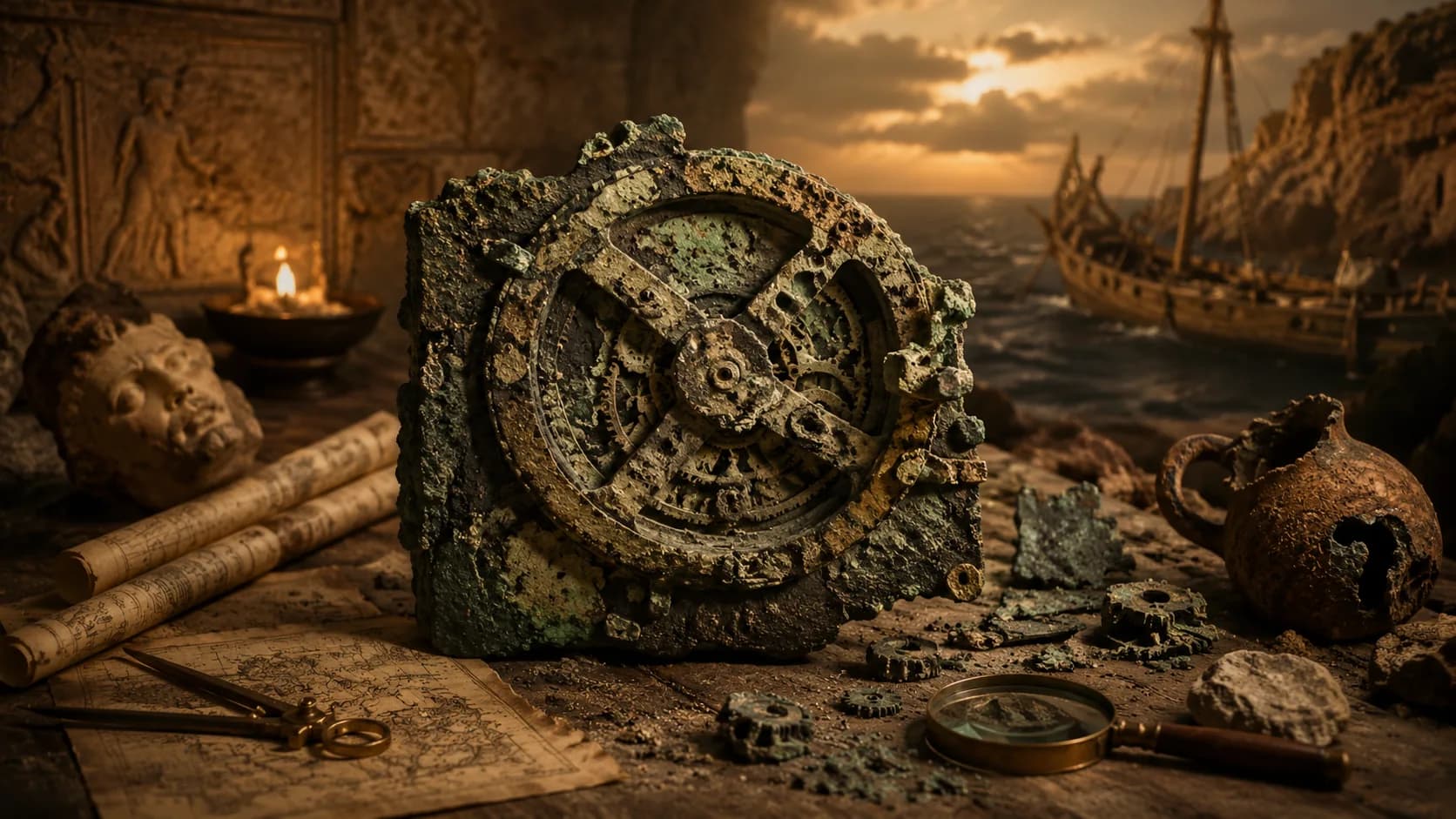
The Antikythera Mechanism is a good starting point because the object, imaging data and competing reconstructions are well documented.
Source trail
Selected references and research starting points
- John Peter Oleson, The Oxford Handbook of Engineering and Technology in the Classical World
- Jean-Pierre Adam, Roman Building
- Alexander Jones, A Portable Cosmos
The list is a research trail. Specific claims should be checked against the cited edition, object record or publication.
Keep exploring: Use the topic hub for closely related articles or browse the full archive instead of starting a new search.