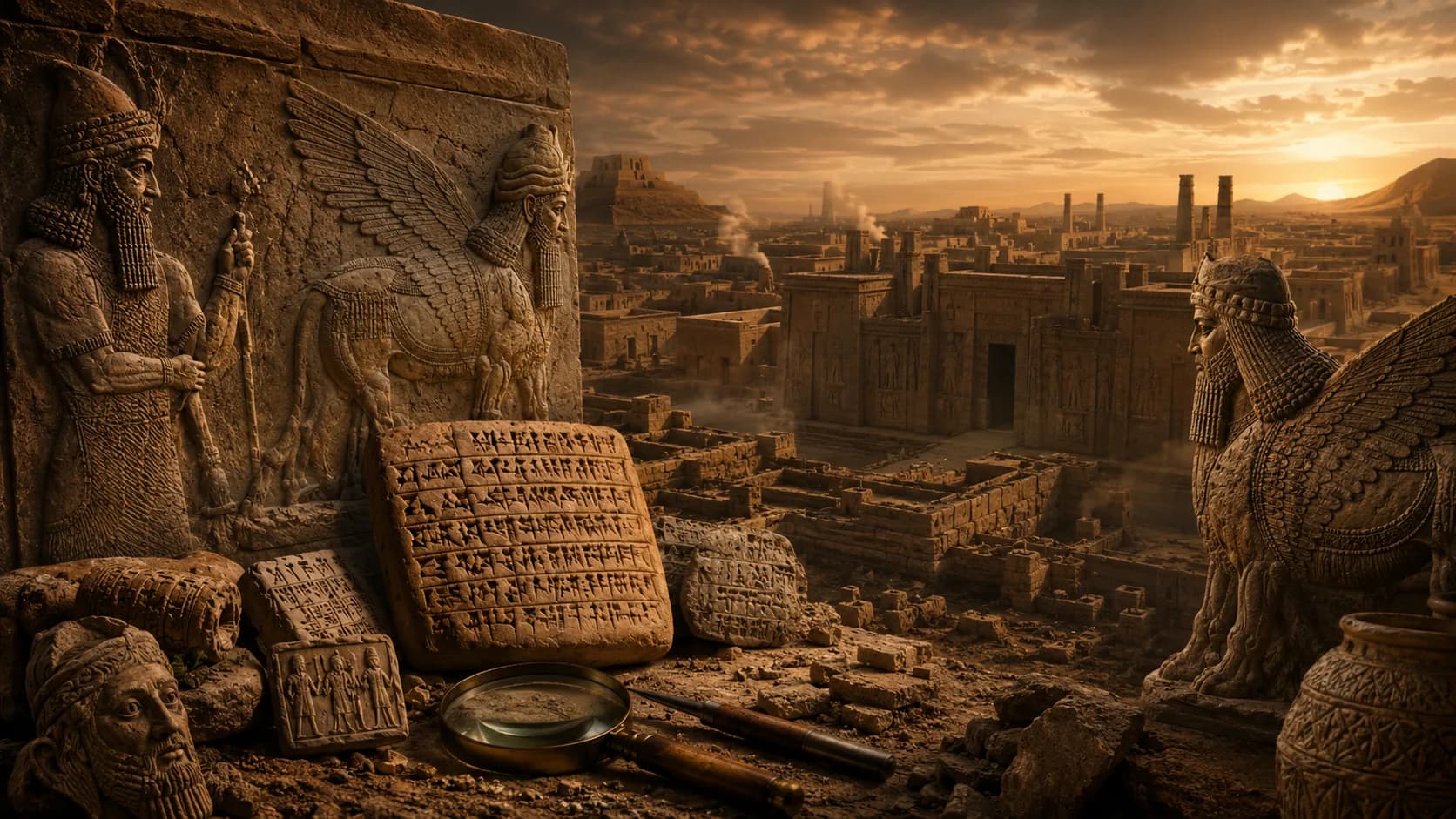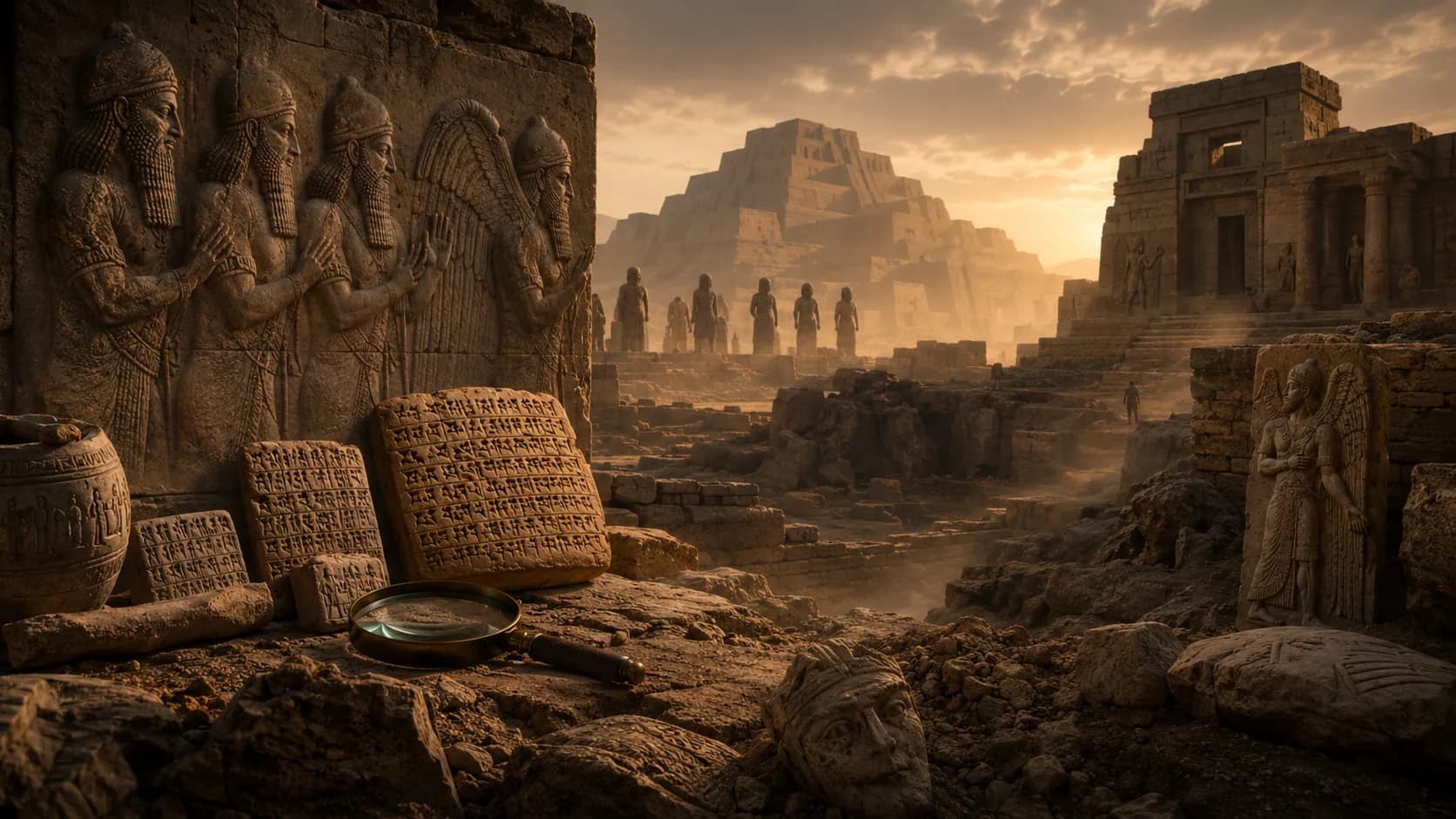
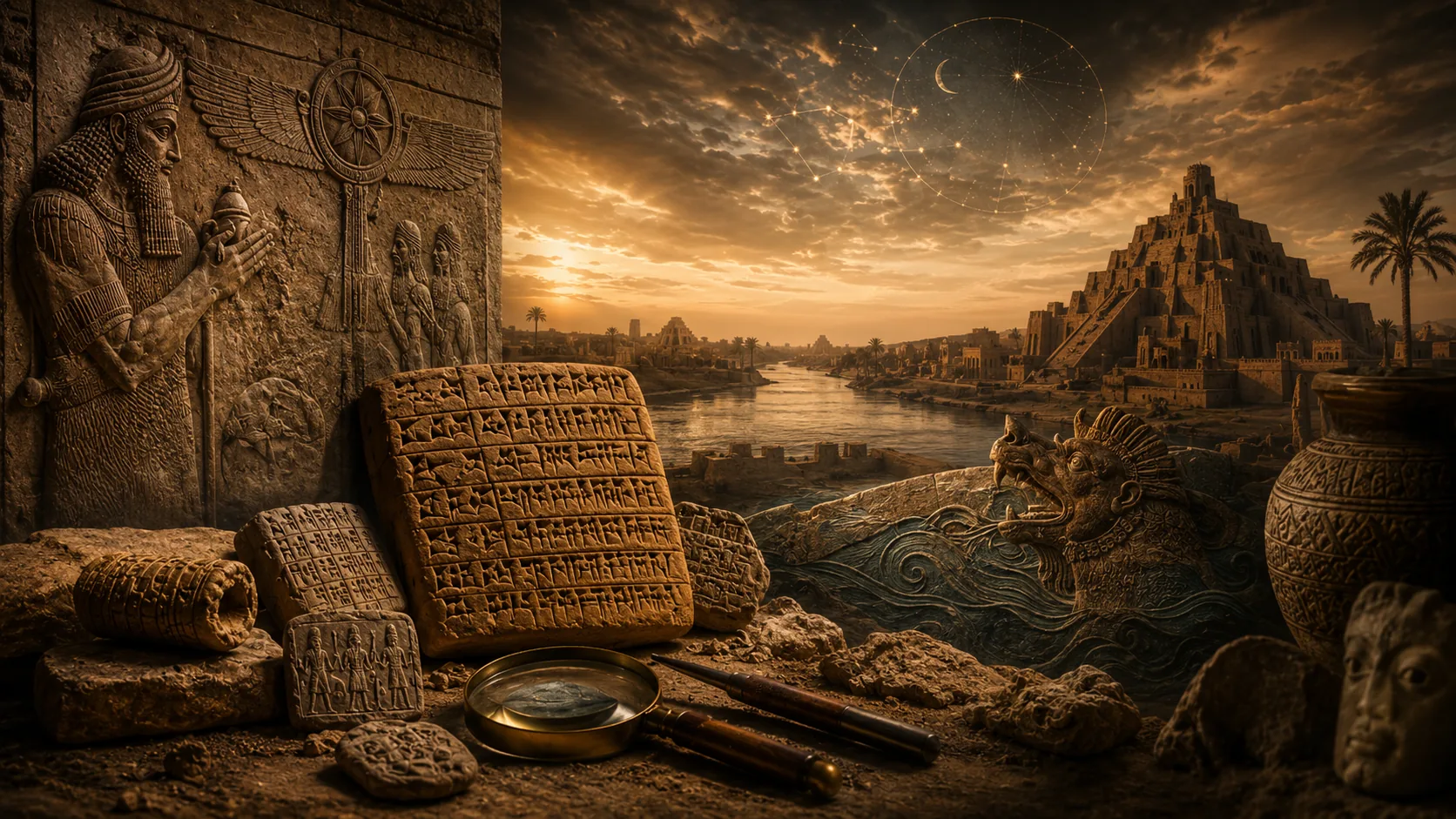
Enuma Elish Explained: Creation, Marduk and Babylonian Power
Enuma Elish is a Babylonian creation epic and a political theology of Marduk’s rise, not a scientific account of planetary collision.
The story in outline
At the beginning, fresh and salt waters mingle in the divine beings Apsu and Tiamat. Younger gods disturb the old order. Conflict grows, Apsu is killed and Tiamat prepares for war. Marduk agrees to fight her if the divine assembly grants him unmatched authority. He defeats Tiamat, divides her body and constructs an ordered cosmos.
The gods then create humanity from the blood of a defeated rebel so that humans can perform service. Babylon and Marduk’s temple become the center of the new order.
Why Marduk is the central figure
Enuma Elish is not only a creation story. It explains why Marduk deserves supremacy and why Babylon deserves a privileged place. The poem gathers older divine roles around Marduk, presenting his rise as the solution to cosmic crisis.
This political dimension matters. Ancient myths could support institutions and cities without being simple propaganda. Ritual performance, theology and royal ideology reinforced one another.
Does the battle describe planets?
Modern interpretations sometimes turn Tiamat into a planet destroyed by another world. The text presents Tiamat as a divine, personified primordial sea and monster-like opponent. Reading every weapon, wind or body part as an astronomical object requires a translation system not accepted by specialists.
Cosmic combat is a widespread mythic pattern. Similarity to a collision does not transform the poem into an eyewitness report of solar-system formation.
How to read the epic today
Enuma Elish should be read as literature, ritual text and theology. Its repetitions, speeches and names build Marduk’s legitimacy. The final praise section is as important as the battle because naming establishes divine identity and power.
The epic gives modern readers evidence for how Babylonians connected the structure of the universe with the structure of their city and cult.
Building an evidence map from the tablets
A reliable reading of Enuma Elish Explained: Creation, Marduk and Babylonian Power begins by separating the object or text itself from the story later built around it. Mesopotamian evidence survives in copies produced for different cities, schools and periods. The same divine name or mythic episode can therefore appear with a changed role, spelling or emphasis. A claim about Enuma Elish, Babylon, Ancient Texts should identify the composition, tablet or manuscript tradition, the language being translated and the date of the surviving witness. Without those details, a quotation cannot be checked and a modern paraphrase can easily be mistaken for an ancient statement.
Genre matters just as much as vocabulary. Hymns praise, rituals prescribe, lexical lists classify, royal inscriptions legitimize and myths explore divine order through narrative. None of these forms is a neutral scientific report. Reading a divine journey as a spacecraft log or a creation scene as a laboratory protocol changes the function of the text before the evidence has been examined. The working rule is simple: first establish what kind of document survives, then ask what its language can responsibly support.
What would strengthen or weaken the interpretation?
A stronger interpretation would explain grammar, repeated phrases and parallel passages across more than one text. It would also fit the historical vocabulary used by trained scribes. A weaker interpretation depends on one English word, removes a line from its surrounding passage or assigns a technical meaning that is absent from dictionaries and comparable texts. This article therefore treats the following checkpoint as decisive: The title Enuma Elish comes from the opening words, usually translated as “When on high.”
Translations should be compared rather than selected only because one version sounds dramatic. Differences may reflect damaged signs, uncertain readings or genuine scholarly debate. They do not give permission to invent any meaning. Works such as W. G. Lambert, Babylonian Creation Myths, Stephanie Dalley, Myths from Mesopotamia and Benjamin R. Foster, Before the Muses provide different routes into the evidence: linguistic, literary and historical. Agreement across those routes carries more weight than repetition across websites that trace back to one popular book.
How to research the topic independently
Begin with the exact ancient title or tablet identifier, then locate a transliteration and at least two translations. Mark words that carry the argument and check whether their proposed meanings occur elsewhere. Note whether the text is Sumerian or Akkadian and whether the surviving copy is contemporary with the events it describes. Finally, compare the claim with archaeology from the relevant city and period. This process does not eliminate interpretation; it makes the interpretation visible and testable.
The wider value of Enuma Elish Explained: Creation, Marduk and Babylonian Power lies in the way Mesopotamian societies connected labor, kingship, mortality, divine authority and the order of the cosmos. Modern science-fiction readings may be entertaining, but they often reduce many centuries of religious thought to a single hidden plot. Preserving historical difference produces a more complex and more human account of the ancient world.
The limits of certainty
Every historical reconstruction has a confidence level. Some points in Enuma Elish Explained: Creation, Marduk and Babylonian Power rest on direct physical evidence or securely identified texts; others depend on comparison, restoration or probability. A responsible article does not flatten those levels into one voice. It distinguishes what is observed, what is inferred and what remains open. That distinction is especially important when a topic has become part of popular culture, because repeated certainty can make a weak claim feel stronger than the underlying record.
The statement “we do not know the exact answer” should not be confused with “all explanations are equally likely.” Evidence can eliminate proposals even when it cannot select one final solution. Chronology, material traces, grammar, site context and known historical practices place real boundaries around interpretation. In this case, the boundary is summarized by the article’s evidence checkpoint: The title Enuma Elish comes from the opening words, usually translated as “When on high.”
How future evidence could change the picture
New discoveries could revise parts of this page. A securely excavated parallel object, a longer inscription, improved dating, a newly published archive or a successful experimental reconstruction might clarify disputed details. The important point is that useful new evidence must be documented well enough for independent researchers to inspect. A private photograph, anonymous translation or claim that the decisive object has disappeared cannot carry the same weight.
Updates should also be proportional. One new find may change a date or local interpretation without proving a global theory. The works listed in the source trail, including W. G. Lambert, Babylonian Creation Myths and Stephanie Dalley, Myths from Mesopotamia, provide a baseline against which later claims can be compared. When a new argument overturns an established view, it should explain the older evidence at least as well as the view it replaces.
Reader takeaway
The most useful conclusion from Enuma Elish Explained: Creation, Marduk and Babylonian Power is not a slogan but a method. Start with the surviving evidence, keep language and chronology visible, compare independent sources and label uncertainty. This approach protects curiosity from becoming credulity. It also gives ancient societies credit for their own institutions, beliefs and technical knowledge instead of treating them as empty spaces waiting for a modern mystery to fill.
Frequently asked questions
Is Enuma Elish Sumerian?
The surviving standard version is Babylonian and written in Akkadian, although it draws on older Mesopotamian traditions.
Is Tiamat the Earth?
The poem does not identify Tiamat with planet Earth in the modern astronomical sense.
Was the epic recited at a festival?
It is strongly associated with Babylonian ritual and the Akitu New Year festival, though details of performance are reconstructed from evidence.
Source trail
Selected references and research starting points
- W. G. Lambert, Babylonian Creation Myths
- Stephanie Dalley, Myths from Mesopotamia
- Benjamin R. Foster, Before the Muses
The list is a research trail. Specific claims should be checked against the cited edition, object record or publication.
Keep exploring: Use the topic hub for closely related articles or browse the full archive instead of starting a new search.