Golden Tongues in Egypt: What the Marina el-Alamein Burials Really Mean
Eighteen burials and 24 thin gold tongue foils from Marina el-Alamein reveal how Egyptian, Greek and Roman funerary beliefs overlapped.
What was announced in 2026?
Egypt’s Ministry of Tourism and Antiquities announced the results in July 2026 after work at Marina el-Alamein on the northwestern Mediterranean coast. The cemetery belonged to the ancient port commonly identified as Leukaspis. Archaeologists documented 11 rock-cut burial complexes and seven above-ground tombs built from limestone blocks, with some original coverings still in place. That preservation allows researchers to reconstruct burial architecture rather than studying isolated objects with no context.
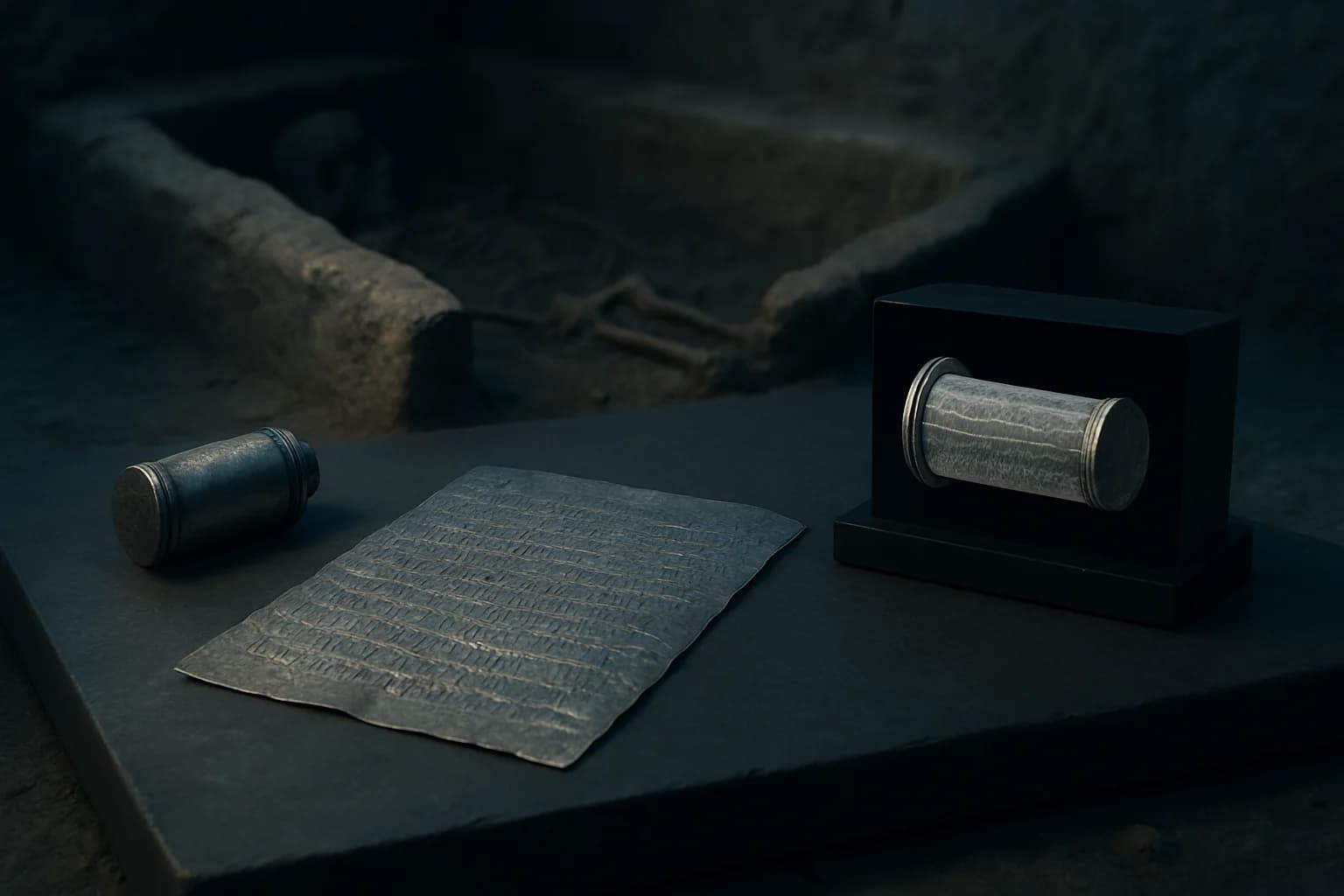
The assemblage includes a granite sarcophagus about 2.5 metres long, human remains, lamps, amphorae, ceramic vessels, small altars and fragments of sculpture. The most widely shared objects are 24 pieces of thin gold foil recovered from the mouth area of the deceased. The phrase “golden-tongued mummies” is memorable but imprecise: the discovery does not involve biological tongues turning to gold. The foils were ritual additions intended to stand for speech or divine communication after death.
The historical setting
Leukaspis stood within the connected Mediterranean world of Ptolemaic and Roman Egypt. Local Egyptian religious practices, Greek-language communities and Roman imperial institutions overlapped for centuries. A burial could therefore combine architectural forms, images and protective rites drawn from more than one tradition. Treating the cemetery as purely Egyptian, purely Greek or purely Roman would miss the cultural negotiation visible in the material record.
The custom is generally interpreted through ideas about the dead speaking before divine powers or participating successfully in the afterlife. Gold was durable, luminous and closely associated with divinity. The presence of a gold Eye of Horus amulet alongside the mouth foils shows that older Egyptian protective symbols continued under Hellenistic and Roman rule. The rite is best understood as part of a changing funerary language rather than as evidence for one fixed ceremony performed identically everywhere.
How researchers reached the conclusion
The interpretation depends on context rather than on the gold alone. Excavators recorded where each foil lay in relation to the jaw, skull and other grave goods, as well as the tomb type and the condition of the burial. Post-burial movement, collapse and earlier disturbance must be considered before an object can be described as deliberately placed in the mouth. Lamps, vessels, altars and sculpture fragments provide an additional framework for identifying the funerary setting.
The Ptolemaic and Roman dates are based on several kinds of evidence, including architecture, ceramics, coins and comparison with regional burial customs. The popular phrase “2,000 years old” is a broad approximation, not a single construction date for every grave. Cemeteries can remain in use for generations, and individual tombs or later insertions may belong to different phases. Final dating will depend on the detailed excavation publication.
Why the discovery matters
The cemetery widens public attention beyond royal pyramids and pharaonic tombs. Communities living on Egypt’s Mediterranean coast adapted older protective ideas within a Greco-Roman environment. The number of mouth foils and the variety of tomb architecture suggest that the practice was not an isolated accident. It offers a way to study how families used ritual objects to negotiate identity, status and expectations about death.
Gold tongue or mouth-foil burials have been reported elsewhere in Egypt, so Marina el-Alamein is not the first example of the custom. Its importance lies in the new, documented group of tombs and associated objects. Comparison with other cemeteries may reveal regional differences, chronological change and the social range of people who used the rite. A repeated practice can be more historically informative than a supposedly unique treasure.
What the evidence does not prove
The foils cannot prove that the dead literally spoke with gods or that every family followed the same theological text. Ritual objects materialize hope, identity and protection, but they do not preserve a complete statement of personal belief. Gold also does not automatically identify ethnicity, office or exact social rank. Those questions require the whole burial assemblage, biological evidence and regional comparison.
Viral captions sometimes claim that Egyptians “turned tongues into gold” or used the foils as a resurrection device. The objects are thin ritual sheets, not metal-preserved organs or technology. No evidence connects them with sound frequencies, biological reanimation or hidden machinery. The funerary interpretation fits their placement, material and parallels far better than those modern inventions.
Why the story is trending now
The story combines three powerful drivers of online interest: gold, mummies and the Egyptian afterlife. It also arrived during a cluster of Egyptian archaeological announcements, including a Byzantine city in the Western Desert. “Golden tongue” is a short and visually striking phrase, so it travelled rapidly across search results and social platforms even when many summaries omitted the mixed Greco-Roman setting.
A reliable report should keep the foils inside the larger context of 18 tombs. Focusing only on the gold removes the sarcophagus, architecture, pottery and other protective symbols that make historical interpretation possible. It should also distinguish a ministry announcement from a full peer-reviewed excavation report, which may later refine counts, dates and interpretations.
Questions that remain open
Researchers can now test whether mouth foils cluster in particular tomb types, age groups or family groups. Metallurgical analysis may reveal production methods and perhaps the circulation of gold. A full catalogue can show whether the sheets follow standard dimensions, carry marks or differ through time. Bioarchaeological study may also place ritual practice alongside health, diet and mobility.
Detailed plans, skeletal analyses and object catalogues will determine who used the rite and how the cemetery changed over time. The most valuable result will not be a single “golden tongue mystery solved,” but a layered history of death, identity and Mediterranean connections in Leukaspis.
A responsible way to read the headline
The first public announcement about the Marina el-Alamein golden tongue burials is a starting point rather than the final form of the research record. Headlines often compress excavation history, laboratory uncertainty and specialist debate into one sentence. Terms such as “first,” “oldest,” “proof” and “mystery solved” should therefore be checked against the sample size, dating range, archaeological context and the authors’ actual confidence level.
This article separates direct observation from interpretation. Their interpretation as funerary amulets is supported by placement and parallels, but the exact prayer or personal belief attached to each burial is not directly preserved. Later publications may refine the date, identification or social meaning without making the initial discovery worthless. A stronger revision will document the object or sample, explain the analytical steps and show why the new interpretation fits the wider archaeological record better than competing explanations.
How this fits wider archaeological research
The Marina el-Alamein golden tongue burials also illustrates a larger change in archaeology: spectacular objects are increasingly studied together with ordinary materials, spatial data, biological evidence and archival records. The result is a history built from networks of evidence rather than from one famous artefact. Context can reveal who used an object, how a settlement functioned, or whether a biological pattern was exceptional or part of a broader social system.
The public value of the story lies in more than novelty. It gives researchers a test case for questions about religious continuity, cultural mixture and social difference in Greco-Roman Egypt. The most useful next step is not to force the find into a ready-made myth, but to compare it with securely dated parallels and to follow the publication trail as new data appear.
Frequently asked questions
Were the golden tongues real human tongues?
No. They were thin pieces of gold foil placed in or near the mouth.
Why was gold placed in the mouth?
The practice is interpreted as funerary protection connected with speech and successful participation in the afterlife.
Is this the first discovery of the custom?
No. Comparable examples are known elsewhere in Egypt; the value of Marina el-Alamein is its newly documented cemetery context.
Source trail
Selected references and research starting points
- Euronews: Marina el-Alamein tombs and golden tongue amulets — Open source
- Smithsonian: Funerary context of the gold tongue finds — Open source
The list is a research trail. Specific claims should be checked against the cited edition, object record or publication.
Keep exploring: Use the topic hub for closely related articles or browse the full archive instead of starting a new search.