
How Sumerian Tablets Are Read and Translated
How do scholars read Sumerian cuneiform? Follow the process from identifying signs and transliteration to grammar, lexical lists, parallel texts and translation.
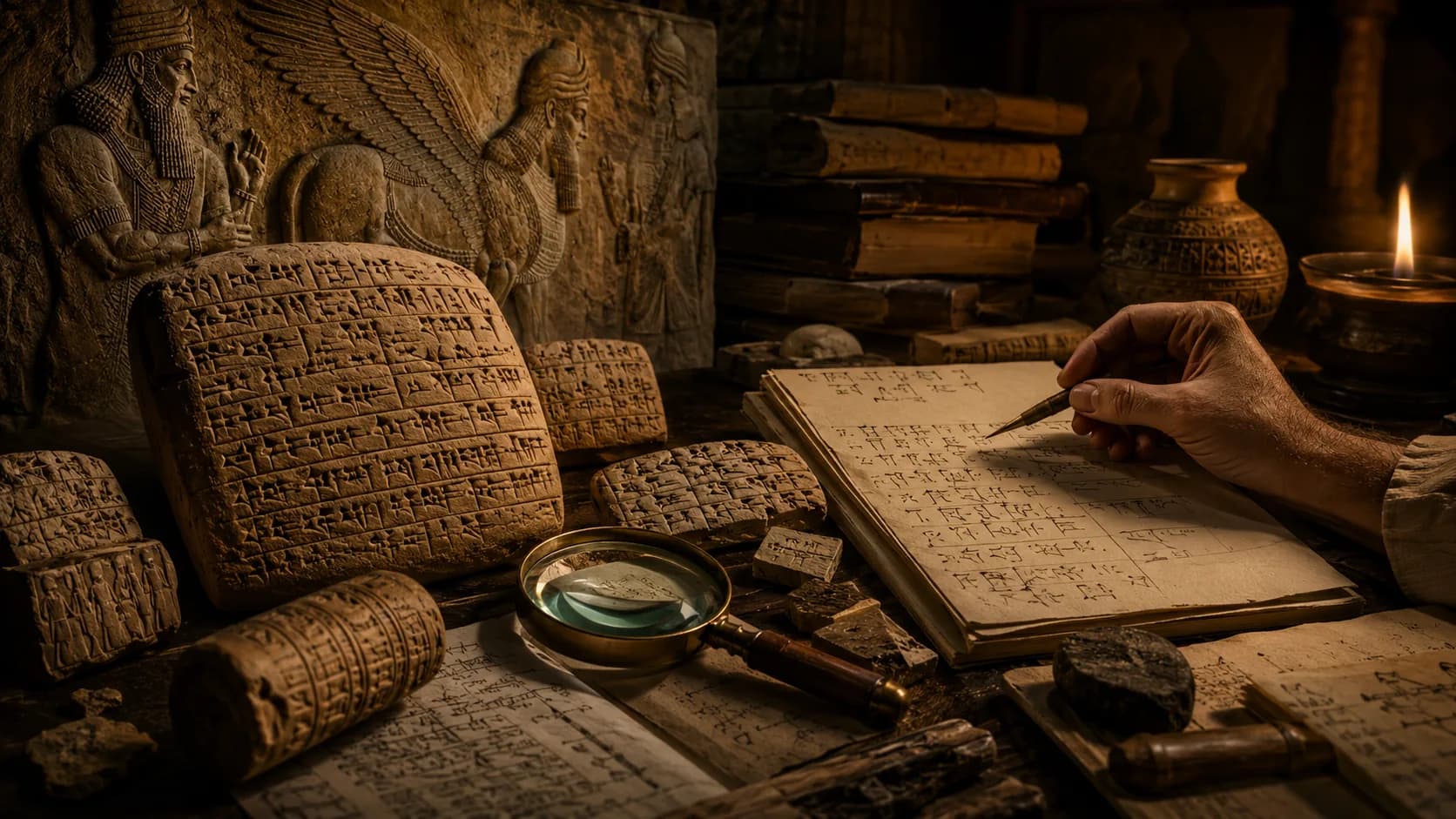
Scholars do not “decode” each Sumerian tablet from scratch. They identify known cuneiform signs, transliterate them into Latin characters, analyze the Sumerian grammar and vocabulary, and compare difficult passages with lexical lists, duplicate texts and established sign readings.
- Identify the signs and damaged areas.
- Transliterate sign values.
- Segment words and grammatical elements.
- Compare dictionaries, lexical lists and parallel texts.
- Translate while marking uncertainty instead of silently guessing.
For the history of decipherment itself, see how cuneiform was deciphered.
Step one: document the tablet
The tablet must be photographed, measured and described. Lighting from different angles makes shallow wedges visible. Archaeological context can identify date, archive and function. A school exercise and a temple account may use similar signs but require different expectations.
Modern techniques such as reflectance transformation imaging and three-dimensional scanning help researchers inspect surfaces without repeatedly handling fragile clay.
From signs to transliteration
Scholars copy wedge groups into standardized sign forms and then transliterate them with Latin characters. Because a sign can have several values, context determines the probable reading. Determinatives, grammatical endings and familiar formulas narrow the options.
Transliteration is not yet translation. It creates a transparent record that other specialists can challenge or improve.
Grammar and duplicate manuscripts
Sumerian is a language isolate with a structure very different from English. Meaning depends on prefixes, suffixes and verbal chains. Scribes also copied literary works in multiple tablets, so duplicates can restore missing lines or reveal variant traditions.
A damaged word may remain uncertain even when the sentence is clear. Responsible editions preserve that uncertainty rather than inventing a smooth result.
Why online “literal translations” are risky
Claims about Anunnaki, energy weapons or space travel often display isolated sign lists without grammar. A dictionary entry is not a sentence translation. The same sign may have different readings, and words change meaning by context.
The best way to evaluate a dramatic translation is to locate a recognized edition, check the tablet identifier and compare more than one scholarly rendering.
What a decipherment must actually explain
The central question in How Are Sumerian Tablets Read? From Broken Clay to Modern Translation cannot be answered by one photograph, quotation or isolated measurement. An undeciphered system is not solved when a few signs can be matched with pictures or modern words. A successful decipherment must account for sign order, repetition, probable word boundaries, grammatical patterns and the physical direction of reading across the available corpus. It should generate readings that work on inscriptions not used to construct the theory. For How Are Sumerian Tablets Read? From Broken Clay to Modern Translation, the size and quality of the surviving sample place hard limits on what can be demonstrated.
Researchers first ask whether the signs encode full spoken language, a restricted notation system or mnemonic information. They then establish a sign inventory, distinguish true signs from variants and record damage. Statistical patterns can reveal structure, but structure alone does not provide sound or meaning. A bilingual text, a closely related known script or a clearly identifiable language would dramatically improve the situation; without those anchors, many incompatible solutions can be made to fit a short sequence.
Why attractive translations fail
Most failed translations begin with the desired language and work backward. The decipherer assigns values until a meaningful phrase appears, ignores signs that do not fit and treats visual resemblance as linguistic proof. The evidence checkpoint for this topic is therefore essential: Square brackets, broken lines and question marks in scholarly editions record uncertainty rather than hiding it. A proposal must explain the difficult signs as well as the convenient ones and must state where uncertainty remains.
Independent comparison is possible through sign catalogues, photographs and specialist editions. Bram Jagersma, A Descriptive Grammar of Sumerian, The Electronic Text Corpus of Sumerian Literature and Cuneiform Digital Library Initiative represent useful starting points because they document the corpus or the history of decipherment rather than simply announcing a solution. When scholars disagree, the disagreement usually concerns sign classification, language affiliation or the function of the objects. Those are specific questions that can be tested as new material appears.
A practical reading checklist
When evaluating a claim about Sumerian, Cuneiform, Ancient Texts, ask five questions. How many inscriptions support the reading? Is the proposed language historically plausible? Does the solution explain repeated sequences consistently? Can another researcher reproduce the sign values? Does the interpretation predict a reading for an unseen text? A proposal that cannot answer these questions may still be an interesting hypothesis, but it should not be presented as a completed translation.
Undeciphered does not mean unknowable. Archaeological context, object type, numerical signs, writing direction and distribution can reveal how a system was used even when sentences remain inaccessible. The historical importance of How Are Sumerian Tablets Read? From Broken Clay to Modern Translation therefore survives uncertainty: it records a community organizing information in a form whose final key has not yet been recovered.
The limits of certainty
Every historical reconstruction has a confidence level. Some points in How Are Sumerian Tablets Read? From Broken Clay to Modern Translation rest on direct physical evidence or securely identified texts; others depend on comparison, restoration or probability. A responsible article does not flatten those levels into one voice. It distinguishes what is observed, what is inferred and what remains open. That distinction is especially important when a topic has become part of popular culture, because repeated certainty can make a weak claim feel stronger than the underlying record.
The statement “we do not know the exact answer” should not be confused with “all explanations are equally likely.” Evidence can eliminate proposals even when it cannot select one final solution. Chronology, material traces, grammar, site context and known historical practices place real boundaries around interpretation. In this case, the boundary is summarized by the article’s evidence checkpoint: Square brackets, broken lines and question marks in scholarly editions record uncertainty rather than hiding it.
How future evidence could change the picture
New discoveries could revise parts of this page. A securely excavated parallel object, a longer inscription, improved dating, a newly published archive or a successful experimental reconstruction might clarify disputed details. The important point is that useful new evidence must be documented well enough for independent researchers to inspect. A private photograph, anonymous translation or claim that the decisive object has disappeared cannot carry the same weight.
Updates should also be proportional. One new find may change a date or local interpretation without proving a global theory. The works listed in the source trail, including Bram Jagersma, A Descriptive Grammar of Sumerian and The Electronic Text Corpus of Sumerian Literature, provide a baseline against which later claims can be compared. When a new argument overturns an established view, it should explain the older evidence at least as well as the view it replaces.
Reader takeaway
The most useful conclusion from How Are Sumerian Tablets Read? From Broken Clay to Modern Translation is not a slogan but a method. Start with the surviving evidence, keep language and chronology visible, compare independent sources and label uncertainty. This approach protects curiosity from becoming credulity. It also gives ancient societies credit for their own institutions, beliefs and technical knowledge instead of treating them as empty spaces waiting for a modern mystery to fill.
Frequently asked questions
Can anyone learn to read cuneiform?
Yes, with sustained study of sign lists, grammar and language. Different cuneiform languages require different training.
Why do translations differ?
Tablets may be damaged, signs may be ambiguous and scholars may disagree about grammar or literary nuance.
Are all tablets religious?
No. Many are receipts, contracts, letters, lists, school texts and administrative records.
Source trail
Selected references and research starting points
- Bram Jagersma, A Descriptive Grammar of Sumerian
- The Electronic Text Corpus of Sumerian Literature
- Cuneiform Digital Library Initiative
The list is a research trail. Specific claims should be checked against the cited edition, object record or publication.
Keep exploring: Use the topic hub for closely related articles or browse the full archive instead of starting a new search.