How Was the Library of Alexandria Destroyed? There Was No Single Fire
The Library of Alexandria declined through multiple episodes, institutional change and political disruption rather than one clearly documented night of total destruction.
What was the Library?
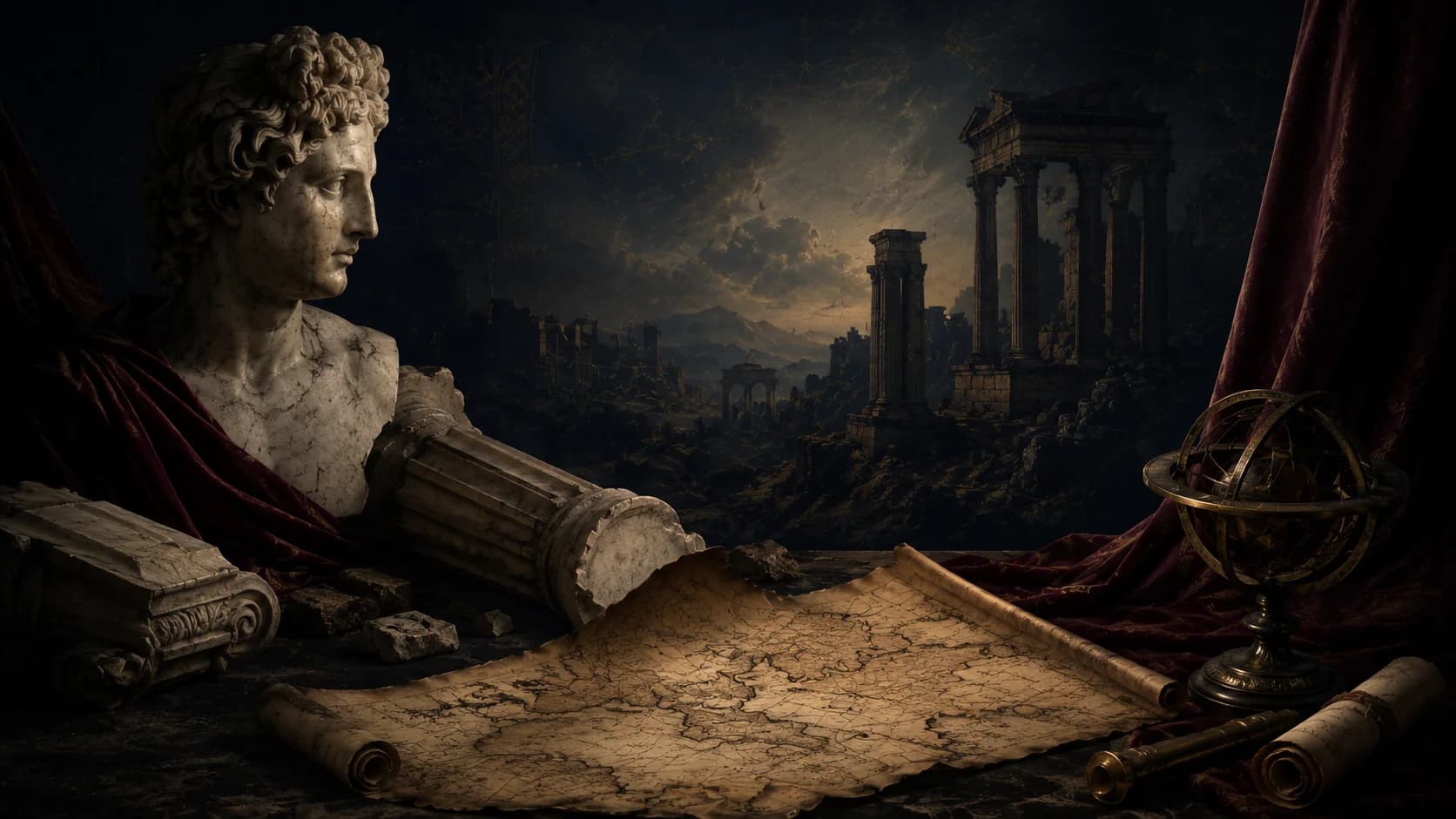
The Ptolemaic rulers created a scholarly institution in Alexandria that supported research, editing and collecting. The main library was associated with the Mouseion, while another collection may have been linked to the Serapeum.
Ancient numbers for scrolls vary widely and may reflect rhetorical prestige rather than audited inventory.
Did Julius Caesar burn it?
During fighting in 48 BCE, Caesar’s forces set fire to ships and nearby areas. Some ancient authors say books or storehouses were destroyed. The evidence does not prove that the entire main library vanished permanently in that incident.
Scholarship continued in Alexandria afterward, which suggests survival, rebuilding or separate collections.
Other episodes
Imperial conflict damaged parts of the city in the third century CE. The Serapeum was destroyed in 391 during Christian-pagan conflict, but whether it still held a major library is uncertain. The later story that Arab conquerors burned the library appears centuries after the alleged event and is not considered reliable.
These episodes show why one dramatic culprit is inadequate.
How institutions disappear
Libraries can decline through lost funding, political change, dispersal, neglect and gradual copying failure. Papyrus collections require continuous maintenance. A scholarly center can vanish without every scroll burning at once.
The myth of one fire reflects a desire to locate the loss of ancient knowledge in a single preventable tragedy.
Separating the documented core from the modern story
The central question in How Was the Library of Alexandria Destroyed? There Was No Single Fire cannot be answered by one photograph, quotation or isolated measurement. Popular historical claims usually contain a documented core: a map exists, a city was destroyed, a text mentions unusual beings or a monument is genuinely large. The problem begins when that core is treated as automatic proof of a much broader conclusion. For How Was the Library of Alexandria Destroyed? There Was No Single Fire, the argument must show every step between evidence and explanation rather than hiding the steps inside suggestive images or rhetorical questions.
Chronology is the first filter. The people, object, source and proposed event must belong to compatible periods. Provenance is the second: researchers need to know where a quotation, image or artifact came from and how it was recorded. Mechanism is the third: a theory should explain how the claimed process worked and what physical traces it would leave. These tests apply equally to conventional and unconventional explanations.
How repetition creates false confidence
A claim can appear to have dozens of sources when websites, videos and books all repeat one earlier assertion. Counting repetitions is not the same as counting independent evidence. Trace the citation backward until it reaches a primary document, excavation record or measurable observation. The checkpoint for this article remains: Stories blaming one person or one fire usually combine different institutions and events separated by centuries.
Useful starting points include Lionel Casson, Libraries in the Ancient World, Mostafa El-Abbadi, Life and Fate of the Ancient Library of Alexandria and Ancient accounts of Caesar, the Mouseion and the Serapeum. Their conclusions may differ, but they make their evidence visible. A responsible comparison notes whether disagreement concerns facts, dating, terminology or interpretation. It does not convert ordinary scholarly debate into proof that every established conclusion is fabricated.
A five-step fact-check for historical mysteries
First, identify the original source. Second, verify the date and translation. Third, inspect the full image or archaeological context. Fourth, list plausible alternatives and compare what each explains. Fifth, ask what future discovery would confirm or falsify the preferred claim. Applying this method to Library of Alexandria, Ancient Knowledge, Historical Myths turns a passive mystery into a researchable question.
The goal is not to remove wonder from How Was the Library of Alexandria Destroyed? There Was No Single Fire. It is to place wonder where it belongs: in the real complexity of maps, institutions, migrations, engineering and cultural memory. Historical skepticism is productive when it demands better evidence while remaining open to revision.
The limits of certainty
Every historical reconstruction has a confidence level. Some points in How Was the Library of Alexandria Destroyed? There Was No Single Fire rest on direct physical evidence or securely identified texts; others depend on comparison, restoration or probability. A responsible article does not flatten those levels into one voice. It distinguishes what is observed, what is inferred and what remains open. That distinction is especially important when a topic has become part of popular culture, because repeated certainty can make a weak claim feel stronger than the underlying record.
The statement “we do not know the exact answer” should not be confused with “all explanations are equally likely.” Evidence can eliminate proposals even when it cannot select one final solution. Chronology, material traces, grammar, site context and known historical practices place real boundaries around interpretation. In this case, the boundary is summarized by the article’s evidence checkpoint: Stories blaming one person or one fire usually combine different institutions and events separated by centuries.
How future evidence could change the picture
New discoveries could revise parts of this page. A securely excavated parallel object, a longer inscription, improved dating, a newly published archive or a successful experimental reconstruction might clarify disputed details. The important point is that useful new evidence must be documented well enough for independent researchers to inspect. A private photograph, anonymous translation or claim that the decisive object has disappeared cannot carry the same weight.
Updates should also be proportional. One new find may change a date or local interpretation without proving a global theory. The works listed in the source trail, including Lionel Casson, Libraries in the Ancient World and Mostafa El-Abbadi, Life and Fate of the Ancient Library of Alexandria, provide a baseline against which later claims can be compared. When a new argument overturns an established view, it should explain the older evidence at least as well as the view it replaces.
Reader takeaway
The most useful conclusion from How Was the Library of Alexandria Destroyed? There Was No Single Fire is not a slogan but a method. Start with the surviving evidence, keep language and chronology visible, compare independent sources and label uncertainty. This approach protects curiosity from becoming credulity. It also gives ancient societies credit for their own institutions, beliefs and technical knowledge instead of treating them as empty spaces waiting for a modern mystery to fill.
Frequently asked questions
Who burned the Library of Alexandria?
No single person can be identified as destroying the entire institution in one event.
Were all ancient books lost there?
No. Texts existed in many libraries and private collections, though enormous amounts of ancient literature were lost over time.
Did the library contain advanced technology?
It preserved scholarship, but claims of modern machines or unlimited secret knowledge are unsupported.
Source trail
Selected references and research starting points
- Lionel Casson, Libraries in the Ancient World
- Mostafa El-Abbadi, Life and Fate of the Ancient Library of Alexandria
- Ancient accounts of Caesar, the Mouseion and the Serapeum
The list is a research trail. Specific claims should be checked against the cited edition, object record or publication.
Keep exploring: Use the topic hub for closely related articles or browse the full archive instead of starting a new search.