Pompeii Graffiti: What Romans Actually Wrote on the Walls
Pompeii’s walls preserve election notices, names, jokes, insults, love messages and everyday marks. See what Roman graffiti reveals—and what it cannot tell us by itself.
Pompeii’s walls were used for far more than crude jokes. Surviving inscriptions include names, greetings, boasts, insults, love messages, commercial notices and painted election endorsements. Together they provide a rare view of informal written communication in a Roman town.
But one inscription is not a survey of “what Romans believed.” Context, location, handwriting and the difference between scratched graffiti and painted notices all matter.
Why does Pompeii graffiti matter?
Ancient history is often reconstructed from laws, military narratives, monumental inscriptions and books written by educated elites. Pompeii preserves another archive. When Vesuvius buried the town in seventy-nine CE, painted walls and plaster surfaces survived in extraordinary numbers. Thousands of texts have been recorded, ranging from professionally painted public notices to names and personal messages scratched with a pointed tool.
The historical value of these texts comes partly from their ordinariness. People promoted candidates, praised businesses, recorded debts, declared affection, mocked rivals or simply announced that they had been present. Pompeii can therefore resemble a vast ancient message board. The comparison with social media is useful but incomplete: literacy, access to visible walls and the power to keep a message in place were not distributed equally.
Graffiti and painted notices were not the same
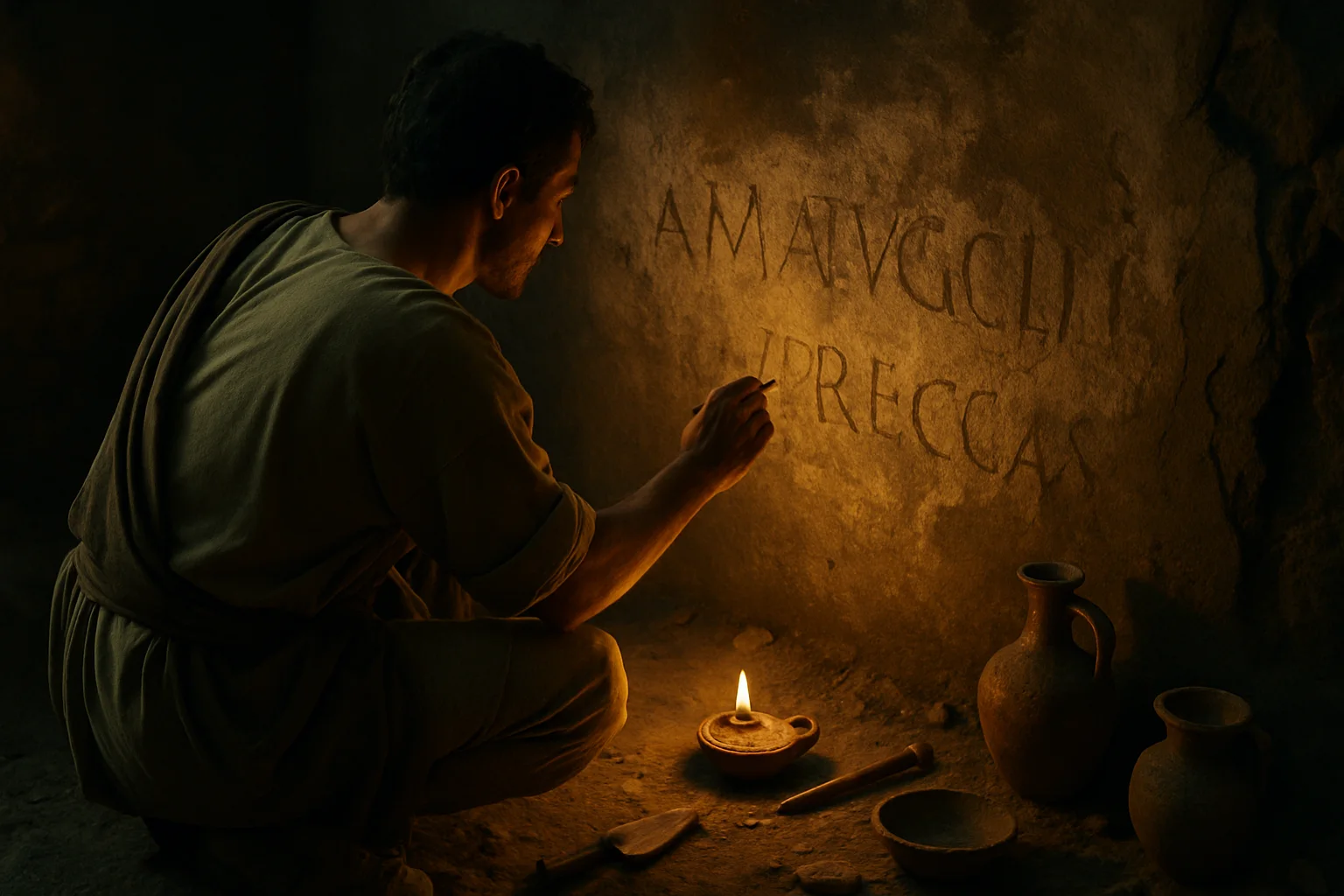
Scholars commonly distinguish scratched graffiti from painted texts known as dipinti. Graffiti could be cut into plaster with a stylus, nail or other sharp object. Dipinti were applied with a brush and were often planned for public visibility. Electoral endorsements, advertisements and announcements for spectacles frequently belonged to the painted category.
The distinction reveals differences in production and audience. A professionally lettered election notice was designed to be seen by many pedestrians, while a small message inside a room may have addressed a narrower circle. Yet private and public space overlapped. Entrances, inns, baths, shops and house façades became layered communication surfaces used by residents, workers, customers and visitors.
What do election notices reveal?
Many Pompeian façades carried endorsements for candidates seeking local office. Standard formulas described a candidate as worthy of office, honest or a good man. Some messages named occupational groups, neighborhoods, businesses or individual supporters.
These notices show that local politics extended beyond private meetings among wealthy families. Candidates needed public visibility, and busy streets became campaign space. Women could not formally vote in Roman municipal elections, yet named women appear in some endorsements. Their presence suggests that political influence could operate through property, family networks, reputation and public advocacy even without a ballot.
Love, jealousy and insult
Pompeii’s walls preserve romantic praise, sexual boasting, complaints about rejection and sharp insults. These texts make ancient people appear less like distant marble figures and more like individuals with humor, desire and resentment. Some messages adapt poetic language, while others consist only of a name and a brief emotional statement.
Not every inscription should be treated as literal autobiography. A wall text may be a joke, a quotation, a parody or an attack written under another person’s name. Archaeologists therefore examine handwriting, location, neighboring messages and the sequence of plaster layers before drawing conclusions.
Inns, taverns and commercial life
Texts from eating and drinking establishments can include prices, accounts, customer names and game records. Some inscriptions refer to dice or board games; others appear to record services, purchases or debts. These minor entries help reconstruct patterns of consumption and the social role of commercial spaces.
Pompeii’s economy was not limited to elite villas. Bakeries, workshops, food counters, small shops and lodging houses shaped the daily rhythm of the town. Wall writing adds human names and arguments to the material evidence of ovens, counters, storage jars and tools.
Why are gladiators so visible?
Arena spectacles were major public entertainment. Pompeian inscriptions record programs, fighters’ names, results and expressions of admiration. Some gladiators were praised for attractiveness as well as skill, showing that successful performers could become widely recognized celebrities.
The popularity should not hide the violence of the system. Gladiators might be enslaved, condemned or driven by economic pressure. Fame did not remove physical danger or restricted freedom. The wall texts reveal the contradiction between intense public admiration and a brutal entertainment economy.
Was everyone literate?
The visibility of writing does not prove universal literacy. Roman literacy existed on several levels. Some people may have recognized names, numbers and common formulas without being able to read complex literature. Professional sign painters produced many public texts, and people could also ask others to write on their behalf.
Even with these limits, the variety of handwriting shows that writing reached deeply into urban life. Letters and numbers appeared not only in government documents but in shops, houses, streets and leisure spaces. Misspellings and irregular forms are particularly valuable because they preserve users who did not follow elite educational standards.
How are the inscriptions documented?
Pompeian wall texts were systematically copied from the nineteenth century onward and published in the fourth volume of the Corpus Inscriptionum Latinarum. Early drawings now have exceptional value because some plaster deteriorated after excavation through exposure to weather, light, moisture and human contact.
Modern researchers use high-resolution photography, raking light, photogrammetry and three-dimensional recording to capture faint marks. Digital mapping also makes it possible to study a text within its architectural setting. Whether an inscription stood beside a doorway, above a shop counter, inside a bedroom or along a major street can change its interpretation.
What kind of Rome do the walls reveal?
The inscriptions do not present one orderly Roman society. Political competition, commercial bargaining, sexual humor, literary ambition, sports fandom and personal conflict overlap on the same surfaces. Pompeii therefore preserves the diversity and disorder of urban life rather than an idealized civic portrait.
The most important lesson is that ordinary people were not entirely silent. Many individuals who appear nowhere else in the historical record left names, preferences and emotions on walls. Their messages are incomplete, biased and sometimes impossible to interpret, but they open a rare path into the unofficial layers of the Roman past.
Frequently asked questions
Is Pompeii graffiti authentic?
Yes. Thousands of examples were documented in archaeological contexts and published in major Latin inscription catalogues.
Why did Romans write on walls?
They used walls for elections, advertising, love, humor, insult, accounting, spectacle announcements and personal commemoration.
Could everyone in Pompeii read and write?
No. Literacy varied widely, and professional painters produced many public texts.
What are the most common themes?
Names, electoral endorsements, romantic and sexual messages, gladiator notices, commercial records and short poetic lines are especially prominent.
Sources and further reading
- Pompeii Archaeological Park, inscriptions and conservation resources.
- Corpus Inscriptionum Latinarum, Volume IV.
- Rebecca R. Benefiel, research on graffiti and social interaction at Pompeii.
- Mary Beard, Pompeii: The Life of a Roman Town.
- Kristina Milnor, Graffiti and the Literary Landscape in Roman Pompeii.
Frequently asked questions
What kind of graffiti was found at Pompeii?
Researchers have documented names, greetings, jokes, insults, love messages, drawings, commercial notices and political endorsements among the wall inscriptions.
Could ordinary Romans read and write?
The graffiti show that writing circulated beyond elite literature, but they do not prove universal literacy. Literacy varied by social setting, occupation and type of writing.
Is all writing on Pompeii walls graffiti?
No. Archaeologists distinguish scratched inscriptions from professionally painted notices and electoral programmata, although both can illuminate public communication.
Source trail
Selected references and research starting points
- Pompeii Archaeological Park
- Corpus Inscriptionum Latinarum IV
- Rebecca R. Benefiel, Pompeii graffiti studies
- Mary Beard, Pompeii: The Life of a Roman Town
- Kristina Milnor, Graffiti and the Literary Landscape in Roman Pompeii
- Archaeological Park of Pompeii — “Bruits de couloir”: Shedding New Light on Ancient Graffiti: Open source
- Archaeological Park of Pompeii — “Hic et ubique”: voices and lives in the Black Hall: Open source
The list is a research trail. Specific claims should be checked against the cited edition, object record or publication.