
Sak Tahn Waax: The Named Maya Mathematician Behind a Planetary Formula
A wall text at Xultun attributes a sophisticated 781 CE calendrical formula involving Venus, Mars and Maya time cycles to Sak Tahn Waax.
What was announced in 2026?
A study published in Antiquity in July 2026 re-examined “Text 19” on the east wall of Structure 10K-2 at Xultun in northeastern Guatemala. The mural chamber was discovered in 2010, but documenting its small and partly eroded inscriptions required years of photography, multispectral imaging and epigraphic comparison. The new reading identifies a personal attribution after the mathematical sequence.
The passage consists of only 11 glyph blocks, yet it organizes a span of 2,920 days. It incorporates a 20-day uinal, the 260-day Tzolkin, 1,560 days corresponding to two Mars synodic cycles, three 360-day tuns and a total equal to five Venus synodic cycles. The final glyphs contain a quotative expression followed by the name Sak Tahn Waax, translated as “White-chested Fox.”
The historical setting
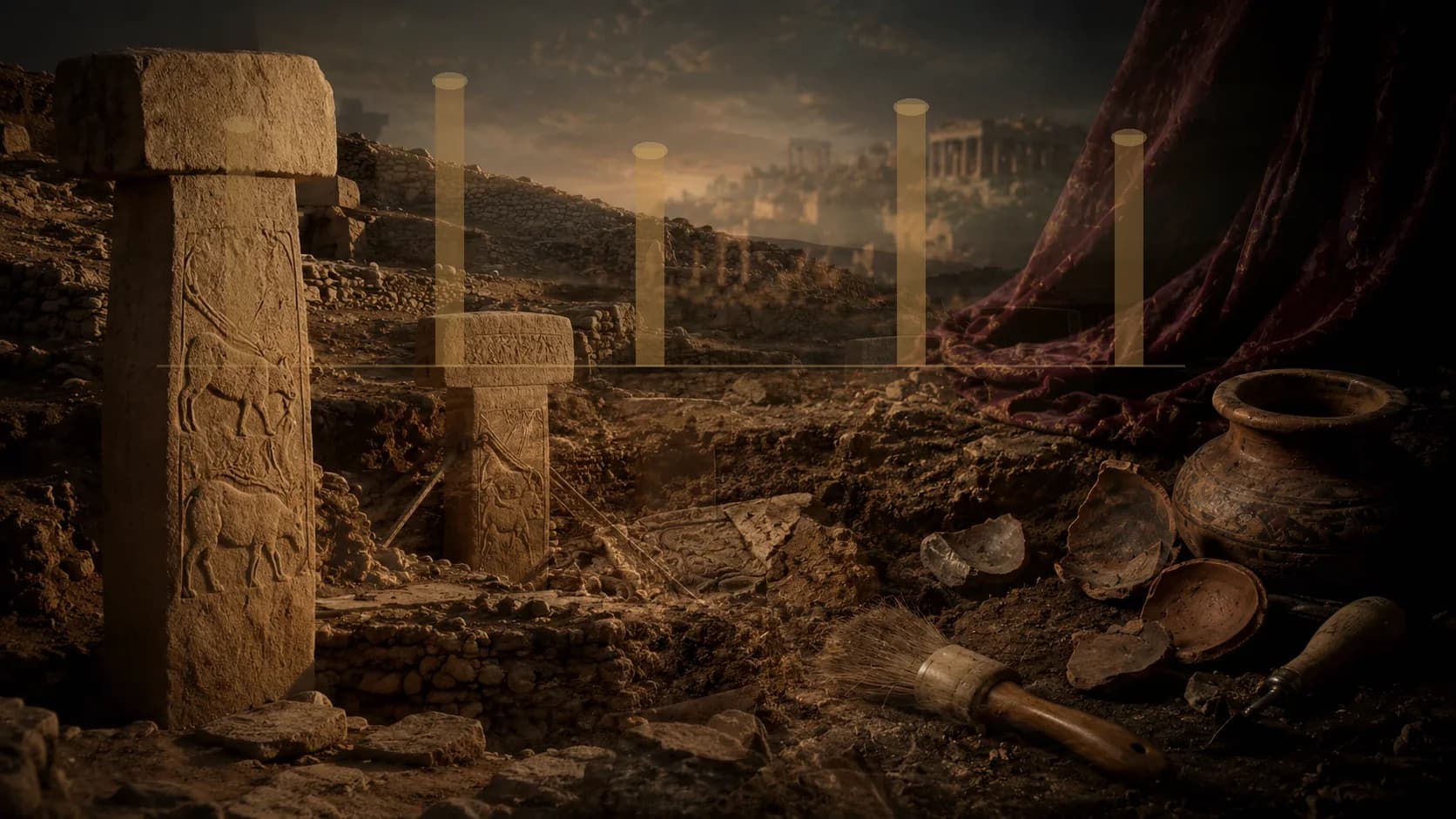
In Classic Maya society, astronomy, mathematics, calendrics and political ceremony were not isolated disciplines. Planetary cycles could inform ritual dates, monument dedications and the timing of public events. Monumental inscriptions usually display finished dates and royal histories, whereas working calculations are rare. That makes the Xultun room unusually valuable: it resembles an intellectual workspace where the mechanics behind formal calendrical statements were explored.
More than 50 discrete texts have been identified in the chamber. Lunar tables, large numerical arrays and calculations involving planetary cycles suggest an active place of training, experimentation or book production. Sak Tahn Waax may have painted the text personally, but the phrase could also credit a respected scholar whose calculation was copied by another scribe. Either way, the attribution links intellectual work to a historical person.
How researchers reached the conclusion
Researchers began with the best-preserved calendar signs and reconstructed the damaged sequence in both directions. Bars and dots, Haab and Tzolkin stations and “Distance Numbers” were compared with known Maya notation. A 1,560-day interval matches two approximations of the 780-day synodic cycle of Mars, while the total 2,920 days equals five 584-day Venus cycles and eight 365-day years. These relationships support the proposed reading of eroded signs.
Palaeography and calendrical reconstruction produce a best-fit initial date of 7 November 781 in the Julian calendar. That does not necessarily mean the paint was applied on that exact day; the date may be the starting point of the calculation. The writing style, archaeological setting and associated mural texts nevertheless place the intellectual activity securely within the eighth-century Classic Maya world.
Why the discovery matters
The central importance is not simply another demonstration that Maya astronomy was sophisticated. The text attaches a name to intellectual work. Histories of ancient science often revolve around a small canon of Mediterranean individuals; Sak Tahn Waax provides direct evidence that Indigenous American knowledge was also produced by identifiable specialists who experimented with inherited numerical systems.
Later surviving codices contain Mars and Venus tables, but Text 19 packages several cycles within one 2,920-day structure in a previously unattested way. The arrangement shows creative manipulation rather than mechanical copying. The intervals resemble a sequence known in modern Western mathematics as Fibonacci-like, yet the study carefully avoids claiming that the Maya used the same concept or theoretical label.
What the evidence does not prove
The text does not prove that Sak Tahn Waax held a modern profession equivalent to a university mathematician or astronomer. Those labels translate the nature of the work for present readers. The person’s gender, exact court title and role in producing the formula remain uncertain. The attribution could identify the painter, the calculator, a teacher or an authority whose result was being quoted.
The formula is not evidence for telescopes, space travel or electronic computing. Long-term naked-eye observation, careful records and a powerful positional notation are sufficient to explain the calculation. It also should not be forced into a modern opposition between science and religion. Maya celestial knowledge operated within ritual, political and calendrical systems at the same time.
Why the story is trending now
A named ancient mathematician is an unusually personal story, and the translation “White-chested Fox” makes the discovery memorable. Coverage by Nature, Science, National Geographic, Scientific American and Smithsonian within days of publication amplified search interest. The story also fits a wider effort to recognize Indigenous knowledge makers rather than treating Maya achievements as anonymous civilizational traits.
Some headlines call Sak Tahn Waax “the first scientist in the Americas.” A more accurate description is the only known Classic Maya mathematician-astronomer directly named in connection with a surviving piece of intellectual work. Many earlier specialists certainly existed; their names may not survive. The discovery concerns attribution, not the invention of American science in 781.
Questions that remain open
The relationship between Text 19 and more than 50 other inscriptions in the chamber remains incomplete. Identifying the same scribal hand elsewhere might reveal a larger body of work. Researchers also need to determine whether the formula was a teaching exercise, a reusable calendrical tool, an intellectual display or a draft related to codex production.
Additional multispectral imaging may clarify damaged glyphs, while comparison with other Xultun texts and surviving codices could reveal how the formula circulated. The long-term importance is larger than adding one name to a list: it opens a path toward reconstructing the social organization of knowledge, training and authorship in Maya courts.
A responsible way to read the headline
The first public announcement about the Sak Tahn Waax formula at Xultun is a starting point rather than the final form of the research record. Headlines often compress excavation history, laboratory uncertainty and specialist debate into one sentence. Terms such as “first,” “oldest,” “proof” and “mystery solved” should therefore be checked against the sample size, dating range, archaeological context and the authors’ actual confidence level.
This article separates direct observation from interpretation. The name reading and calendrical relationships rest on detailed epigraphy, but whether Sak Tahn Waax personally painted the wall remains uncertain. Later publications may refine the date, identification or social meaning without making the initial discovery worthless. A stronger revision will document the object or sample, explain the analytical steps and show why the new interpretation fits the wider archaeological record better than competing explanations.
How this fits wider archaeological research
The Sak Tahn Waax formula at Xultun also illustrates a larger change in archaeology: spectacular objects are increasingly studied together with ordinary materials, spatial data, biological evidence and archival records. The result is a history built from networks of evidence rather than from one famous artefact. Context can reveal who used an object, how a settlement functioned, or whether a biological pattern was exceptional or part of a broader social system.
The public value of the story lies in more than novelty. It gives researchers a test case for questions about Indigenous science, authorship, planetary observation and the social organization of knowledge. The most useful next step is not to force the find into a ready-made myth, but to compare it with securely dated parallels and to follow the publication trail as new data appear.
Frequently asked questions
Who was Sak Tahn Waax?
An eighth-century Maya specialist named at the end of a mathematical-astronomical wall text at Xultun.
What does the formula calculate?
It relates Venus, Mars and Maya calendar cycles within a 2,920-day framework.
Is it a Fibonacci sequence?
The intervals resemble a Fibonacci-like progression in modern terminology, but the evidence does not show that the Maya defined it through the same concept.
Source trail
Selected references and research starting points
- Antiquity: The identification and work of an eighth-century Maya mathematician — Open source
- Nature: Mathematics formula found on a Maya wall — Open source
The list is a research trail. Specific claims should be checked against the cited edition, object record or publication.
Keep exploring: Use the topic hub for closely related articles or browse the full archive instead of starting a new search.