Tartessos Bronze Chariot: What Was Found at Casas del Turuñuelo?
A small bronze wheeled object from Casas del Turuñuelo drew attention to Tartessian ritual and craftsmanship. See what archaeologists found and what the object can—and cannot—prove.
The Casas del Turuñuelo object is a small bronze wheeled model found in the archaeological complex associated with Tartessian culture in southwestern Iberia. Its importance comes from its excavated context and craftsmanship, not from evidence that it was a full-size vehicle or a mysterious lost technology.
The useful question is therefore archaeological: what does the model reveal about ritual display, metalworking and elite symbolism at the site?
A roughly 2,500-year-old bronze votive chariot discovered at Casas del Turuñuelo in Spain has renewed debate about connections linking Tartessos with Etruria, Greece, the eastern Mediterranean and Egypt. This evidence-led guide explains what was found, what the context reveals and which interpretations remain provisional.
What was found at Casas del Turuñuelo?
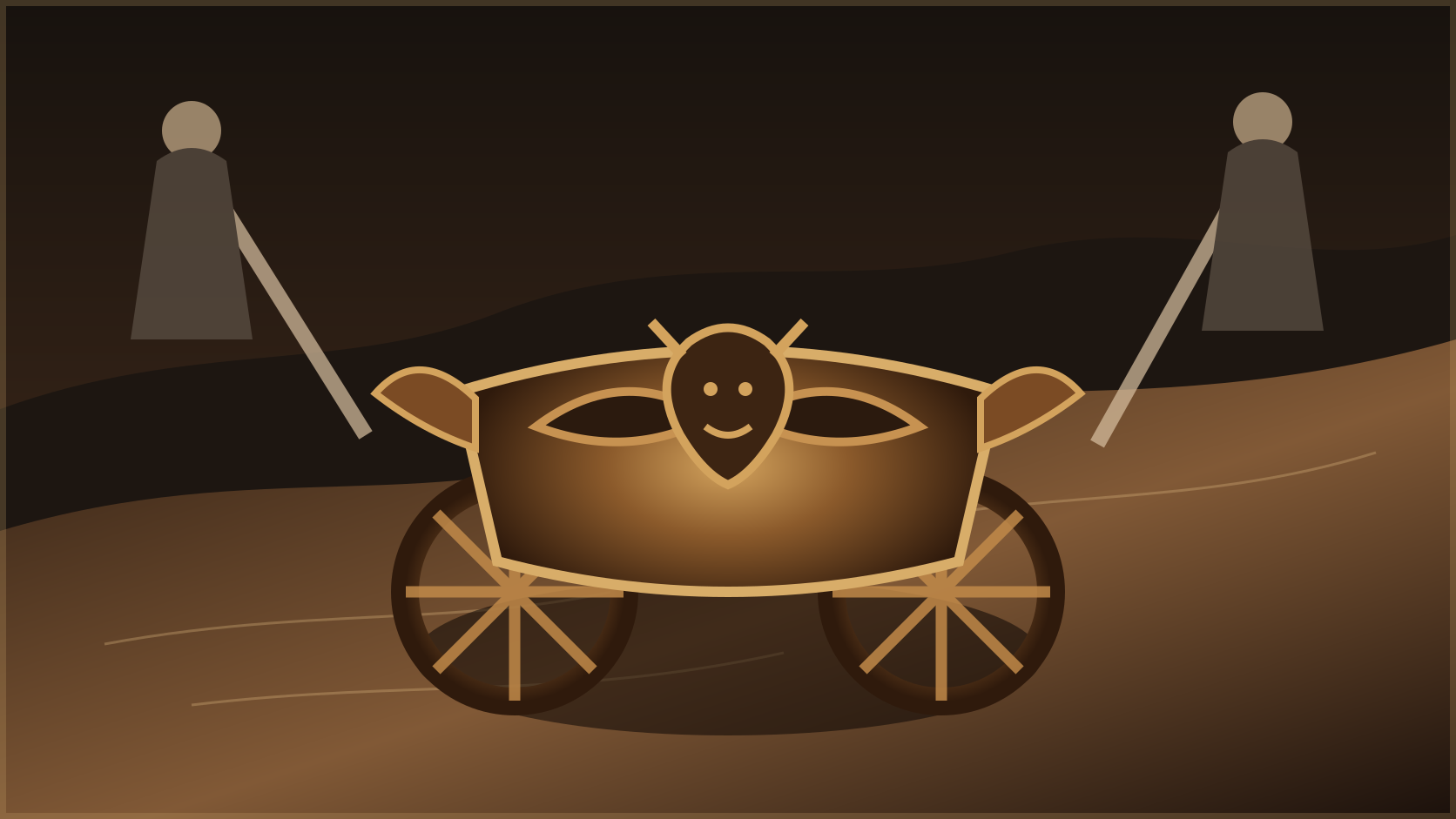
Casas del Turuñuelo, near Guareña in Spain’s Extremadura region, has become one of the most important sites for understanding the world conventionally called Tartessos. During the 2026 campaign archaeologists announced a small bronze votive chariot with no known direct parallel in the Iberian Peninsula. It was not a full-sized transport vehicle but a ceremonial object with wheels, a decorated body and relief figures.
Official descriptions identify a hybrid face interpreted as Achelous on the front, griffins with eagle heads and lion bodies on the sides, and human figures raising their arms to support the structure. The imagery suggests that motifs circulating across the Mediterranean were selected and reorganized for a local ritual setting.
These interpretations distinguish the official excavation announcement from broader comparative archaeology. Dating, manufacturing detail and contextual interpretation may be refined when the full scholarly publication appears.
Who were the Tartessians?
Ancient Greek and Roman writers used the name Tartessos for a wealthy region, river zone or political formation in the southwest of the Iberian Peninsula. Modern archaeology uses the term more cautiously for a diverse cultural environment that developed between the Late Bronze Age and Early Iron Age, combining local traditions with Phoenician and broader Mediterranean connections.
It should not automatically be imagined as a centralized empire with fixed borders. Settlements, sanctuaries, mining zones, ports and inland elite centres had different roles. Casas del Turuñuelo is one of the clearest inland nodes in that wider network.
These interpretations distinguish the official excavation announcement from broader comparative archaeology. Dating, manufacturing detail and contextual interpretation may be refined when the full scholarly publication appears.
Was the chariot made in Etruria?
Early comparisons indicate strong formal similarities with ceremonial bronzes from Etruria in central Italy. Etruscan workshops were famous for metalworking, relief decoration, incense equipment and ritual vehicles during the first half of the first millennium BC. Movement of objects, specialists and visual ideas across the Mediterranean was common.
Three possibilities remain open: a finished import, production in Iberia by a travelling specialist, or local manufacture inspired by Etruscan models. Alloy composition, lead-isotope analysis, casting seams, repairs and surface residues may help distinguish these scenarios. The phrase Etruscan chariot should therefore be treated as a comparative hypothesis rather than a final identification.
These interpretations distinguish the official excavation announcement from broader comparative archaeology. Dating, manufacturing detail and contextual interpretation may be refined when the full scholarly publication appears.
What do Achelous and the griffins mean?
Achelous was a river and shape-changing deity in Greek mythology, often represented through a mixture of human, bovine and other animal features. The Turuñuelo face appears to combine Achelous-like and gorgoneion-like traits, potentially joining water, the underworld and protective power.
Griffins travelled from the eastern Mediterranean into Greek and Etruscan art, frequently guarding sacred spaces, valuable objects or royal authority. The raised-arm figures recall atlas or caryatid traditions, but resemblance does not prove an identical religious story. Borrowed symbols could be transformed in a new setting.
These interpretations distinguish the official excavation announcement from broader comparative archaeology. Dating, manufacturing detail and contextual interpretation may be refined when the full scholarly publication appears.
How might the object have been used?
The excavation team has suggested that the chariot may have served as a device for burning incense or aromatic resins. Small wheeled bronzes elsewhere in the Mediterranean have been linked to offerings, smoke and ceremonial display. Fragrant substances could separate sacred time from ordinary activity and demonstrate access to valuable imported materials.
The interpretation remains testable rather than certain. Residue analysis, microscopic examination and evidence of controlled heating are needed before the object can confidently be called an incense burner. Researchers will also ask whether it moved during ceremonies, stood beside an altar or was dismantled at the end of its use.
These interpretations distinguish the official excavation announcement from broader comparative archaeology. Dating, manufacturing detail and contextual interpretation may be refined when the full scholarly publication appears.
Why was the building burned and buried?
One of the most remarkable features of Casas del Turuñuelo is that the building appears not simply to have been destroyed by accident. Excavation indicates a large closure ceremony followed by deliberate burning and burial. Earlier campaigns uncovered a mass animal sacrifice, especially horses, showing that the final event was extraordinary in scale.
The reason for the closure is unknown. Political instability, environmental stress, movement of a sacred centre, external danger and social transformation have all been considered. A dramatic fire layer does not automatically prove warfare. The orderly sealing of rooms and survival of valuable objects support a planned abandonment.
These interpretations distinguish the official excavation announcement from broader comparative archaeology. Dating, manufacturing detail and contextual interpretation may be refined when the full scholarly publication appears.
What does it reveal about Mediterranean trade?
The chariot does not explain the entire Tartessian economy, but together with Greek ceramics, eastern ivory and Egyptian alabaster it demonstrates that the Guadiana valley was connected to Mediterranean exchange. Such networks moved more than commodities. They circulated technical knowledge, religious imagery, systems of measurement, elite dining customs and models of political display.
Tartessian wealth is often connected with control of silver, copper and tin. Inland centres may have managed routes linking raw materials to coastal trade and received prestige goods in return. The chariot makes those connections visible and shows that Iberian communities actively selected and adapted foreign objects and ideas.
These interpretations distinguish the official excavation announcement from broader comparative archaeology. Dating, manufacturing detail and contextual interpretation may be refined when the full scholarly publication appears.
Which claims require caution?
The discovery is exceptional, but it does not solve the mystery of Tartessos. One object cannot establish the language, political organization or cause of transformation of an entire cultural region. Similarity to Etruscan material is not proof of workshop origin. Identification of the hybrid face remains an interpretation, and exact ritual function requires residue and wear analysis.
Reliable conclusions emerge when context, stratigraphy, dating, scientific analysis and comparison are considered together. The real importance of the chariot is not that it supports a lost-civilization story. It provides direct evidence that an inland ceremonial centre in fifth-century BC Iberia participated in far-reaching exchange and visual communication.
These interpretations distinguish the official excavation announcement from broader comparative archaeology. Dating, manufacturing detail and contextual interpretation may be refined when the full scholarly publication appears.
Conclusion
The bronze votive chariot concentrates several kinds of evidence in one object: advanced metalworking, Mediterranean imagery, ceremonial practice and elite access to distant networks. Future studies may clarify the alloy’s origin, identify traces of resin or heat and reveal how its separate parts were assembled.
The strongest conclusion available today is that the Tartessian world was neither closed nor isolated. Communities of the Guadiana valley obtained foreign materials and images, then incorporated them into local ritual systems. The chariot is a spectacular witness to that process, but its archaeological meaning lies in the sealed building and complete context in which it was found.
These interpretations distinguish the official excavation announcement from broader comparative archaeology. Dating, manufacturing detail and contextual interpretation may be refined when the full scholarly publication appears.
Related ODYOMUH reading
Explore the New Discoveries cluster and the complete English archive.
What will archaeologists examine next?
Form alone cannot reveal the complete biography of a bronze object. X-ray imaging may expose internal cracks and ancient repairs; portable XRF can estimate copper, tin, lead and trace-element proportions. Metallography may show whether casting was followed by hammering or annealing. Organic residue analysis can test for resin, oil or burned aromatic compounds.
Micromorphology of the surrounding deposit may clarify the relationship between the moment the object was placed and the burning of the building. Ash, charcoal, seeds, pollen and animal remains can reveal seasonality, fuel selection and food consumption during the closure ceremony. These datasets turn the chariot from an isolated museum object into part of a historical action.
Why has the discovery attracted broad attention?
Tartessos has long been surrounded by lost-civilization narratives because ancient texts emphasize wealth while archaeological definitions remain complex. The unusual architecture, animal sacrifice, human reliefs and now the bronze chariot at Turuñuelo intensify public interest. Scientific archaeology, however, does not need to enlarge the mystery; it creates testable questions from each discovery.
The chariot shows that ancient societies did not merely purchase foreign goods. They adopted and transformed images, rituals and technologies. The object therefore contributes not only to Tartessian history but also to debates about ancient connectivity, cultural transfer and local identity.
Frequently asked questions
What is the Casas del Turuñuelo bronze chariot?
It is a small bronze wheeled object or model recovered in the archaeological context of Casas del Turuñuelo, a major Tartessian-period site in southwestern Iberia.
Was the Tartessos bronze object a full-size chariot?
No. The find is a small bronze model rather than a full-size vehicle.
Why is Casas del Turuñuelo important?
The site preserves exceptional architecture, ritual deposits and material culture that help archaeologists study Tartessian society during the first millennium BCE.
Source trail
Selected references and research starting points
- Government of Extremadura official announcement, June 24, 2026: Open source
- Euronews Culture, June 30, 2026: Open source
- RTVE, June 25, 2026: Open source
- Construyendo Tarteso research project — Casas del Turuñuelo: Open source
- Construyendo Tarteso — EL CARRO, monograph on Casas del Turuñuelo: Open source
The list is a research trail. Specific claims should be checked against the cited edition, object record or publication.