Karahan Tepe and Taş Tepeler: Why One Site Is Not the Whole Story
Karahan Tepe expands the study of early monumental landscapes beyond Göbekli Tepe and reveals a regional network of Neolithic communities.
Why Karahan Tepe changed the conversation
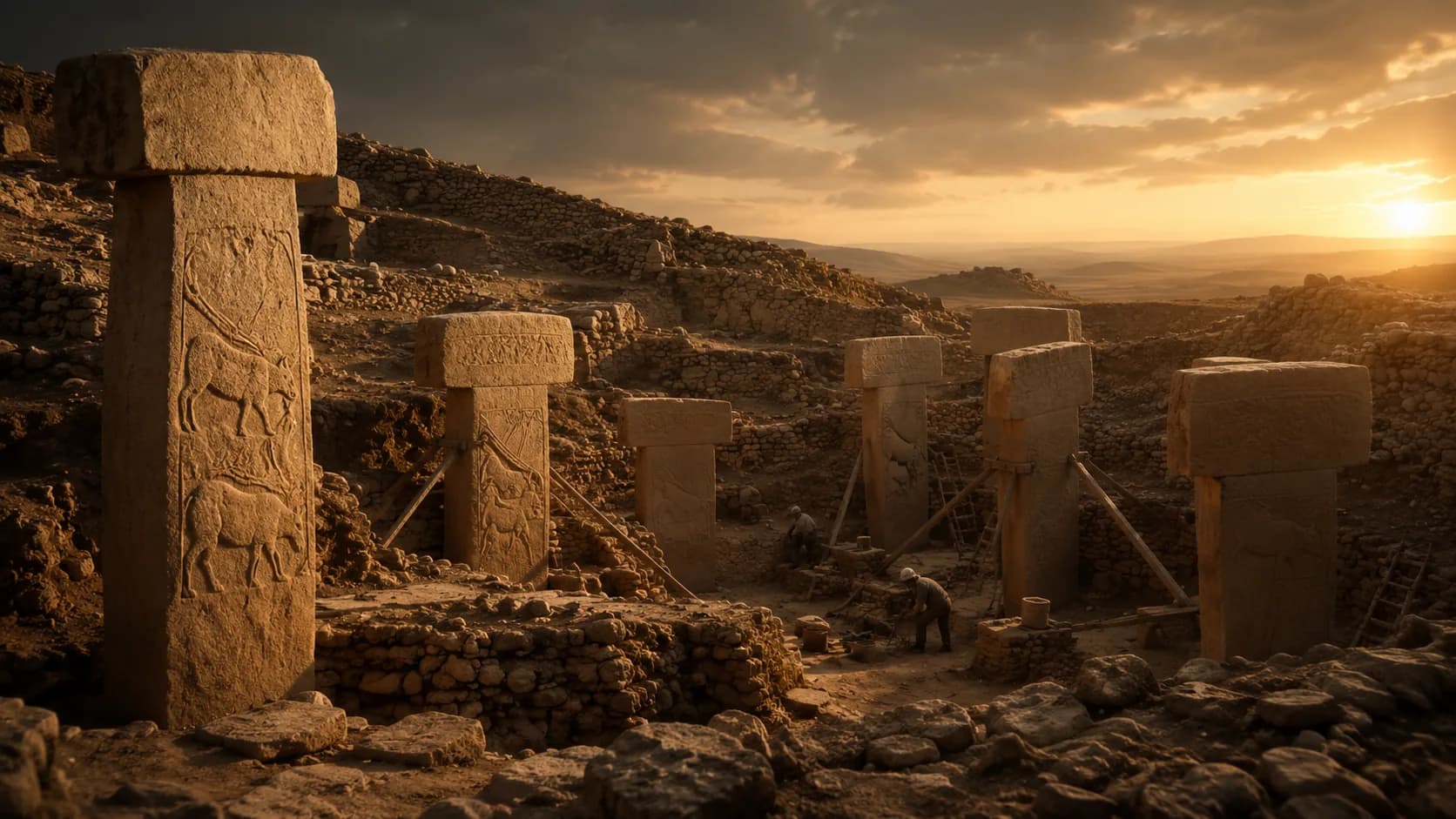
Göbekli Tepe became so famous that it was often described as a unique miracle. Karahan Tepe shows that related architectural and symbolic traditions existed across a wider landscape. This shifts the question from “who built one impossible site?” to “how did regional communities interact?”
Comparison reveals both shared forms and local choices. Similar T-shaped pillars do not make every site identical.
The carved human presence
Karahan Tepe includes anthropomorphic pillars, sculpted heads and a striking rock-cut space with projecting forms. These discoveries emphasize the human body more strongly than some familiar Göbekli Tepe imagery.
Exact ritual meanings remain unknown. Visual symbolism can be described carefully without assigning named gods or secret initiations.
Settlement and daily life
Research increasingly examines houses, food processing, tools and environmental change alongside monumental spaces. Ritual and daily life were not separate worlds. The same communities that built special structures also managed water, food and domestic tasks.
This integrated approach prevents monuments from floating free of the people who created them.
What “rewriting history” should mean
New excavations do revise models, but they rarely prove that everything known before was false. Karahan Tepe refines chronology, regional diversity and ideas about cooperation during the Neolithic transition.
The strongest history is updated through accumulation of evidence, not replaced by one viral headline.
How archaeology turns a site into an argument
The strongest way to investigate Karahan Tepe and Taş Tepeler: Why One Site Is Not the Whole Story is to build an evidence map before choosing an explanation. Archaeologists do not interpret a building or object in isolation. They record stratigraphy, associated finds, construction phases, later disturbance and the relationship between special spaces and ordinary settlement. For Karahan Tepe and Taş Tepeler: Why One Site Is Not the Whole Story, the most reliable explanation is the one that accounts for the entire site sequence rather than one spectacular room, stone or photograph.
Dating is also a chain of reasoning. Radiocarbon samples date organic material, not a stone wall directly. Pottery styles provide relative chronology, inscriptions can identify rulers or institutions, and geological processes can alter deposits. Each method has a range and potential sources of contamination. Strong conclusions emerge when independent methods converge.
Why context defeats many viral claims
Viral posts often remove scale bars, crop out surrounding structures or combine finds from different phases. Once context is restored, an “impossible” object may belong to a known workshop, an apparently sudden destruction may represent several events, and a mysterious chamber may have changed function over centuries. The evidence checkpoint for this article is therefore central: Taş Tepeler is a modern research framework for multiple sites, not the ancient name of a single kingdom.
Reliable research begins with site reports and specialist syntheses such as Türkiye Ministry of Culture and Tourism, Taş Tepeler research, Necmi Karul and colleagues, Karahan Tepe publications and Neolithic archaeology of the Upper Mesopotamian region. These sources may revise one another because excavation is cumulative. Revision is not evidence of concealment; it is the normal result of new trenches, improved dating and better comparison. A responsible article records what changed and why.
Questions to ask before accepting a reconstruction
Who excavated the feature, and under what recording standards? Is the proposed date based on material from a secure layer? Are there comparable sites nearby? Does the reconstruction distinguish surviving architecture from restored or imagined elements? Are alternative functions discussed? Applying these questions to Karahan Tepe, Taş Tepeler, Neolithic prevents certainty from outrunning the evidence.
The lasting importance of Karahan Tepe and Taş Tepeler: Why One Site Is Not the Whole Story is not that it supplies one final mystery. It shows how communities built, adapted, abandoned and remembered places over long periods. Archaeology is strongest when it reconstructs those changing relationships rather than turning the past into a frozen scene created for modern expectations.
The limits of certainty
Every historical reconstruction has a confidence level. Some points in Karahan Tepe and Taş Tepeler: Why One Site Is Not the Whole Story rest on direct physical evidence or securely identified texts; others depend on comparison, restoration or probability. A responsible article does not flatten those levels into one voice. It distinguishes what is observed, what is inferred and what remains open. That distinction is especially important when a topic has become part of popular culture, because repeated certainty can make a weak claim feel stronger than the underlying record.
The statement “we do not know the exact answer” should not be confused with “all explanations are equally likely.” Evidence can eliminate proposals even when it cannot select one final solution. Chronology, material traces, grammar, site context and known historical practices place real boundaries around interpretation. In this case, the boundary is summarized by the article’s evidence checkpoint: Taş Tepeler is a modern research framework for multiple sites, not the ancient name of a single kingdom.
How future evidence could change the picture
New discoveries could revise parts of this page. A securely excavated parallel object, a longer inscription, improved dating, a newly published archive or a successful experimental reconstruction might clarify disputed details. The important point is that useful new evidence must be documented well enough for independent researchers to inspect. A private photograph, anonymous translation or claim that the decisive object has disappeared cannot carry the same weight.
Updates should also be proportional. One new find may change a date or local interpretation without proving a global theory. The works listed in the source trail, including Türkiye Ministry of Culture and Tourism, Taş Tepeler research and Necmi Karul and colleagues, Karahan Tepe publications, provide a baseline against which later claims can be compared. When a new argument overturns an established view, it should explain the older evidence at least as well as the view it replaces.
Reader takeaway
The most useful conclusion from Karahan Tepe and Taş Tepeler: Why One Site Is Not the Whole Story is not a slogan but a method. Start with the surviving evidence, keep language and chronology visible, compare independent sources and label uncertainty. This approach protects curiosity from becoming credulity. It also gives ancient societies credit for their own institutions, beliefs and technical knowledge instead of treating them as empty spaces waiting for a modern mystery to fill.
Frequently asked questions
Is Karahan Tepe older than Göbekli Tepe?
Their phases overlap broadly, and precise comparisons depend on individual structures and dating results.
Were the sites connected?
Shared architectural traditions suggest regional interaction, but the exact social network is still being studied.
Was this a lost civilization?
The sites belong to documented Neolithic communities, although much about their language and beliefs remains unknown.
Source trail
Selected references and research starting points
- Türkiye Ministry of Culture and Tourism, Taş Tepeler research
- Necmi Karul and colleagues, Karahan Tepe publications
- Neolithic archaeology of the Upper Mesopotamian region
The list is a research trail. Specific claims should be checked against the cited edition, object record or publication.
Keep exploring: Use the topic hub for closely related articles or browse the full archive instead of starting a new search.