From Ottoman School Watchmen to Metal Detectors: A Long History of School Security
Hiring security guards for Turkish schools has a long history. From Ottoman bevvâbs to Law 5188 and CCTV, we trace how school security has evolved.
Introduction: Why School Security Never Leaves the Agenda
In Turkey, the approach of each new school year brings a familiar headline: the Ministry of National Education and İŞKUR announcing temporary hiring of cleaners and security guards for public schools under Community Benefit Programs (TYP). Tens of thousands of people are assigned to keep classrooms clean and to stand at school gates, visibly embodying society’s anxiety about student safety.([haberturk.com](https://www.haberturk.com/iskur-typ-alimlari-ne-zaman-basvurusu-nasil-yapilir-2022-okullara-guvenlik-temizlik-personeli-alimi-ne-zaman-basliyor-sartlari-neler-3514788))
Parliamentary records show that calls to appoint “30,000 security guards to schools” have been voiced repeatedly over the past decade.([cdn.tbmm.gov.tr](https://cdn.tbmm.gov.tr/TbmmWeb/Tutanak/27/5/66/Basilmis/b794d7d4-a5a1-4fb1-a378-ced1cad7a569.pdf)) Yet the question remains: is school security really just about putting a guard at the door? When we zoom out historically, the answer becomes far more complex. School security involves architecture, discipline, community surveillance, formal regulations, technological systems and, increasingly, digital monitoring.
This article traces the long trajectory of school security in what is now Turkey: from Ottoman neighbourhood schools and Tanzimat-era reforms to the Republican mass education project and the 2004 Private Security Law. By doing so, it seeks to show that today’s arguments over guards, cameras and metal detectors are only the latest chapter in a story stretching back at least 150 years.
Ottoman Neighbourhood Schools: Safety as a Community Function
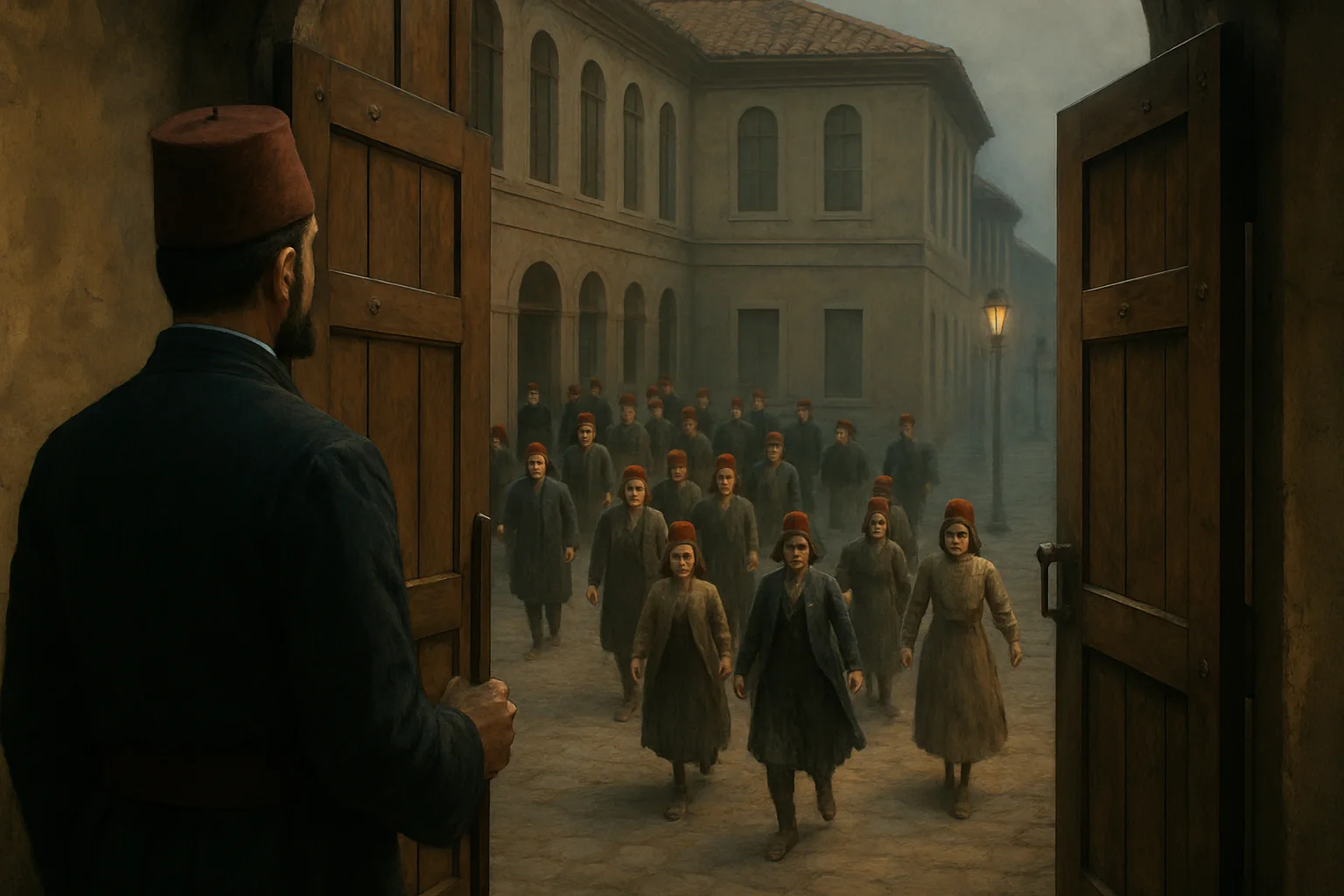
In the classical Ottoman era, primary education was largely provided by small sıbyan mektebi schools attached to mosques or located in the middle of neighbourhoods. The main guarantee of safety was not a specialised security force but the social fabric itself: the imam, the teacher, shopkeepers, neighbours and night watchmen who patrolled the streets.
There was no separate security post inside these schools. Order was maintained by the teacher’s authority and by the watchful eyes of the community. Corporal punishment, however, was widely accepted as part of discipline. As the Turkish Maarif Encyclopaedia notes, beating children on the soles of their feet or on their hands was considered a legitimate educational tool in many settings until the mid-19th century.([turkmaarifansiklopedisi.org.tr](https://turkmaarifansiklopedisi.org.tr/disiplin))
This began to change with the reform era. For the first time, education officials and intellectuals started to ask not only how to keep outsiders away from schools, but also how to protect children from excessive violence inside them.
Tanzimat and New School Security Actors: The Bevvâb and the Mubassır
After the 1839 Tanzimat Edict, the Ottoman state opened a wide range of new schools: secondary rüşdiye, preparatory idâdî institutions and teacher training colleges. This expansion brought practical security problems, from managing entry and exit to handling conflicts among large numbers of pupils.
A 2024 article in the Türkiye Araştırmaları Dergisi shows that this period saw the emergence of dedicated school security roles: the bevvâb (gatekeeper), mubassır (in-school supervisor responsible for order), night watchmen, and, when needed, police or military units acting around schools.([turkad.org](https://turkad.org/index.php/pub/article/view/41)) Security was no longer just an informal community function; it was being professionalised within the educational system.
The 1869 Maârif-i Umûmiye Regulation, which systematised modern schooling throughout the empire, included detailed provisions on how schools would be established, staffed and supervised. Crucially, it also addressed student behaviour and school discipline, giving school rules a clear legal foundation.([turkmaarifansiklopedisi.org.tr](https://turkmaarifansiklopedisi.org.tr/maarif-i-umumiye-nizamnamesi)) Questions we still argue about today – whether there should be uniformed guards at school gates, or whether security should rest with civilian staff – were already being debated, albeit in different language, in late Ottoman Istanbul.
From Discipline to Child Protection: Banning the Falaka
School security is not only about threats coming from outside; it is also about protecting students from harm inside the institution. A milestone here is a July 20, 1863 instruction by the Ottoman Education Ministry that explicitly banned certain forms of corporal punishment – including the notorious falaka, beating the soles of a child’s feet – in primary schools. The document argued that such practices were not compatible with Islamic law.([turkmaarifansiklopedisi.org.tr](https://turkmaarifansiklopedisi.org.tr/disiplin))
The 1869 Maârif-i Umûmiye Regulation then went a step further, forbidding beating and verbal abuse in all schools and requiring that discipline be maintained instead through rewards and non-violent sanctions such as warnings, standing during class or temporary suspension.([turkmaarifansiklopedisi.org.tr](https://turkmaarifansiklopedisi.org.tr/disiplin)) This marked an important shift: schools were increasingly conceived as places where children had to be protected not only from strangers at the gate but also from the excessive anger of teachers and administrators.
Archival research on late Ottoman education confirms that these bans were reiterated in later regulations, suggesting that the state considered them more than symbolic gestures. In other words, the history of school security in this region includes both the rise of new security personnel and a long, uneven struggle to reduce violence committed in the name of discipline.
The Republican Era: Mass Schooling and the “Safe School” Ideal
After 1923, the new Republic transformed education into a central pillar of nation-building. Within a few decades, hundreds of thousands of children were attending a growing network of public schools. Security now became an issue of national policy rather than local custom.
Republican regulations gradually formalised issues such as school health services, fire safety, hygiene and, later, student transportation.([avys.omu.edu.tr](https://avys.omu.edu.tr/storage/app/public/huseyin.aslan/117934/ebut617_sunump_unite3%20%281%29.pdf)) “Security” in official documents could refer to both physical dangers and to perceived political or moral threats (for example, “harmful publications”). Yet in practical terms it translated into concrete measures: school site selection, boundary walls, duty schedules for teachers on supervision, and coordination with local police where needed.
By the late 20th century, work safety and occupational health frameworks were being applied to schools as workplaces, adding another layer to how security and risk were understood in educational settings.
The Private Security Era: Law 5188 and Its Impact on Schools
A major turning point came with the rise of the private security industry. On June 10, 2004, the Turkish Grand National Assembly adopted Law No. 5188 on Private Security Services. The law created a detailed framework for granting private security permits, licensing companies and defining the duties and oversight of private security officers.([tbmm.gov.tr](https://www.tbmm.gov.tr/Yasama/Kanun/f72877bd-9dc3-037b-e050-007f01005610))
Within this framework, public institutions, including schools, were allowed to establish their own private security units or contract services from private firms, subject to provincial commission approval. For the Ministry of National Education, this opened the door to stationing licensed private security guards at schools that provincial directorates considered high risk, particularly in large cities.([mevzuat.meb.gov.tr](https://mevzuat.meb.gov.tr/dosyalar/1973.pdf))
In effect, the Ottoman bevvâb and neighbourhood watchmen were replaced by uniformed, card-carrying private guards whose role and training are defined by national law. At the same time, this shift sparked debates over whether security should be “outsourced” at all, and how guards interact with teachers, students and parents in the daily life of schools.
Circulars and Protocols: Cameras, Turnstiles and School Police
From the 2000s onward, school security in Turkey became a multi-agency field. On April 27, 2018, the Ministry of National Education issued a nationwide circular on school security. It called for stricter control of school entrances and exits, monitoring of surrounding traffic and derelict buildings, training and background checks for security personnel, and the installation of camera and alarm systems in school buildings with appropriate monitoring of the footage.([meb.gov.tr](https://www.meb.gov.tr/okul-guvenligi-genelgesi-yayimlandi/haber/16262/tr))
A June 2026 directive by the Interior Ministry’s Directorate General of Provincial Administration pushed these measures further. It instructed authorities to demolish derelict structures near schools, prevent loitering by people with no connection to the school, confine entry and exit to a single controlled gate, and install camera systems covering both the school interior and its surroundings.([onikisubat.meb.gov.tr](https://onikisubat.meb.gov.tr/meb_iys_dosyalar/2026_06/6a21d3775a741209054481_%C4%B0LLER_%C4%B0DARES%C4%B0_Okul_ve_%C3%87evresi_G%C3%BCvenlik_Tedbirleri_int.pdf))
The same document emphasises assigning fixed “school law enforcement officers” to high-risk schools and “safe education coordination officers” to others, increasing patrols around school routes, and stepping up “cyber patrols” to monitor online threats and digital radicalisation.([onikisubat.meb.gov.tr](https://onikisubat.meb.gov.tr/meb_iys_dosyalar/2026_06/6a21d3775a741209054481_%C4%B0LLER_%C4%B0DARES%C4%B0_Okul_ve_%C3%87evresi_G%C3%BCvenlik_Tedbirleri_int.pdf)) School security is thus envisioned as a dense web linking principals, counsellors, private guards, police, local governments and even specialised cybercrime units.
Global Context: Metal Detectors, School Police and Climate Debates
These developments mirror wider international trends. In the United States, concerns about youth crime in the 1970s and high-profile school shootings in the 1990s – especially the 1999 Columbine massacre – led to the rapid expansion of school-based policing and physical security technologies such as metal detectors and CCTV.([ewa.org](https://ewa.org/issues/early-learning/history-and-background-school-safety-security))
A 2021 explainer by the Education Writers Association traces how federal reports in the 1970s, “zero tolerance” disciplinary policies in the 1990s and successive waves of funding after major shootings helped normalise police officers, surveillance cameras and weapons screening in American schools. At the same time, research shows that these measures have disproportionately affected students of colour and have not consistently reduced violence.([ewa.org](https://ewa.org/issues/early-learning/history-and-background-school-safety-security))
In March 2026, the U.S. state of Georgia moved toward becoming the first to require weapons detection systems at the entrances of all public schools, in direct response to a fatal 2024 school shooting. The Associated Press reports that, if the bill becomes law, every student would pass through a weapons screening system each day.([apnews.com](https://apnews.com/article/784da79e1c81b2c01a33a12dd53a8ba9)) Critics argue that such measures are costly, generate constant false alarms and can undermine students’ sense of belonging and trust in their schools.
Recent studies suggest that while there is some evidence that school-based police can reduce certain forms of violence, the overall impact of heavy security and policing on safety is ambiguous. By contrast, a growing body of work links positive school climate, strong relationships, counselling and restorative practices to lower rates of violence and victimisation.([ewa.org](https://ewa.org/issues/early-learning/history-and-background-school-safety-security))
Conclusion: What Can a Guard at the Gate Really Do?
The historical record makes one point very clear: responsibility for school security has never rested with a single actor. In Ottoman times, it was shared by teachers, neighbourhood elders and watchmen; in the Tanzimat era, by bevvâbs, mubassırs and provincial officials; in the Republic, by central ministries, principals and health officers; and today, by a dense network of private guards, law enforcement, psychologists and digital monitoring teams.
As Turkey again considers hiring thousands of security guards for schools, history offers two cautions. First, a guard or a metal detector at the entrance cannot by itself eliminate bullying, teacher-targeted violence or the psychological harm caused by exclusion and discrimination. The heart of safety lies in the everyday climate of the school – in trust, fairness and a sense of belonging. Second, overly militarised or intrusive security can unintentionally make students feel less safe, normalising fear and surveillance and disproportionately affecting already vulnerable groups.
None of this means that physical security measures or trained guards are useless. Rather, the long history from Ottoman regulations to contemporary circulars suggests that they are only one layer in a multi-layered system. Effective school security is best understood as part of a broader educational project that protects children’s physical, emotional and digital well-being, instead of outsourcing safety solely to the person standing at the gate.
Frequently asked questions
Did Ottoman schools have dedicated security guards?
In classical Ottoman neighbourhood primary schools (<em>sıbyan mektepleri</em>), there was no dedicated security guard in the modern sense. Order was maintained by the teacher and by figures such as the imam, local elders and night watchmen responsible for the streets. After the Tanzimat reforms, however, new roles emerged in modern state schools: the <em>bevvâb</em> (gatekeeper) at the entrance, the <em>mubassır</em> supervising students inside, and, when necessary, police or soldiers around the building, as documented by recent archival research on Ottoman school security.
How did the 1869 Maârif-i Umûmiye Regulation change school security?
The 1869 Maârif-i Umûmiye Regulation was the first comprehensive law to systematise modern schooling throughout the Ottoman Empire. Besides specifying how schools would be founded, funded and staffed, it set detailed rules on student behaviour and discipline. It banned corporal punishment and verbal abuse, required that misbehaviour be addressed through non-violent sanctions and made attendance at primary schools compulsory, with fines for parents who did not comply. In doing so, it turned school discipline and aspects of student safety into matters of imperial law rather than local custom.
What did Turkey’s 2004 Private Security Law change for schools?
Law No. 5188 on Private Security Services, adopted in 2004, created a legal framework for private security units and companies, defining how they are licensed, supervised and deployed. Under this law, public institutions such as schools can request permission to establish their own private security unit or to contract security services from companies, based on an assessment of their protection needs. For the Ministry of National Education, this has meant that high-risk schools can be assigned licensed private guards whose duties, appearance and training are regulated at the national level rather than informally arranged locally.
When did CCTV and metal detectors start to appear in schools?
In Turkey, CCTV and alarm systems became increasingly common in schools in the 2000s. A nationwide school security circular issued in 2018 by the Ministry of National Education explicitly called for installing camera and alarm systems and managing the recording and monitoring process. A 2026 directive by the Interior Ministry further emphasised CCTV coverage of both school interiors and surroundings. Metal detectors have been discussed and used more selectively, mainly at high-risk sites. Internationally, especially in the United States, metal detectors began to spread in the 1990s in response to fears of school shootings.
Do research findings support putting more police and guards in schools?
International research, particularly from the United States, paints a nuanced picture. Reviews by organisations such as the Education Writers Association highlight that while some studies find reductions in certain types of violence when school-based police are present, the overall evidence does not clearly show that heavy policing and hardware like metal detectors make schools safer in general. At the same time, there is robust evidence that positive school climate, strong student–adult relationships, counselling and restorative practices are associated with lower levels of violence and victimisation. These findings suggest that security staff and equipment should complement, not replace, broader efforts to create supportive, inclusive school environments.
Sources and further reading
- “Disiplin” maddesi — Türk Maarif Ansiklopedisi (Türkiye Maarif Vakfı & TÜBA), 2022-12-18
- “Tanzimat Sonrası Osmanlı Devleti’nde Okul Güvenliği” — Türkiye Araştırmaları Dergisi, 2024-12-31
- 5188 sayılı Özel Güvenlik Hizmetlerine Dair Kanun — Türkiye Büyük Millet Meclisi, 2004-06-10
- “Okul güvenliği genelgesi yayımlandı” — T.C. Millî Eğitim Bakanlığı, 2018-04-27
- “Okul ve Çevresi Güvenlik Tedbirleri” genel yazısı — T.C. İçişleri Bakanlığı İller İdaresi Genel Müdürlüğü, 2026
- “History and Background: School Safety & Security” — Education Writers Association, 2021-07-23
- “Georgia could become the first state with weapons detection in all public schools” — Associated Press, 2026-03-24
Keep exploring: Use the topic hub for closely related articles or browse the full archive instead of starting a new search.