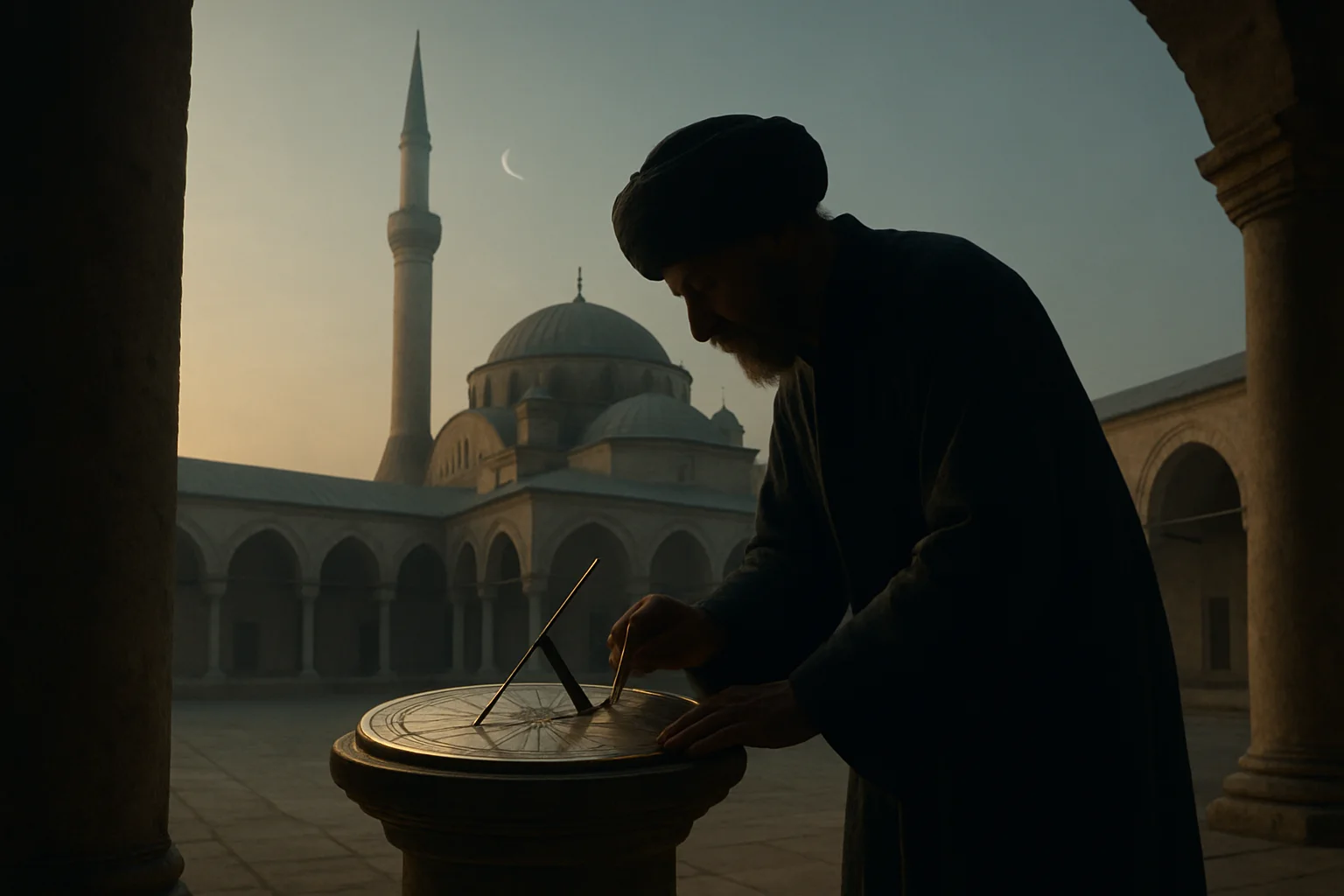
From Shadows to Digital Schedules: Islamic Prayer Times, Ottoman Timekeepers and Today’s Calculations
Prayer times once depended on shadows and horizon glows. Today they come from satellites and apps. This article traces that long history.
Why are prayer times an astronomical problem?
In Islamic tradition, the five daily prayers are defined not by fixed hours but by the Sun’s apparent motion in the sky. Fajr begins with the first true dawn light on the eastern horizon, ẓuhr when the Sun passes its noon peak, ʿaṣr when shadows reach a certain length, maghrib at sunset and ʿishāʾ when the evening glow disappears. Classical hadith reports describe these moments in terms of fejr, zawāl, shadow lengths and twilight colours – all atmospheric signs caused by the Earth’s rotation.([kurul.diyanet.gov.tr](https://kurul.diyanet.gov.tr/tr/fetva/45-enlemin-otesinde-namaz-vakitleri/d681fdc5-924c-4f02-bb74-08dd1c135350))
This means that a “prayer time” is never a universal fixed clock reading. It depends on latitude, longitude and season. Even within Türkiye, for example, official timetables show that the difference between imsak (fast-start) in Tekirdağ and Adana can reach tens of minutes in winter and summer.([vakithesaplama.diyanet.gov.tr](https://vakithesaplama.diyanet.gov.tr/vakit_kiyaslamalari.php)) From the beginning, then, regulating prayer has been as much an exercise in practical astronomy and geometry as a matter of law and devotion.
Early Islam: horizons, shadows and the birth of time science
In the first centuries of Islam, people had no precise mechanical clocks. Time was read directly from the sky: the whitening of the eastern horizon, the moment of sunrise and sunset, the changing length of shadows, and at night the position of the Moon and prominent stars.
The simplest instrument was a vertical stick in the ground – a gnomon. By watching how its shadow shortened and lengthened over the day, observers could divide daylight into recognizable segments. The Encyclopaedia Iranica notes that in Muslim societies, sundials and the science of gnomonics were especially cultivated because they were essential for determining both the times of the five daily prayers and the qibla (direction of Mecca).([iranicaonline.org](https://www.iranicaonline.org/articles/clocks-pers/))
Out of this practice grew a specialized discipline known as ʿilm al-mīqāt – the science of times. Medieval Muslim scholars computed tables linking the Sun’s position to shadow lengths and prayer boundaries using spherical trigonometry. For a given latitude, these tables gave approximate prayer windows through the year, which could then be refined by local visual checks.
Timekeepers and their rooms: the rise of the muwaqqit and the muvakkithane
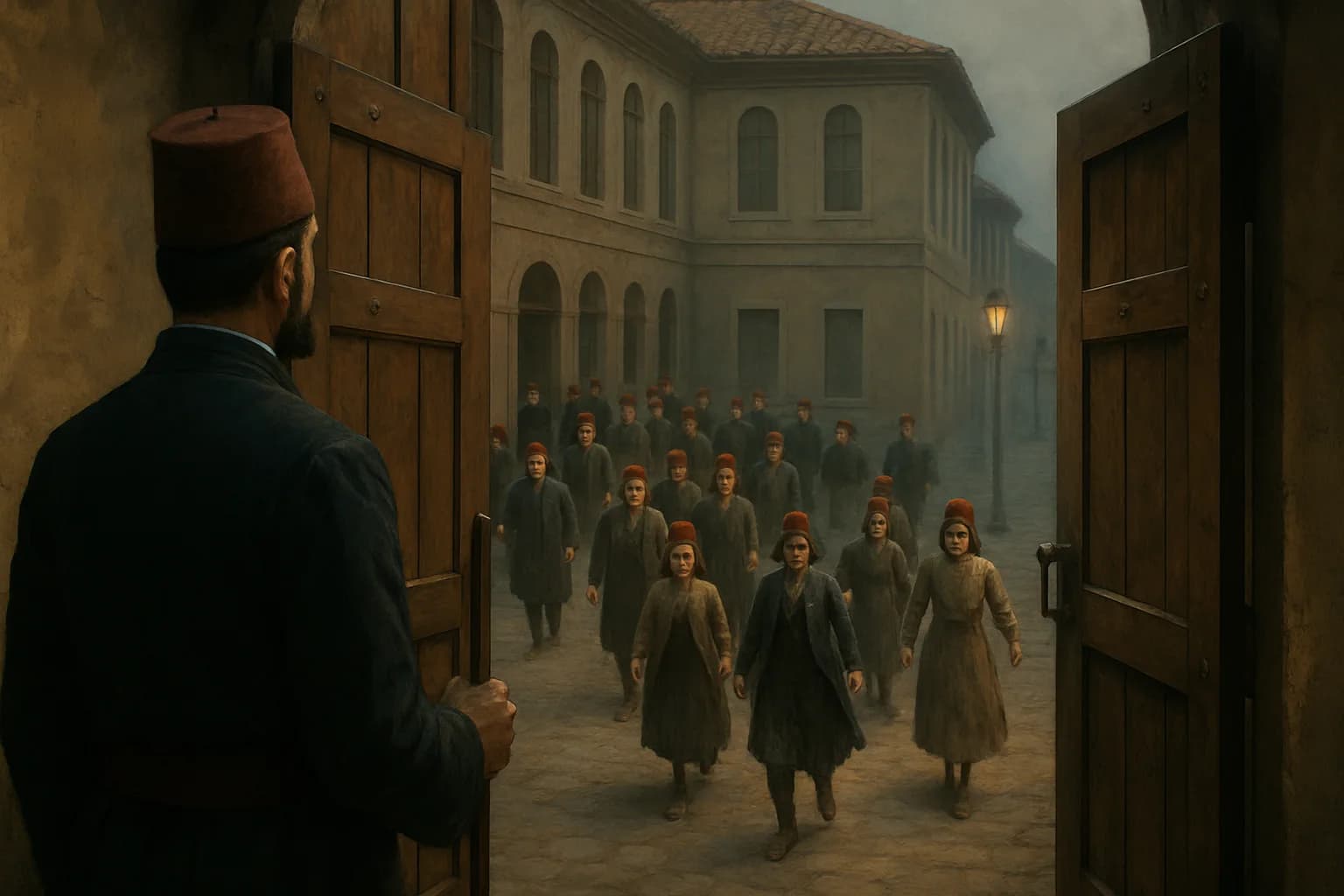
Over time, this expertise was institutionalised in the figure of the muwaqqit – a timekeeper attached to major mosques and madrasas. His task was to regulate prayer times and communicate them to the muezzin using mathematical astronomy. The spatial counterpart of this office was the dar al-muwaqqit, known in Ottoman Turkish as the muvakkithane: a dedicated room or small building, usually attached to a mosque, where calculations and observations were made.
In Istanbul, surviving endowment deeds and architectural surveys suggest that from the 15th century onward most imperial mosques were given such timekeeping rooms, often as one- or two-room annexes with their own dome.([muslimheritage.com](https://www.muslimheritage.com/uploads/OttomanInstitutions.pdf)) Inside, muwaqqits used wall sundials, quadrant instruments, astrolabes and, later, mechanical clocks. Turkish historical dictionaries and Ottoman science studies describe how these rooms functioned as semi-scientific laboratories, where religious needs pushed advances in astronomical practice.([sozluk.ttk.gov.tr](https://sozluk.ttk.gov.tr/detay/2402/Muvakkith%C3%A2ne-%28%D9%85%D9%88%D9%82%D8%AA%D8%AE%D8%A7%D9%86%D9%87%29))
At the top of the hierarchy stood the müneccimbaşı, the chief court astronomer. A detailed article in the journal Belleten shows that he was responsible each year for preparing the official calendar and the Ramadan almanac (imsakiye) presented to the sultan and leading officials – an Ottoman continuation of the much earlier Islamic link between piety, timekeeping and state power.([belleten.gov.tr](https://www.belleten.gov.tr/tam-metin/46/tur))
From sundials to mechanical clocks: when time spoke two languages
By the 18th century, mechanical clocks had become common in the Ottoman world, and many muwaqqits were also skilled clockmakers and repairers. Sources describe them integrating clocks into their toolkit and even designing special dials that showed prayer times directly.
Yet the underlying conception of time remained dual. One system, known as ezanî or alla turca time, began the day at sunset; the length of an “hour” in everyday speech effectively shifted with the seasons. The other, alla franca or mean-time reckoning, divided the day into 24 equal hours starting at midnight. A recent study of 19th-century Ottoman palace clocks shows that many had double dials, displaying both systems at once – clear evidence that Ottoman society learned to read two temporal “languages” simultaneously.([dergipark.org.tr](https://dergipark.org.tr/tr/pub/msdergisi/article/1940356))
Sundials did not disappear overnight. As late as the late 19th century, figures such as Ahmed Muhtar Pasha were still publishing treatises on portable sundials designed to give sunrise and sunset, prayer times, and day length according to the traditional zevâlî scheme.([dergipark.org.tr](https://dergipark.org.tr/tr/pub/iuoba/article/14151)) The scientific core of mīqāt remained in place even as technology changed.
Republican reforms: civil time versus sacred time
After the founding of the Republic of Türkiye, the state moved decisively to align civil life with international time standards. A 1925 law mandated that the day begin at midnight and that hours be counted from 0 to 24; it also fixed the country’s legal time zone to the 30°E meridian passing near İzmit.([islamansiklopedisi.org.tr](https://islamansiklopedisi.org.tr/saat)) Train schedules, offices and schools now followed the same framework as Europe.
Prayer times, however, remained tied to the Sun. What changed was the reference frame: instead of being expressed in local ezanî hours that slid with sunset, they were converted into the new 24-hour clock. This hybrid arrangement effectively translated an old astronomical regime into a modern temporal language. Some mosque timekeeping rooms fell out of use, while others adapted, housing mechanical regulators and printed timetables instead of astrolabes.
How does Diyanet calculate prayer times today?
Today in Türkiye, almost all state-regulated mosques follow the timetable produced by the Presidency of Religious Affairs (Diyanet). The institution has a dedicated “Time Calculation” unit. Its official explanations state that it bases the legal limits of prayer windows on classical fiqh descriptions, but determines their exact start and end moments using astronomical formulas and spherical trigonometry.([vakithesaplama.diyanet.gov.tr](https://vakithesaplama.diyanet.gov.tr/imsak.php))
For imsak and fajr, Diyanet defines the criterion as the Sun’s centre reaching about 18 degrees below the horizon – a value it argues agrees with early Muslim astronomers’ definitions of true dawn (fecr-i ṣādiq) and with modern observational campaigns at several sites in Türkiye.([vakithesaplama.diyanet.gov.tr](https://vakithesaplama.diyanet.gov.tr/imsak.php)) For ẓuhr, ʿaṣr, maghrib and ʿishāʾ, it uses conditions tied to the Sun’s altitude and shadow lengths, in line with standard prayer time calculations.
Diyanet now publishes these times responsively on the web and via an official API, allowing cities worldwide to be covered with the same methodology.([awqatsalah.diyanet.gov.tr](https://awqatsalah.diyanet.gov.tr/index.html)) In this sense, the muwaqqit’s tables have become cloud services: the tools changed, the mathematics remained.
Imsak, safety margins and controversy
Precisely because prayer times and fasting boundaries matter so much in practice, adjustments to them are controversial. In the early 1980s, Diyanet revised the way it handled temkin – an additional safety margin that had historically been added to prayer times. It reduced this buffer and adopted the -18° criterion for imsak, rather than earlier, more cautious values.([vakithesaplama.diyanet.gov.tr](https://vakithesaplama.diyanet.gov.tr/temkin.php))
Supporters argued that modern astronomy and careful observations made such margins unnecessary and could even be misleading if they significantly delayed fajr. Critics saw the move as narrowing devotional space. Similar debates exist in many countries: different institutions may choose slightly different solar depression angles for dawn and night, reflecting their reading of the same textual and observational record.
The issue becomes more complex at high latitudes where the Sun may barely set or rise in some seasons. Diyanet’s High Council of Religious Affairs notes that in such regions, classical descriptions cannot be applied literally; instead, jurists resort to taqdīr – “estimation” by analogy with the nearest latitude that has normal day–night cycles.([kurul.diyanet.gov.tr](https://kurul.diyanet.gov.tr/tr/fetva/45-enlemin-otesinde-namaz-vakitleri/d681fdc5-924c-4f02-bb74-08dd1c135350)) Here the ancient science of mīqāt and the mechanisms of legal reasoning are tightly entwined.
Digital prayer times: rupture or continuity?
Seen from a smartphone screen, prayer times can look like a purely digital artifact. Yet under the interface, they still come from the same Sun whose shadows early Muslims and Ottoman muwaqqits watched so closely. Diyanet’s software continues to rely on solar altitudes, twilight definitions and shadow-based criteria; these have simply been encoded in algorithms that can compute them to the second.([vakithesaplama.diyanet.gov.tr](https://vakithesaplama.diyanet.gov.tr/imsak.php))
What has changed most is how time is experienced. In early modern Istanbul, the sound of the adhan structured the entire social day: markets, courts and workshops often opened and closed around prayer cycles rather than around a fixed nine-to-five schedule.([acikerisim.duzce.edu.tr](https://acikerisim.duzce.edu.tr/bitstreams/c99717eb-49d5-4c71-97ac-bb33eb49352f/download)) In contemporary cities, prayer time has become one layer among many in a dense grid of work shifts, transport timetables and global meetings. The adhan still calls people to turn towards Mecca, but it now enters a soundscape dominated by traffic, notifications and alarms.
Even so, each prayer time remains anchored in the same physical reality. When the timetable says that maghrib in Istanbul falls at a particular minute, that entry encodes centuries of accumulated observation and calculation. From a gnomon’s moving shadow in a mosque courtyard to the digits on a backlit OLED display, the story of “namaz vakti” is less about abandoning tradition and more about continually translating an old relationship with the sky into new technologies.
Frequently asked questions
What exactly was a muwaqqit or muvakkit?
A muwaqqit (Turkish: muvakkit) was a specialist attached to major mosques whose main duty was to calculate and regulate prayer times using astronomy and mathematical tables. He worked in a dedicated room called a dar al-muwaqqit or muvakkithane, equipped with sundials, quadrants, astrolabes and later mechanical clocks, and would inform the muezzin when each prayer window began.
How did ordinary people know the prayer times before printed timetables?
Most people took their cue from the adhan itself and from public indicators such as mosque sundials and, later, clock towers. Daily activities like opening markets, starting court sessions or holding Friday sermons were often tied to prayer times, so the social rhythm of the city helped everyone keep track, even without owning a personal watch.
Do all mosques in Türkiye follow Diyanet’s timetable?
State-run mosques in Türkiye are expected to follow the Presidency of Religious Affairs’ (Diyanet) official timetable, which is distributed in print and digitally. Independent prayer rooms or communities, especially abroad, may use alternative timetables based on other institutions’ calculations, but within Türkiye Diyanet’s schedule is the de facto standard.
Why do different Islamic organisations sometimes give different prayer times?
Differences usually arise from technical choices rather than fundamentally different beliefs: for example, using -18° or -19° for dawn, including or excluding additional safety margins, or preferring one classical description of shadow length at ʿaṣr over another. These small differences in input lead to a few minutes’ difference in published times, which each organisation justifies from the same shared textual and scientific heritage.
Did the adoption of the 24-hour clock change Islamic prayer times?
The 24-hour clock, adopted in Türkiye in 1925 for civil life, did not change the underlying astronomical definitions of prayer times. Fajr, ẓuhr, ʿaṣr, maghrib and ʿishāʾ are still tied to the Sun’s motion. What changed was the way these moments are expressed: instead of being given in a sunset-based local system (ezanî time), they are now converted into standard civil time, aligning religious practice with railway schedules, office hours and other modern structures.
Sources and further reading
- Vakit Hesaplama – İmsak — T.C. Diyanet İşleri Başkanlığı, n.d.
- 45. Enlemin Ötesinde Namaz Vakitleri — T.C. Diyanet İşleri Başkanlığı Din İşleri Yüksek Kurulu, 2009-01-01
- Osmanlı Devleti’nde Müneccimbaşılık Müessesesi — Türk Tarih Kurumu / Belleten, 2006-04-01
- CLOCKS (Pers. sāʿat) — Encyclopaedia Iranica, n.d.
- Dar al-Muwaqqit — Wikipedia, n.d.
- SAAT — Türkiye Diyanet Vakfı İslâm Ansiklopedisi, 2009-01-01
- Ahmed Muhtar Paşa’nın Tasarladığı Taşınabilir Güneşsaati — Osmanlı Bilimi Araştırmaları / Dergipark, 2009-01-01
Keep exploring: Use the topic hub for closely related articles or browse the full archive instead of starting a new search.