The Altalena Arms Ship: How a 1948 Showdown Brought Israel to the Brink of Civil War
The 2026 discovery of the Altalena wreck revives the story of how an Irgun arms ship was shelled off Tel Aviv in 1948 as Israel imposed a single national army.
2026: A Lost Ship Reappears on Sonar
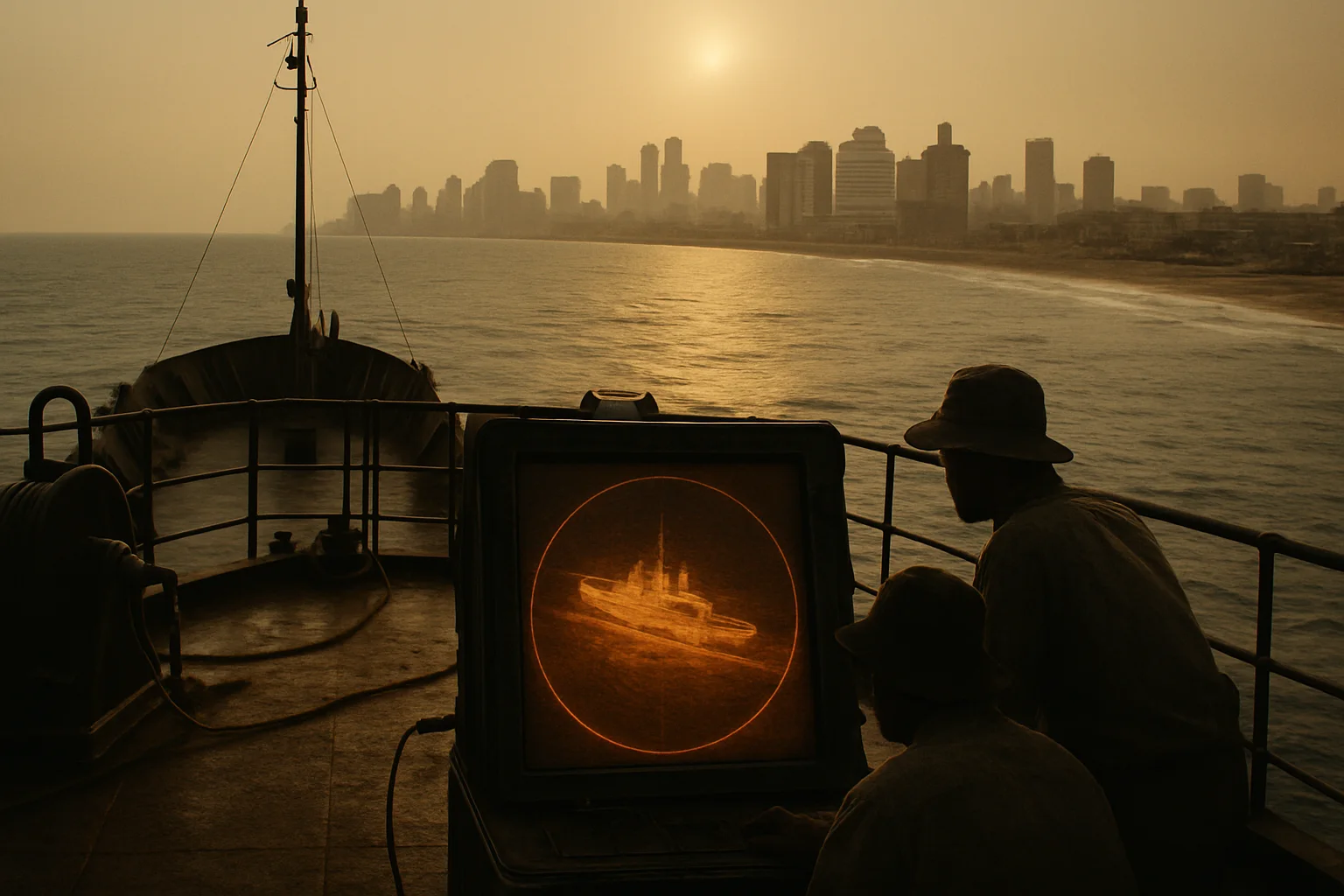
On 24 August 2026, Israel’s Heritage Ministry announced that the wreck of the Altalena had finally been located on the floor of the eastern Mediterranean. Using a survey vessel equipped with advanced sonar and mapping gear, search teams identified a ship lying some 20 kilometres off Israel’s coast at a depth of 503 metres, with the hull described as largely intact.([jpost.com](https://www.jpost.com/history/article-906395))
The find closes a physical circle that began in June 1948, when the burned-out hulk of the Irgun arms ship was towed away from Tel Aviv beach and deliberately sunk in deep water. For decades its exact resting place remained uncertain, even as the “Altalena Affair” became one of the most painful reference points in Israel’s political memory.([jta.org](https://www.jta.org/archive/hull-of-altalena-sunk-vessel-destroyed-in-1948-when-irgun-tried-to-land-munitions))
The 2026 operation is more than a feat of underwater survey. By bringing the wreck back into public view—through sonar images and political speeches—it has revived questions about how Israel built a single national army out of rival undergrounds, and how close the country came to a fratricidal war in its first weeks.
From US Tank Lander to Irgun Arms Ship
Altalena began life as USS LST-138, a tank landing ship in the United States Navy during the Second World War. After the war it was sold off as surplus. Irgun representatives acquired the vessel, renamed it Altalena after a pen name used by Revisionist leader Vladimir (Ze’ev) Jabotinsky, and began preparing it for an arms run to the new Jewish state.
By the spring of 1948, the ship lay in a French port, loaded with hundreds of Jewish volunteers—many of them recent survivors from European camps—and a substantial cargo of weapons and ammunition. Contemporary and later accounts converge on rough figures: about 900–940 passengers, some 2,000 rifles, 200 or so Bren light machine guns, 3,000 shells and millions of rounds of small-arms ammunition.([jewishvirtuallibrary.org](https://jewishvirtuallibrary.org/the-altalena-affair?ios_app=true))
To Irgun leaders, this was a vital reinforcement for the war against surrounding Arab armies and, crucially, a way to ensure that their own men—especially on the Jerusalem front—would not be left dependent on a rival political camp for arms. That logic, however, collided head-on with the priorities of a provisional government trying to impose a monopoly of force.
June 1948: A Ceasefire, an Integration Deal and a Ship at Sea
On 1 June 1948, less than three weeks after the State of Israel declared independence, Irgun and the provisional government signed an agreement for the underground’s formal incorporation into the newly created Israel Defense Forces. One clause required Irgun to cease all independent arms procurement.([jewishvirtuallibrary.org](https://jewishvirtuallibrary.org/the-altalena-affair?ios_app=true))
Yet the Altalena operation was already in motion. The ship’s departure from France was delayed by organisational problems; when it finally sailed on 11 June, it did so on the very day the first United Nations–brokered truce in the war took effect—explicitly banning the import of further arms and combatants.
News of the sailing reached Irgun leaders in Israel via foreign radio. They feared both a diplomatic scandal if the UN truce was visibly breached and a domestic crisis if the ship’s weapons were used to maintain what government officials already called “an army within an army”. Menahem Begin requested that 20 percent of the cargo be earmarked for Irgun units fighting in Jerusalem, whose status within the IDF was still exceptional; state representatives insisted that all weapons had to come under IDF authority.([jewishvirtuallibrary.org](https://jewishvirtuallibrary.org/the-altalena-affair?ios_app=true))
Kfar Vitkin: First Shots Between State and Underground
On Sunday 20 June 1948 the Altalena arrived off Kfar Vitkin, a small coastal settlement north of Netanya. Begin himself was among those waiting on the beach. Through the night, most passengers disembarked and local residents helped unload a portion of the arms.([jewishvirtuallibrary.org](https://jewishvirtuallibrary.org/the-altalena-affair?ios_app=true))
While this was happening on the sand, the government met in Tel Aviv. David Ben-Gurion reported on the ship and the negotiations with Begin, framing the issue starkly: either state authority would prevail or the government would have to accept a rival, politically loyal armed force. Ministers authorised the IDF to use force if necessary to seize control of the cargo and the vessel.
The next day, the Alexandroni Brigade surrounded the area and delivered an ultimatum demanding that Begin hand over all remaining weapons. Irgun fighters on board and on shore refused to accept the terms. Skirmishes broke out; there were casualties on both sides. Eventually, Kfar Vitkin’s residents helped broker a local ceasefire, under which the arms already unloaded were turned over to the IDF. The ship, however, weighed anchor again—with Begin now aboard—and headed south.
Tel Aviv, 22 June: Artillery Fire off the Beach
Begin hoped that in Tel Aviv, a city where Irgun enjoyed significant sympathy, it might be possible to secure a more favourable arrangement and avoid further bloodshed. But the government viewed any attempt to land arms there as far too provocative, both in terms of the UN truce and of the message it would send about who really held power in the new state.([blog.nli.org.il](https://blog.nli.org.il/en/hoi_altalena_affair/))
IDF units massed along the city’s beachfront. Artillery batteries and armoured vehicles took up positions, while navy vessels moved to block the ship. On 22 June the Altalena grounded just off the coast opposite central Tel Aviv. After further failed talks, Ben-Gurion authorised the use of force. IDF guns opened fire; at least one shell struck the ship, setting it ablaze. Small-arms and machine-gun fire swept the decks as men jumped into the sea.([jpost.com](https://www.jpost.com/history/article-906395))
Accounts differ slightly on the exact casualty figures, but a broad consensus in official reports and later scholarship identifies 16 Irgun fighters and 3 IDF soldiers killed—a total of 19 dead. Once the danger of an ammunition explosion became too great, the captain ordered the ship abandoned. The charred hulk remained off Tel Aviv’s beach for a time before being towed out and sunk on the high seas, where it lay until its 2026 rediscovery.([jpost.com](https://www.jpost.com/history/article-906395))
“Jews Shooting Jews”: Memory and Metaphor
The image of Jewish fighters exchanging fire with fellow Jews so soon after the Holocaust left a deep scar. Right-leaning accounts, drawing on Irgun veterans and later politicians, tended to portray the affair as a heavy-handed and even cynical move by Ben-Gurion’s camp to crush a rival movement. Left-leaning narratives emphasised instead the existential need to prevent multiple partisan militias from undermining state authority.([israelhayom.co.il](https://www.israelhayom.co.il/opinion/15988))
Menahem Begin’s decision not to order retaliation against the IDF, and his radio appeal urging followers to avoid civil war, became central to his later political legend. The Knesset’s official biography highlights this stance as a key moment in consolidating the principle of a single national army and in avoiding a potentially catastrophic Jewish-on-Jewish war.([m.knesset.gov.il](https://m.knesset.gov.il/EN/About/Pages/begin.aspx))
Over the following decades, “Altalena” turned into shorthand within Israeli discourse. Politicians and commentators invoked it to warn that partisan militancy and inflammatory rhetoric might again push the country toward internal violence. The National Library of Israel’s blog and various essays from across the spectrum show how the ship’s story remains a flashpoint in debates about legitimacy, loyalty and dissent.([blog.nli.org.il](https://blog.nli.org.il/en/hoi_altalena_affair/))
Historians, Militias and the Making of a State Monopoly on Force
In his wide-ranging study 1948: A History of the First Arab–Israeli War, historian Benny Morris treats the Altalena Affair less as a decisive military turning point and more as a crucial political and institutional test. He argues that the crisis helped entrench the principle that the state alone would command organised violence, ending the era in which multiple party-based undergrounds could wage war in their own name.([books.google.com](https://books.google.com/books/about/1948.html?id=CC7381HrLqcC))
Memoirs from Irgun veterans and sympathetic writers, by contrast, often cast the episode as a tragedy of betrayed comradeship: men who had fought the British and Arab forces now coming under fire from a government they believed they had helped to create. Some left-wing commentators go further in the opposite direction, presenting Ben-Gurion’s decision as a necessary and even heroic stand for unity.
What emerges from this plurality of voices is not a single settled lesson but a set of enduring questions: How far may a new state go in coercing former allies into line? At what point does insisting on a monopoly of arms become indistinguishable from crushing political pluralism? And when do underground loyalties become an obstacle rather than a resource?
The Wreck as an Underwater Archive
With the hull now located half a kilometre below the surface, Altalena has also become a potential site for maritime archaeology. Officials have indicated that, for the moment, the ship will remain in place, to be documented with high-resolution sonar and remotely operated vehicles rather than raised.([jpost.com](https://www.jpost.com/history/article-906395))
In principle, careful study of shell impacts, fire damage and structural deformation might refine or challenge aspects of existing narratives: where the fatal hits landed, how fires spread, whether the ship sank quickly or only after deliberate scuttling measures. Such material data could narrow some factual uncertainties—though it is unlikely to resolve disputes over motives or political alternatives.
The wreck also raises ethical questions. Is it primarily a war grave, a national symbol, a research site or some combination of all three? Decisions about how close to get, what to recover and how to present any finds will themselves become part of the ongoing story of how Israelis remember (and argue over) 1948.
Altalena in a Broader History of Disarming the Underground
Altalena is not the only case in which a victorious movement has had to confront its own armed wings. Across the twentieth century, national liberation struggles and resistance movements—from Europe to the Middle East and beyond—faced difficult choices once the common enemy receded: integrate irregulars into a single army, transform them into political parties, or suppress them by force.
The 1948 showdown off Tel Aviv illustrates a particularly stark version of this dilemma. The new Israeli state asserted its claim to a monopoly of force at gunpoint, against a group that saw itself as a founding partner rather than a rebel. The price was bloodshed and a wound that still aches in collective memory; the outcome was a firmly centralised army and the disappearance of independent Jewish militias.
Viewed from 2026, with the wreck resting in the deep and its name still echoing in political arguments, Altalena stands as both warning and precedent. It shows how quickly comrades-in-arms can become enemies when the question shifts from whether there will be a state to who will control it—and how the legacies of such moments can surface again, decades later, in unexpected flashes of sonar green.
Frequently asked questions
Where exactly was the Altalena wreck found in 2026?
According to the Israeli Heritage Ministry and media reports, the wreck was located about 20 kilometres off Israel’s Mediterranean coast at a depth of roughly 503 metres, during a dedicated maritime survey using sonar and advanced mapping systems.([jpost.com](https://www.jpost.com/history/article-906395))
How many people were killed in the Altalena Affair?
Sources vary slightly, but official figures and most later studies converge on 16 Irgun (Etzel) members and 3 IDF soldiers killed in the clashes at Kfar Vitkin and off Tel Aviv, for a total of 19 dead.([jpost.com](https://www.jpost.com/history/article-906395))
Why is the Altalena episode seen as a near–civil war in Israel?
Because it involved organised Jewish fighters on both sides—Irgun militants and the new state army—trading fire only weeks after independence. Menahem Begin’s refusal to order retaliation against the IDF is widely credited with preventing wider armed confrontation, so the affair is often remembered as the moment Israel came closest to Jewish civil war.([m.knesset.gov.il](https://m.knesset.gov.il/EN/About/Pages/begin.aspx))
Could the weapons on Altalena have changed the outcome of the 1948 war?
Irgun sympathisers sometimes argue that getting the arms—especially to the Jerusalem front—might have produced faster or more sweeping victories. Most historians are cautious: while the cargo was significant, they see the affair’s main impact in state-building and civil–military relations rather than in shifting the overall military balance of the war.([books.google.com](https://books.google.com/books/about/1948.html?id=CC7381HrLqcC&utm_source=openai))
Is there a plan to raise the Altalena from the seafloor?
So far, Israeli officials have spoken of documenting the wreck in situ rather than raising it. Given the depth, costs and the ship’s status as both a war grave and a charged national symbol, any decision to lift it would require political consensus and extensive technical preparation, and no such plan has yet been officially announced.([jpost.com](https://www.jpost.com/history/article-906395))
Sources and further reading
- Israel finds lost Altalena ship intact on Mediterranean seafloor, 78 years after IDF sinking — The Jerusalem Post, 2026-08-24
- Details of operation to locate the Altalena revealed — Israel National News (Arutz Sheva), 2026-08-24
- The Irgun: The Altalena Affair — Jewish Virtual Library (AICE), undated (reference article, accessed 2026-08-25)
- Altalena — Encyclopedia.com, undated (reference entry, accessed 2026-08-25)
- 1948: A History of the First Arab–Israeli War — Yale University Press / Benny Morris, 2008-04-28
Keep exploring: Use the topic hub for closely related articles or browse the full archive instead of starting a new search.