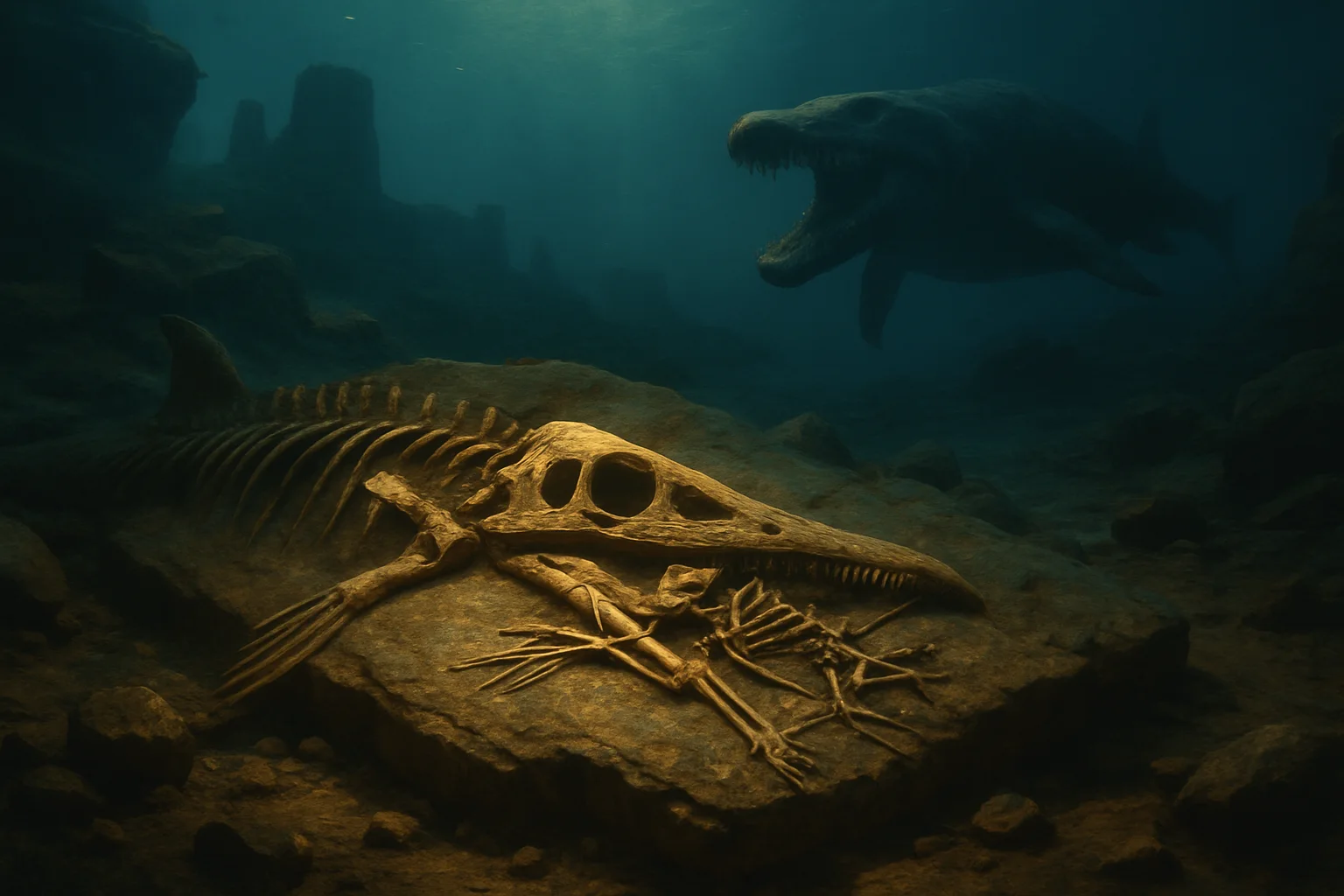
The 100-Million-Year-Old “Bag of Bones”: What Killed the Ichthyosaur That Ate a Pterosaur?
A Queensland fossil preserves a pterosaur-eating ichthyosaur that may later have been torn apart by the giant marine predator Kronosaurus.
Where was the Bag of Bones fossil found?
The fossil was discovered in 2019 by visitors searching a public fossil field near Richmond in north-western Queensland. The modern landscape is dry inland country, but during the Early Cretaceous it lay beneath the Eromanga Sea, a broad inland waterway inhabited by ichthyosaurs, plesiosaurs, giant pliosaurs, fishes, ammonites and pterosaurs flying above the surface.
The first bones appeared disarticulated and mixed, inspiring the nickname “Bag of Bones”, or B.O.B. Staff associated with the Kronosaurus Korner museum later returned to recover more of the specimen. Hundreds of hours of preparation were required to separate fragile bones from the surrounding rock while preserving their positions and the relationships between the skeleton, stomach contents and damage patterns.
How was the animal identified as an ichthyosaur?
Although much of the skeleton was broken, vertebrae, ribs, jaw fragments and paddle elements identified the animal as a large ichthyosaur. Ichthyosaurs were streamlined marine reptiles with fish-like bodies, long jaws and powerful flippers. They were not dinosaurs but belonged to a separate reptile lineage that returned fully to life in the ocean.
The B.O.B. individual is estimated to have been about six to seven metres long. That made it a substantial predator, yet it was still vulnerable in an ecosystem containing Kronosaurus, one of the largest and most powerfully built marine hunters known from Early Cretaceous Australia. The chaotic preservation suggests a carcass subjected to violent disruption rather than a complete body settling quietly on the seabed.
Why is the pterosaur jaw so important?
The most remarkable element is a pterosaur jaw found in the ichthyosaur’s abdominal region. Pterosaurs were flying reptiles that fed around coastlines and open water. They could have been captured at the surface, struck while resting, or consumed after falling into the sea. Ichthyosaurs are already known to have eaten fish and cephalopods, but direct evidence of one consuming a flying reptile is exceptionally rare.
The jaw does not prove exactly how the encounter happened. The ichthyosaur may have actively hunted the pterosaur, taken an injured animal from the surface or scavenged a floating carcass. Its position among other digestive remains nevertheless provides a much stronger feeding association than an isolated bone found in the same sediment.
What else was found in the stomach region?
Three-dimensional imaging and careful preparation revealed fish and squid-like cephalopod remains beside the pterosaur fragment. The combination records prey from several ecological niches and suggests that the ichthyosaur was not restricted to a single food source. It may have been an opportunistic predator capable of taking common marine prey and occasional animals from the air-water boundary.
Fossilised stomach contents are especially valuable because teeth and jaw mechanics usually tell scientists what an animal could eat, while preserved food remains move closer to what it actually ate. Even so, one individual’s final meals should not automatically be treated as the standard diet of an entire species. The specimen provides a direct behavioural snapshot, not a complete dietary census.
Did Kronosaurus really kill the ichthyosaur?
Large crush marks, shattered bones and extensive disruption suggest that a powerful set of jaws attacked or consumed the ichthyosaur. Kronosaurus queenslandicus is the leading candidate because it was one of the dominant predators of the Eromanga Sea. Its enormous skull, robust teeth and short, muscular neck were capable of handling prey as large as an ichthyosaur.
Scientific caution is still necessary. The damage may represent a fatal attack, but it could also reflect scavenging after the ichthyosaur had already died. Researchers must compare bite dimensions, fracture geometry and microscopic surface marks. Evidence of healing would indicate an earlier survived injury, while fresh breaks without repair may belong to the final attack or to post-mortem feeding.
What does a three-tier food-chain fossil mean?
The proposed sequence links a flying reptile eaten by a mid-level marine predator and that predator then consumed by a giant pliosaur. Air, shoreline and open-water ecosystems therefore intersect in one fossil context. It is a rare record of interactions rather than merely a list of species that lived in the same geological formation.
Food webs describe how energy moved through ancient ecosystems. A pterosaur becoming food for an ichthyosaur, which in turn became food for a larger predator, shows that ecological boundaries were porous. Modern sharks and large fishes sometimes eat seabirds; the B.O.B. specimen suggests a comparable exchange between aerial and marine communities in the Cretaceous.
What was the Eromanga Sea like?
About 100 million years ago, much of inland Australia was covered by a shallow sea. Water depth, temperature and sediment supply changed through time, creating muddy seabeds capable of rapidly burying dead animals. Those conditions produced some of Australia’s most informative marine-reptile fossils.
Richmond is now internationally known for ichthyosaurs, plesiosaurs, Kronosaurus, fishes and ammonites. Most fossils establish which animals were present. B.O.B. adds something more difficult to recover: evidence for feeding, predation and possible scavenging. It therefore helps reconstruct not only biodiversity but the functioning of the ecosystem.
How did 3D scanning help solve the fossil?
Small bones trapped inside a rock block cannot always be physically removed without destroying them. Computed tomography and related imaging methods distinguish materials by density and allow researchers to segment buried structures digitally. In B.O.B., scanning helped identify delicate elements in the abdominal region and preserve their spatial relationship to the larger skeleton.
Digital models can be measured, shared between institutions and used to test bite or breakage scenarios without repeatedly handling the original fossil. This is particularly important for stomach contents, where context matters as much as the individual bone. Once removed from its position, a tiny fragment may lose much of its behavioural meaning.
What does the specimen prove, and what remains uncertain?
The specimen strongly supports the presence of a pterosaur jaw, fish and cephalopod remains in the ichthyosaur’s digestive region. It also demonstrates severe disruption of the ichthyosaur skeleton. It does not yet prove whether the pterosaur was hunted or scavenged, which predator damaged the ichthyosaur, or whether the attack caused death.
Kronosaurus is a plausible interpretation because of its anatomy, size and presence in the same environment. Future comparisons may strengthen that identification or point to another large pliosaur. The fossil’s scientific value lies partly in allowing several hypotheses to be tested against the same exceptional evidence rather than forcing an overly certain dramatic narrative.
For another deep-time landscape, explore our feature on Çatalhöyük and Neolithic urban life, or browse all recent discoveries in the ODYOMUH archive.
Frequently asked questions
How old is the Bag of Bones fossil?
It is approximately 100 million years old and dates to the Early Cretaceous.
Did the ichthyosaur definitely eat a pterosaur?
The jaw in its digestive region is strong evidence of consumption, although active hunting and scavenging cannot yet be distinguished.
Did Kronosaurus kill the ichthyosaur?
It is a plausible explanation for the heavy damage, but researchers have not yet proved whether the interaction was predation or post-mortem scavenging.
Where is the specimen kept?
The fossil is housed and displayed at Kronosaurus Korner in Richmond, Queensland.
Sources and further reading
- The Australian, “Qld ‘bag of bones’ fossil unlocks world-first prehistoric discovery”, 27 July 2026.
- Kronosaurus Korner, Richmond marine fossil collections and Eromanga Sea educational resources.
- Australian Nuclear Science and Technology Organisation, palaeontological imaging resources.
- University of New England palaeontology commentary cited in the 2026 discovery report.
Keep exploring: Use the topic hub for closely related articles or browse the full archive instead of starting a new search.