Two 6,000-Year-Old Neolithic Tombs Found Side by Side in Galway: Why the Amethyst Pendant Matters
A court tomb and a portal tomb at Maree offer an exceptional view of burial, ritual and community among Ireland’s earliest farming populations.
Why is the Maree discovery exceptional?
Ireland contains many Neolithic monuments, but the close pairing of two distinct tomb traditions is highly unusual. The research team believes Prospecthill may be the only known Irish site where a court tomb and a portal tomb stand together. That creates a rare opportunity to ask whether different communities met at the site, whether one monument was added to an older sacred place, or whether the same population changed its ritual architecture over time.
Both structures date broadly to the Early Neolithic, nearly 6,000 years ago, when farming, livestock keeping and more permanent settlement were spreading across Ireland. This transition reshaped landscapes and social relations. Communities cleared land, built houses and invested enormous labour in monuments that tied living people to ancestors and territory.
What is the difference between a court tomb and a portal tomb?
Court tombs are elongated monuments with an open forecourt, usually defined by stones, leading toward burial chambers. The court may have served as a gathering place for ceremonies involving the dead, collective memory and community identity. The rediscovered Maree court tomb is about 30 metres long and is described as one of the largest and most southerly examples of its type.
Portal tombs are recognised by massive capstones supported by upright stones, creating the dramatic form often called a dolmen. Maree’s portal tomb had a capstone almost four metres long and one metre thick, with an estimated weight of 14 tonnes. Selecting, moving and raising such a block required planning, technical skill and coordinated labour.
How could Neolithic builders move a 14-ton stone?
The builders had no metal cranes, but they understood leverage, timber, rope, sledges and earthen ramps. Large groups could drag stone over prepared surfaces and incrementally raise it using packed soil and wooden supports. Petrographic study may identify the capstone’s geological source, allowing researchers to estimate how far it was transported.
The portal tomb was set into a substantial bedrock pit. That feature helped protect the earliest deposits from later disturbance. In archaeology, an intact foundation and primary burial layer are especially valuable because monuments were often reopened, modified and reused over many generations.
Why does the amethyst pendant matter?
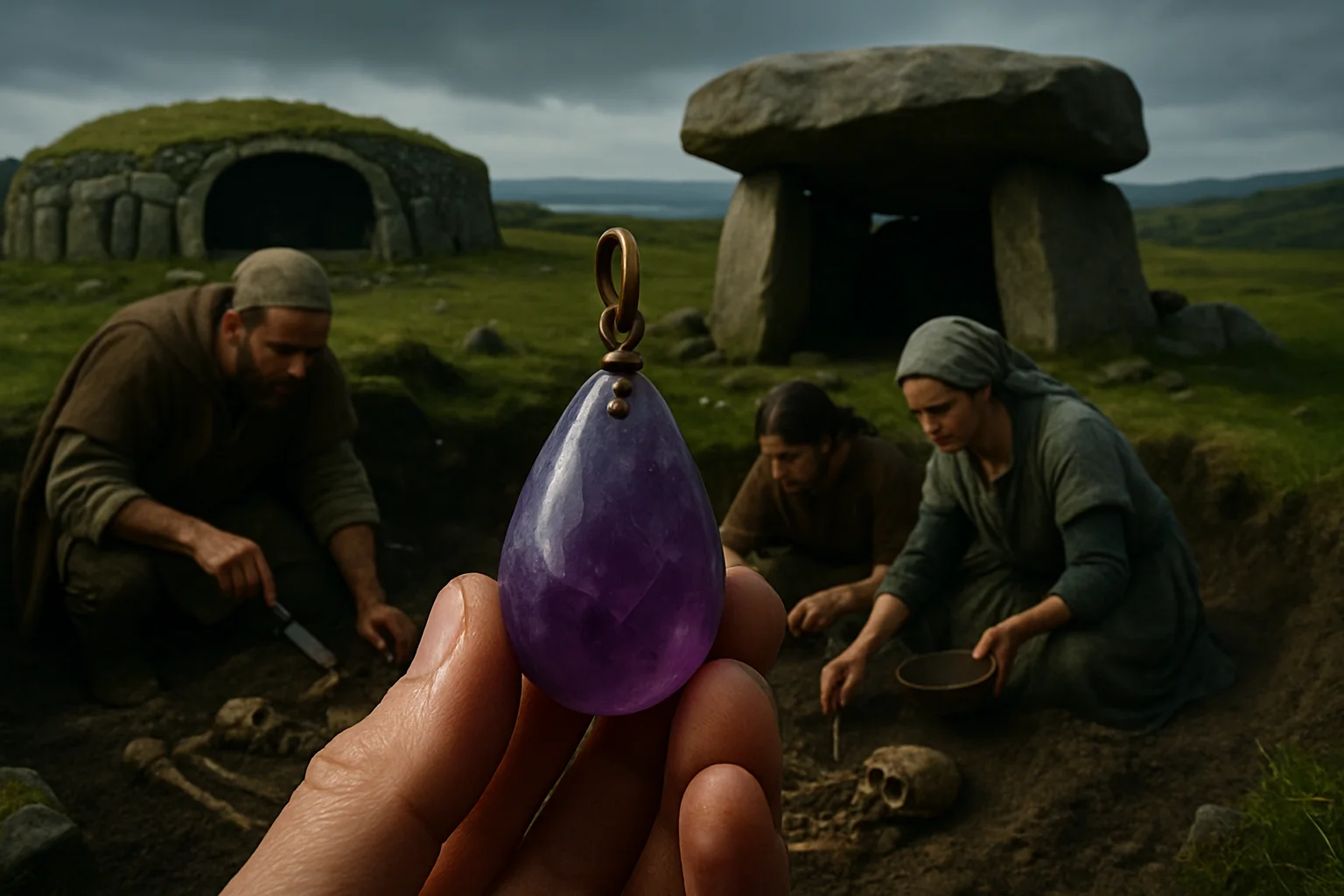
The most striking small object is a purple amethyst pendant recovered from the portal tomb. Quartz beads are known at a few Irish megalithic sites, but the excavation team reports that nothing closely comparable to this pendant is known elsewhere in Ireland. Mineralogical and trace-element analysis may determine whether the stone came from a local geological source or travelled from farther away.
A single ornament cannot by itself prove a long-distance trade network. Yet a non-local source would show that coastal farming communities participated in wider systems of movement and exchange. Atlantic travel by small boats could have carried raw materials, finished objects, people and ritual knowledge. The pendant may have marked status, personal identity, protection or an offering to the dead.
What can cremated remains reveal?
Burned human bone from the preserved portal-tomb deposits indicates that bodies were cremated and selected remains were placed in the monument. Heat often damages ancient DNA, but specialists can still study colour, cracking and deformation to estimate burning conditions. Microscopic work may show whether bones from several individuals were combined and how remains were collected after the pyre cooled.
Radiocarbon dating will be central to reconstructing the sequence. Samples from human bone, charcoal or organic residues may establish the first use of each tomb and identify later episodes. The results should reveal whether the two monuments operated at the same time or whether one deliberately referenced an older structure.
What might two tombs side by side mean?
The project leaders describe the site as a meeting of two traditions. Several explanations remain possible. Migrants with a different monument style may have joined an established community. A later generation may have built a new kind of tomb beside a respected ancestral place. Alternatively, neighbouring groups may have shared the same ceremonial landscape while maintaining distinct identities.
Construction scale also matters. A 30-metre court tomb and a portal tomb with a 14-ton capstone imply a sizeable population capable of organising work beyond a single household. That does not necessarily require a chief or central authority. Kin groups, seasonal gatherings and ritual obligations can mobilise large workforces in relatively egalitarian societies.
Who were Ireland’s first farmers?
Farming reached Ireland around the beginning of the fourth millennium BCE, bringing cattle, sheep, cereals, polished stone axes and new house forms. Genetic research links many early farmers in Britain and Ireland to population movements ultimately derived from continental European farming communities. Their encounters with local hunter-gatherers were likely complex and varied by region.
Megalithic tombs are among the most visible products of this new social world. They were not simply containers for bodies. They materialised claims to land, relationships with ancestors and the ability of a community to work together. Maree turns the broad story of agricultural expansion into a specific landscape populated by builders, mourners and individuals who owned meaningful objects.
What is the MAREE project studying?
MAREE – Land Use Through Time examines how the same coastal landscape was inhabited and understood across thousands of years. In 2025 the project confirmed Rathgurreen Ringfort as a high-status Early Medieval settlement with evidence of links extending toward Rome, Scotland, France and Scandinavia. The new tomb discoveries extend the project’s timeline deep into prehistory.
This long-duration perspective prevents a landscape from being reduced to one famous period. The same ground could serve as an ancestral ceremonial centre for Neolithic farmers, a seat of power for Early Medieval elites and a shared heritage place for communities today.
What questions remain unanswered?
Researchers still need precise radiocarbon dates, biological profiles of the cremated individuals, geological sourcing for the pendant and capstone, and a detailed construction sequence. Soil chemistry, microscopic residues and spatial analysis may reveal where ceremonies occurred and whether food, fire or other materials were used.
The most consequential question is chronological: were both tombs built and used together? If so, Maree may document direct coexistence between two architectural traditions. If one is later, the site may instead show how a new group or generation deliberately attached itself to an older ancestral monument.
Related reading
For another view of Neolithic community organisation, read Çatalhöyük and its roof-accessed settlement. To see how archaeologists infer behaviour from physical traces, continue with the Lake Turkana fossil footprints analysis.
Frequently Asked Questions
Where exactly are the Maree tombs?
They are near Prospecthill in the Maree area of County Galway, on Ireland’s western Atlantic coast.
Are both tombs the same age?
Both are assigned to the Early Neolithic, but radiocarbon dating is needed to establish their exact construction and use sequence.
Does the pendant prove long-distance trade?
Not yet. Geological sourcing must first establish where the amethyst originated.
Were human remains found?
Yes. Cremated human bone survived in protected deposits within the portal tomb.
Is excavation finished?
The major discovery has been announced, but laboratory analysis and detailed interpretation are continuing.
Sources
- University of Galway, “Archaeologists uncover rare Neolithic tombs in Galway,” 27 July 2026.
- Royal Irish Academy, research support and resources on Irish archaeology.
- The Discovery Programme, national archaeological research and landscape survey in Ireland.
Frequently asked questions
Where were the Maree Neolithic tombs found?
They were found near Prospecthill in the Maree area of County Galway on Ireland’s Atlantic coast.
How old are the tombs?
Both monuments belong to the Early Neolithic, roughly 6,000 years ago.
Why is the amethyst pendant important?
Quartz beads are known from a small number of Irish megalithic sites, but no close Irish parallel for this amethyst pendant has been identified.
Source trail
Selected references and research starting points
- [object Object]
- [object Object]
- [object Object]
The list is a research trail. Specific claims should be checked against the cited edition, object record or publication.
Keep exploring: Use the topic hub for closely related articles or browse the full archive instead of starting a new search.
