Galway’s Lost Neolithic Tombs: Why Were Two 6,000-Year-Old Monuments Built Together?
Excavations at Maree relocated a large court tomb and identified an unknown portal tomb with a 14-tonne capstone created by Ireland’s earliest farmers.
What exactly was discovered at Maree?
The excavation took place at Prospecthill in the Maree area overlooking the wider Galway Bay landscape. It forms part of MAREE – Land Use Through Time, a University of Galway research project examining how communities occupied and understood this coastal territory across thousands of years. During the 2026 season, archaeologists relocated the remains of a court tomb known from older records but long considered lost or largely destroyed. At about 30 metres in length, it ranks among the larger court tombs identified in Ireland.
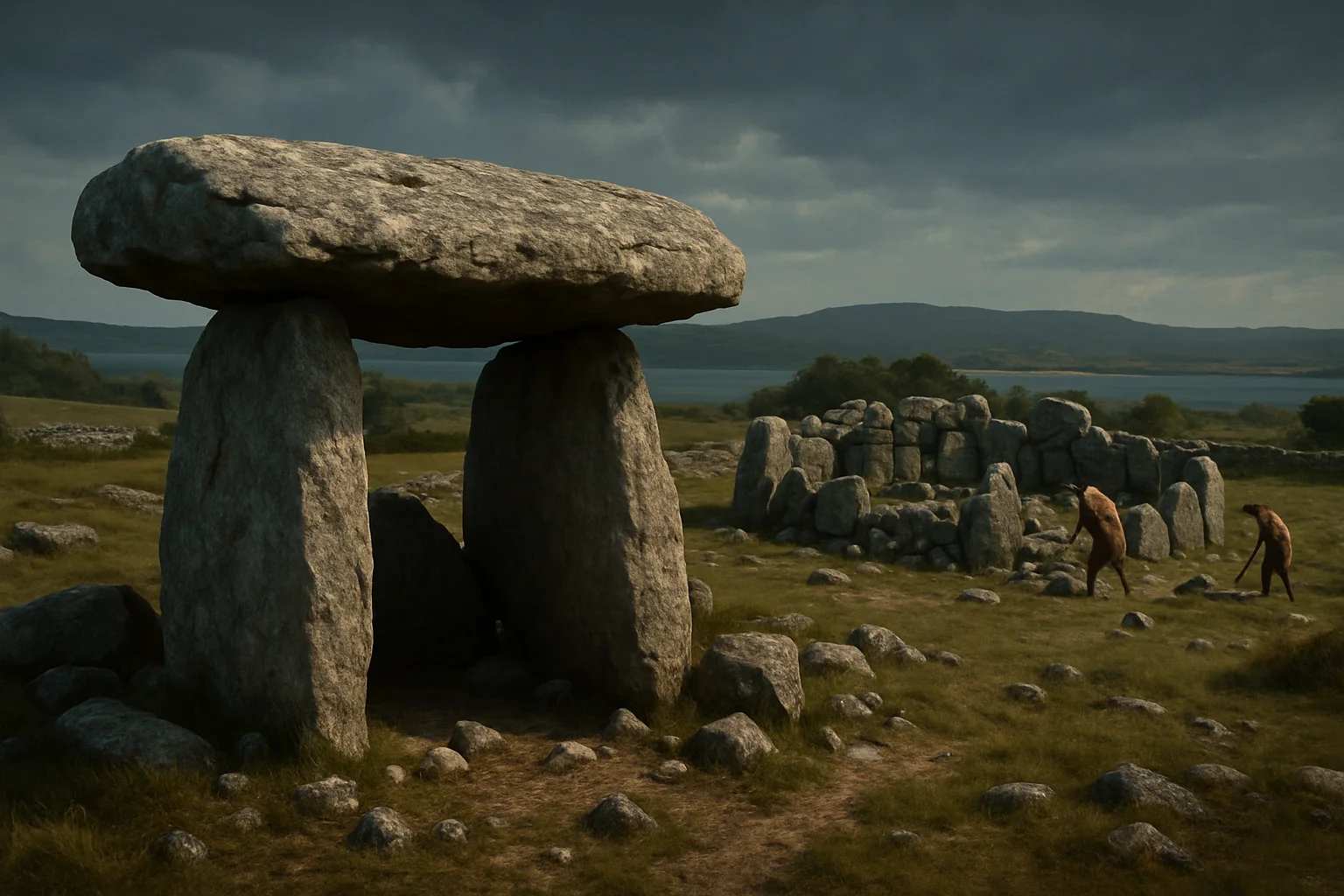
Immediately next to it, the team recognised the remains of a portal tomb that had never previously been recorded as a burial monument. Its capstone measures almost four metres long and about one metre thick, with an estimated weight of 14 tonnes. The importance of the discovery lies not simply in adding two monuments to a map. Their direct physical proximity creates a rare opportunity to investigate how different architectural and ritual traditions interacted during the Early Neolithic.
How does a court tomb differ from a portal tomb?
Court tombs normally contain one or more burial chambers within a long cairn, approached through an open forecourt. That court was not merely an entrance. It may have accommodated funerals, offerings, commemorative ceremonies and gatherings in which living communities interacted with ancestral remains. The roughly 30-metre scale of the Maree example suggests a monument intended for a community rather than a small, private household.
Portal tombs are recognised by tall entrance stones supporting a massive roof slab or capstone. They often survive today as exposed dolmens, although many were probably partly enclosed by a cairn when first built. Their chamber held selected human remains and objects. Moving and raising the Maree capstone would have required planning, ropes, timber, levers, ramps and a substantial workforce, even though the precise construction method remains unknown.
Why were two different monument traditions built together?
The University of Galway team describes the arrangement as a meeting of two traditions. Several explanations are possible. The same community may have changed its funerary architecture over time, building one type of monument before later generations adopted another. Alternatively, neighbouring kin groups with different identities may have maintained distinct architectural customs while sharing the same sacred landscape.
The close placement could also express competition, alliance or deliberate connection with an older monument. A newly arrived group might have built beside an established tomb to claim legitimacy in the landscape. Conversely, different groups may have cooperated at a regional ceremonial centre while preserving separate burial traditions. Radiocarbon dates, construction sequences and biological evidence from human remains will be necessary before one scenario can be preferred.
Why are the preserved deposits inside the portal tomb important?
Archaeologists identified a large pit cut into bedrock where the portal tomb had originally been constructed. This feature appears to have protected deposits associated with the monument’s earliest use from later cultivation and surface disturbance. Many megalithic tombs were reopened, reused, robbed of stone or damaged by natural processes over thousands of years, so a relatively secure early context is especially valuable.
The excavation produced cremated human bone, prehistoric pottery and stone tools. Together they indicate not only burial but a sequence of actions surrounding the dead. Laboratory work may establish how many individuals are represented, whether deposits accumulated in a single event or across generations, and at what stage cremation formed part of the funerary process. The spatial position of each fragment may also distinguish primary burial activity from later rearrangement.
Why is the amethyst pendant exceptional?
A small amethyst pendant was recovered from the portal tomb. Quartz beads are known from a limited number of Irish megalithic sites, but the excavation team states that no comparable amethyst pendant is known from Ireland. Its geological source has not yet been announced. Mineralogical study may determine whether the stone was collected locally or reached Maree through a wider exchange network.
The pendant cannot by itself identify the social status or identity of the buried person. Its rarity nevertheless suggests that it carried more than ordinary decorative value. It may have been a personal possession, a protective object, a marker of group identity or a ceremonial gift. Microscopic wear, drilling technique and residues could help determine whether it had been worn for a long period before burial or was created specifically for deposition.
Who built these monuments?
The tombs belong to the Early Neolithic, when farming and livestock husbandry were becoming established in western Ireland. Communities cultivated crops, kept domestic animals, cleared woodland and developed more permanent relationships with particular territories. Monumental tomb building therefore formed part of a wider transformation in economy, settlement and social identity.
Raising a 14-tonne stone demanded organised labour and practical engineering. Workers may have used timber rollers or sledges, earthen ramps, ropes and coordinated leverage. The long cairn of the court tomb required the collection and placement of large quantities of stone. These were not accidental undertakings by isolated families. They point to communities capable of planning, sharing food and labour, resolving disputes and committing resources to projects whose meaning extended beyond a single lifetime.
Were the monuments only places for storing the dead?
Neolithic tombs should not be understood simply as sealed equivalents of modern cemeteries. Many were used repeatedly and remained active places in the lives of the living. Human remains could be introduced at different times, moved within chambers, selected, cremated or combined with objects. Courts and exterior spaces allowed ceremonies to occur in front of the monument, making burial a public and continuing social process.
Ancestors may also have helped communities express rights to land. By constructing a durable monument, a group could materialise the claim that its history and identity belonged to a particular place. The Maree pair may preserve several episodes of that process. Different generations or groups could have returned to the same location, adding a new architectural statement beside an older one rather than abandoning the ancestral landscape.
Why does Maree’s coastal setting matter?
Maree occupies a coastal environment connected to Galway Bay. Shorelines, rivers, islands and views across the water may have influenced travel, resource use and the placement of monuments. Coastal communities could combine farming with fishing, shellfish collection and access to stone resources, while waterways provided routes linking settlements that were difficult to reach overland.
Future landscape analysis may show whether the capstone and long cairn were visible from particular approaches, ridges or sea routes. Monumental visibility was potentially deliberate. A tomb could act as a landmark, guiding movement and signalling that a socially important place lay ahead. The physical relationship between the two monuments may therefore have been experienced not only at close range but as part of a wider visual map of the territory.
What scientific work could answer the remaining questions?
Radiocarbon dating is essential for establishing whether the court tomb and portal tomb were contemporary or separated by generations. Cremated bone can sometimes produce reliable dates, allowing archaeologists to build a sequence of burial phases. Ancient DNA survives less easily in burnt remains, but suitable material could reveal biological relationships and broader ancestry. Isotope analysis may indicate whether individuals grew up locally and what kinds of food contributed to their diets.
Researchers can also examine pottery fabrics, stone-tool raw materials and the mineral origin of the amethyst pendant. Non-local materials would indicate exchange beyond Maree. Microscopic wear may show whether tools were used in monument construction or ordinary domestic work. Soil chemistry, pollen and plant remains can reconstruct the environment in which the tombs were built, including the extent of woodland clearance and farming around the site.
How does the discovery change the picture of Neolithic Ireland?
The main significance of Maree is not simply the recovery of two ancient structures. According to the excavation team, it may be the only known Irish location where a court tomb and portal tomb stand together. That challenges overly rigid models in which monument types are treated as isolated cultural categories. Real communities may have observed, borrowed, rejected or deliberately maintained different traditions within the same region.
The discoveries also indicate that early farming communities in western Ireland were capable of large, coordinated projects. Monument scale, the rare pendant, preserved burial deposits and long-term reuse of the landscape combine to make Maree a major research site. It offers evidence for how Neolithic people negotiated identity, religious expression, ancestry and territorial belonging at the beginning of farming life in Atlantic Ireland.
For another Neolithic discovery, read about the possible wooden prototype of Stonehenge. More recent archaeological reports are available in the ODYOMUH archive.
Frequently asked questions
How many Neolithic tombs were found at Maree?
A court tomb approximately 30 metres long was rediscovered, and a previously unidentified portal tomb was recognised directly beside it.
How large is the portal tomb capstone?
It is almost four metres long, about one metre thick and estimated to weigh approximately 14 tonnes.
Why is the amethyst pendant important?
The excavation team reports that no comparable object is known from an Irish megalithic site. Its source and use will require further analysis.
Did both tombs belong to the same community?
That remains unknown. Dating, human-remains analysis and study of construction phases may clarify their chronological and social relationship.
Sources and further reading
- University of Galway, “Archaeologists uncover rare Neolithic tombs in Galway”, 27 July 2026.
- University of Galway, MAREE – Land Use Through Time research project.
- Heritage Ireland, Creevykeel Court Tomb.
- Heritage Ireland, Poulnabrone and Kilmogue portal tomb information pages.
Keep exploring: Use the topic hub for closely related articles or browse the full archive instead of starting a new search.