What Was Göbekli Tepe Really? Beyond the “World’s First Temple” Label
Explore Göbekli Tepe’s age, T-shaped pillars, hunter-gatherer builders and the debate over calling it the world’s first temple.
Where is Göbekli Tepe and how old is it?
Göbekli Tepe stands on a limestone ridge in the Germuş mountains, around 15 kilometres northeast of modern Şanlıurfa. UNESCO dates its monumental round, oval and rectangular structures to the Pre-Pottery Neolithic, approximately 9600–8200 BCE. That makes its earliest major buildings about seven millennia older than the pyramids of Giza and more than six thousand years older than the principal stone phases of Stonehenge.
The age is crucial because monumentality was once closely associated with later agricultural societies. At Göbekli Tepe, people quarried, shaped, decorated and erected multi-ton stones at a time when food production was only beginning to transform Upper Mesopotamia. UNESCO therefore recognises the site as one of the earliest major manifestations of human-made monumental architecture.
Who built Göbekli Tepe?
We do not know the names or languages of the builders because writing did not yet exist. Archaeologists identify them through architecture, chipped-stone industries, animal bones, botanical remains and regional material traditions. The earliest monumental buildings are associated with communities that still obtained much of their food from wild plants and hunted animals.
The word “hunter-gatherer,” however, can create a misleading image of tiny groups constantly wandering across the landscape. Early Neolithic communities in Upper Mesopotamia could remain in productive territories for long periods, repeatedly occupy settlements and assemble larger groups for communal work. At the same time, plant management, longer residence and the processes that eventually produced domesticated crops and animals were intensifying across the region.
What do the T-shaped pillars represent?
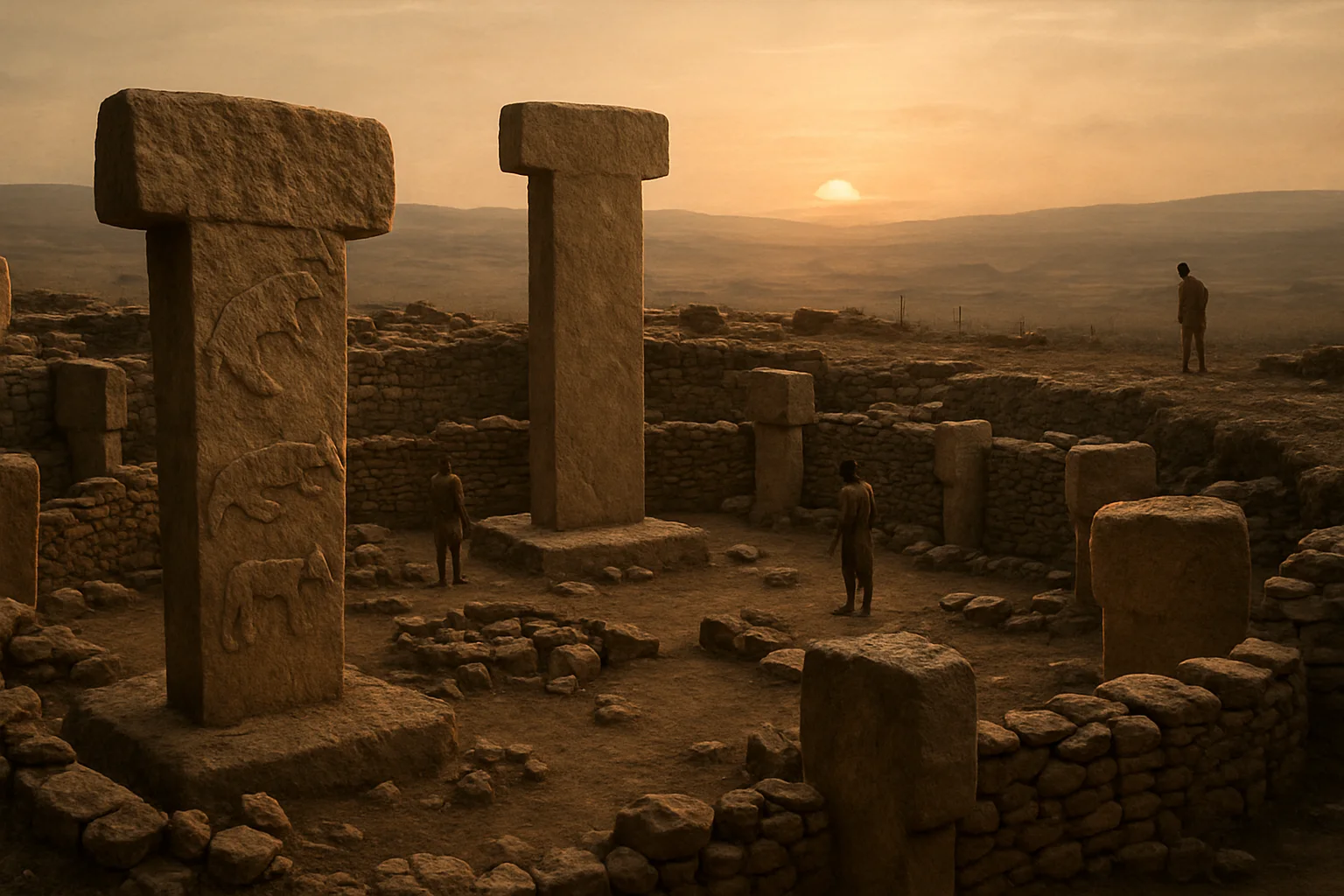
The most distinctive features of Göbekli Tepe are its T-shaped limestone pillars, some reaching about 5.5 metres in height. Several bear carved arms, hands, belts and loincloth-like garments. These details strongly support the interpretation that the T shape represents a highly stylised human body. The two tallest pillars at the centre of several monumental buildings are especially anthropomorphic.
Snakes, foxes, wild boar, birds, scorpions and other wild animals appear in relief or incision across many pillars. Their exact meanings are unknown. Researchers have proposed clan emblems, dangerous beings, mythic figures, ritual narratives and other interpretations. A 2025 study in the Cambridge Archaeological Journal approached the imagery not as a simple catalogue of species but as evidence for relationships among humans, animals, ritual performance and emerging hierarchy.
Was Göbekli Tepe really the world’s first temple?
Calling Göbekli Tepe the “world’s first temple” helped make the site famous, but the phrase is more certain than the evidence allows. “Temple” is a modern functional category. We do not know whether people twelve thousand years ago separated houses, meeting places and sacred spaces in ways comparable to later societies.
There are strong reasons to think the monumental buildings hosted special social and ritual activities: central pillars, repeated architectural forms, elaborate imagery and deliberate planning all point in that direction. Yet recent excavation has also identified smaller, less monumental structures interpreted as domestic buildings. UNESCO’s description accordingly presents Göbekli Tepe as a place containing monumental communal architecture together with evidence for ordinary settlement, rather than reducing the entire mound to a sanctuary.
How could hunter-gatherers build monuments before full farming?
One popular narrative says Göbekli Tepe proves that people “built temples first and invented farming afterward.” The actual transition was more complex. During the tenth and ninth millennia BCE, communities across Upper Mesopotamia were intensively harvesting wild cereals, manipulating useful plants, increasing settlement duration and maintaining broad social networks. Fully domesticated crops and livestock became dominant later, but the transformation toward food production was already underway.
Building a monumental enclosure also did not necessarily require hundreds of workers labouring continuously. The limestone source lay close to the site. Smaller teams, seasonal gatherings and construction spread over years could have achieved impressive results. What the architecture clearly demonstrates is the ability to organise labour, food and technical knowledge around shared projects.
Was Göbekli Tepe a city?
It was not a city in the later Mesopotamian sense. Urban settlements with streets, administrative institutions, specialised quarters and very dense permanent populations emerged thousands of years later. But the opposite picture—an empty ceremonial hill visited only occasionally—also appears increasingly inadequate.
Excavations have recovered grinding stones, chipped-stone production debris, small finds and structures associated with domestic activity. These discoveries suggest varying degrees of residence and repeated everyday use. Ritual and ordinary life may not have been sharply separated. Early Neolithic communities could have embedded ceremony within places where people also prepared food, made tools and maintained social relationships.
Why is the animal imagery so important?
Wild rather than domesticated animals dominate Göbekli Tepe’s visual repertoire. Foxes, boars, cranes, snakes and scorpions were part of the real environment, but the deliberate selection and presentation of these species suggests symbolic significance as well. Some animals are shown aggressively, with teeth or sexual characteristics strongly emphasised.
The carvings remind us that early Neolithic relationships with animals were not purely economic. Hunting, danger, death, identity, memory and cosmology may have been expressed through the same imagery. This makes Göbekli Tepe important for the history of art as well as architecture: large-scale built space and sophisticated figurative symbolism were already combined at an extraordinarily early date.
Why was Göbekli Tepe buried?
Older popular accounts often say the enclosures were deliberately buried in one mysterious act. The fills do include redeposited material placed by people, but there is no need to assume that every structure was closed at the same moment or for the same ritual reason. Buildings were constructed, repaired, altered and eventually filled over centuries.
The stratigraphy therefore represents long architectural biographies rather than a single dramatic abandonment. Some filling episodes may have been deliberate closures, while others could relate to rebuilding, levelling and changing uses of the mound. “Deliberately buried” is useful only if it does not erase this much longer process.
How does Göbekli Tepe relate to Karahantepe and Taş Tepeler?
Göbekli Tepe is no longer best understood as an isolated anomaly. Around Şanlıurfa, sites such as Karahantepe preserve related early Neolithic architecture, special-purpose buildings and versions of the T-shaped pillar tradition. The broader Taş Tepeler research framework is revealing a network of communities across the region.
This regional context makes Göbekli Tepe more, not less, significant. Its monumentality was not a miracle appearing without precedent or connection. It belonged to communities that shared technologies, images and social practices across Upper Mesopotamia. Archaeology increasingly explains major discoveries through networks and landscapes rather than isolated “lost civilisations,” much as our recent Çeşme and Thera tsunami investigation placed one disaster layer within the wider Bronze Age Aegean.
Did Göbekli Tepe overturn the Neolithic Revolution?
Before Göbekli Tepe became widely known, simplified versions of the Neolithic model often proposed a neat sequence: agriculture created surplus; surplus allowed permanent villages; permanent villages enabled specialists, organised religion and monuments. Göbekli Tepe demonstrated that the sequence cannot be treated as a universal ladder. Large communal projects, specialised carving and elaborate symbolic systems could flourish before farming economies were fully established.
That does not prove the equally simple claim that “religion invented agriculture.” Environmental change, population, feasting, competition, ritual, food production and increasing sedentism probably influenced one another. Monument construction may have strengthened group identities and encouraged gatherings that required dependable food supplies; changing subsistence strategies may in turn have made larger communities easier to sustain.
What do the geometry and planning tell us?
Architectural analyses have argued that some major enclosures were laid out according to coherent geometric relationships rather than assembled randomly. This does not imply modern mathematics or lost technology. It shows that builders could transfer spatial concepts into stone using practical measurement, sight lines, cords and accumulated craft knowledge.
The achievement is significant precisely because it does not require an anachronistic explanation. Early Neolithic builders had generations of experience constructing houses and communal spaces. Monumental projects could formalise those traditions into more ambitious plans, while quarrying and sculpting generated specialist skills within the community.
What Göbekli Tepe does—and does not—prove
Göbekli Tepe proves that very early Holocene communities could organise substantial labour, create monumental architecture and sustain complex symbolic traditions. It does not prove the existence of a vanished technologically advanced civilisation, writing, metal tools or astronomical knowledge beyond what the archaeological evidence can demonstrate.
Claims about hidden codes, catastrophic lost cultures and sophisticated machines often become popular because the genuine archaeology is already surprising. But adding unsupported mysteries makes the site less remarkable, not more. The evidence itself shows communities with stone technology, deep environmental knowledge and powerful social institutions achieving something once thought impossible for their period.
Conclusion
Göbekli Tepe opens a window onto communities living roughly 11,000–11,500 years ago, long before writing, metalworking and cities. Describing it only as the “world’s first temple” narrows its real scientific importance. Its monumental architecture, human-like pillars, animal imagery and evidence for ordinary occupation show that hunter-gatherers and early settled communities were active agents in the Neolithic transformation. They were not waiting for agriculture to make complex society possible; social life, ritual, technology and changing subsistence were developing together.
Frequently asked questions
How old is Göbekli Tepe?
Its earliest monumental structures date to around 9600 BCE, roughly 11,500 years ago.
Who built Göbekli Tepe?
Pre-Pottery Neolithic hunter-gatherer and early settled communities whose written names are unknown.
Is Göbekli Tepe really the first temple?
It is among the earliest known monumental ritual and communal complexes, but both “temple” and “first” should be used cautiously because building functions and comparable undiscovered sites remain open questions.
Are the T-shaped pillars people?
Many archaeologists interpret them as stylised human figures because several display carved arms, hands, belts and garments.
Why is Göbekli Tepe important?
It demonstrates that monumental construction and complex symbolic organisation could emerge before or during, rather than only after, the development of fully agricultural economies.
Sources and further reading
Frequently asked questions
How old is Göbekli Tepe?
Its earliest monumental structures date to about 9600 BCE, roughly 11,500 years ago.
Who built Göbekli Tepe?
Pre-Pottery Neolithic hunter-gatherer and early settled communities whose written names are unknown.
Is Göbekli Tepe the world’s first temple?
It is among the earliest monumental ritual and communal complexes, but “temple” and “first” are interpretive labels and should be used cautiously.
What do the T-shaped pillars represent?
Carved arms, hands, belts and garments lead many archaeologists to interpret them as stylised human beings.
Why does Göbekli Tepe matter?
It shows that monumental architecture and complex symbolic organisation developed before or alongside fully agricultural economies.
Source trail
Selected references and research starting points
- UNESCO World Heritage Centre — Göbekli Tepe
- Verhoeven 2025, Cambridge Archaeological Journal
- Haklay & Gopher 2020, Cambridge Archaeological Journal
- UNESCO World Heritage Committee Decision 42 COM 8B.34
The list is a research trail. Specific claims should be checked against the cited edition, object record or publication.
Keep exploring: Use the topic hub for closely related articles or browse the full archive instead of starting a new search.