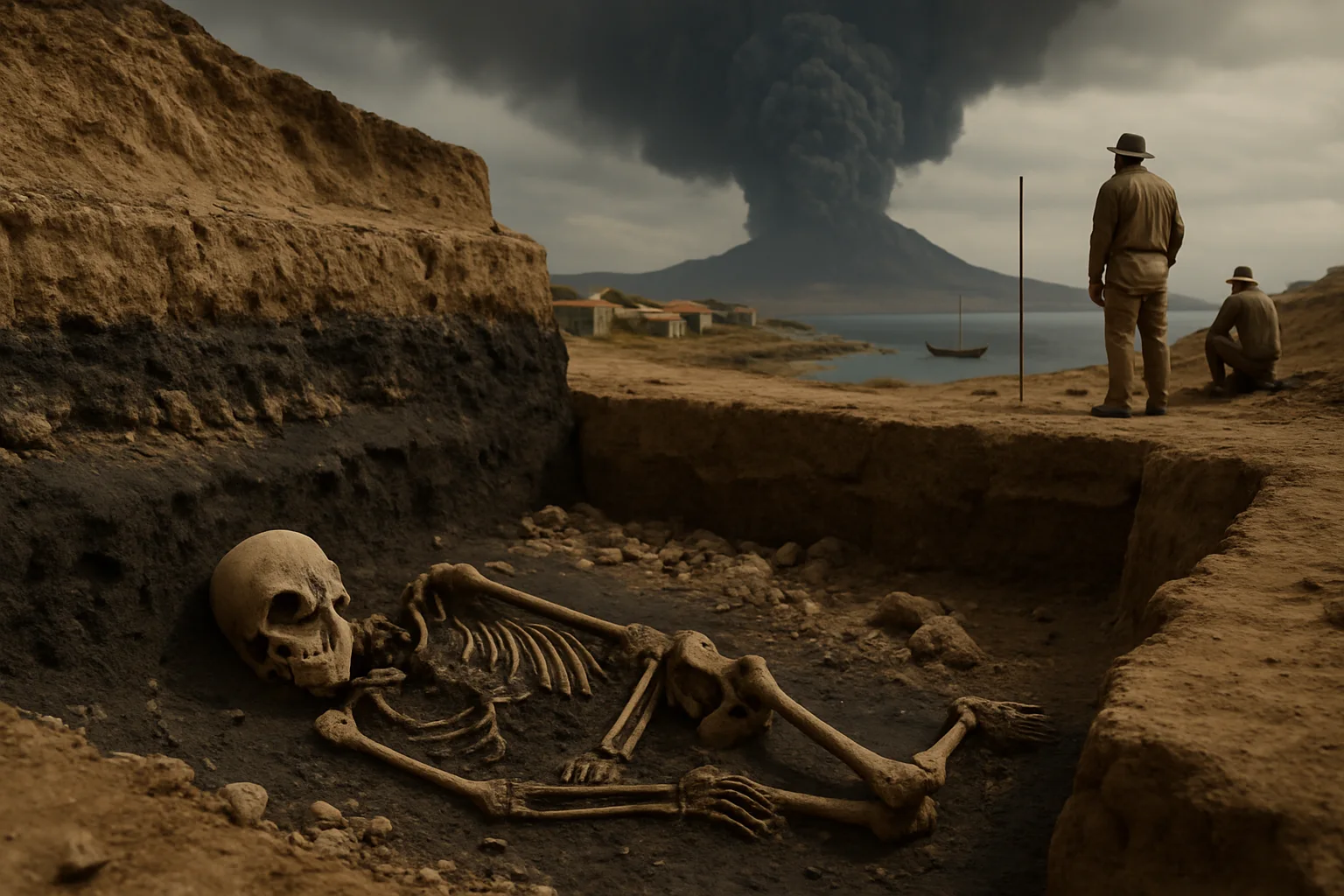
Could the Çeşme Tsunami Victim Redate the Thera Eruption?
New radiocarbon results from a young person found in tsunami debris at Çeşme-Bağlararası have reopened the long-running debate over the date of the Bronze Age Thera eruption.
What was found at Çeşme-Bağlararası?
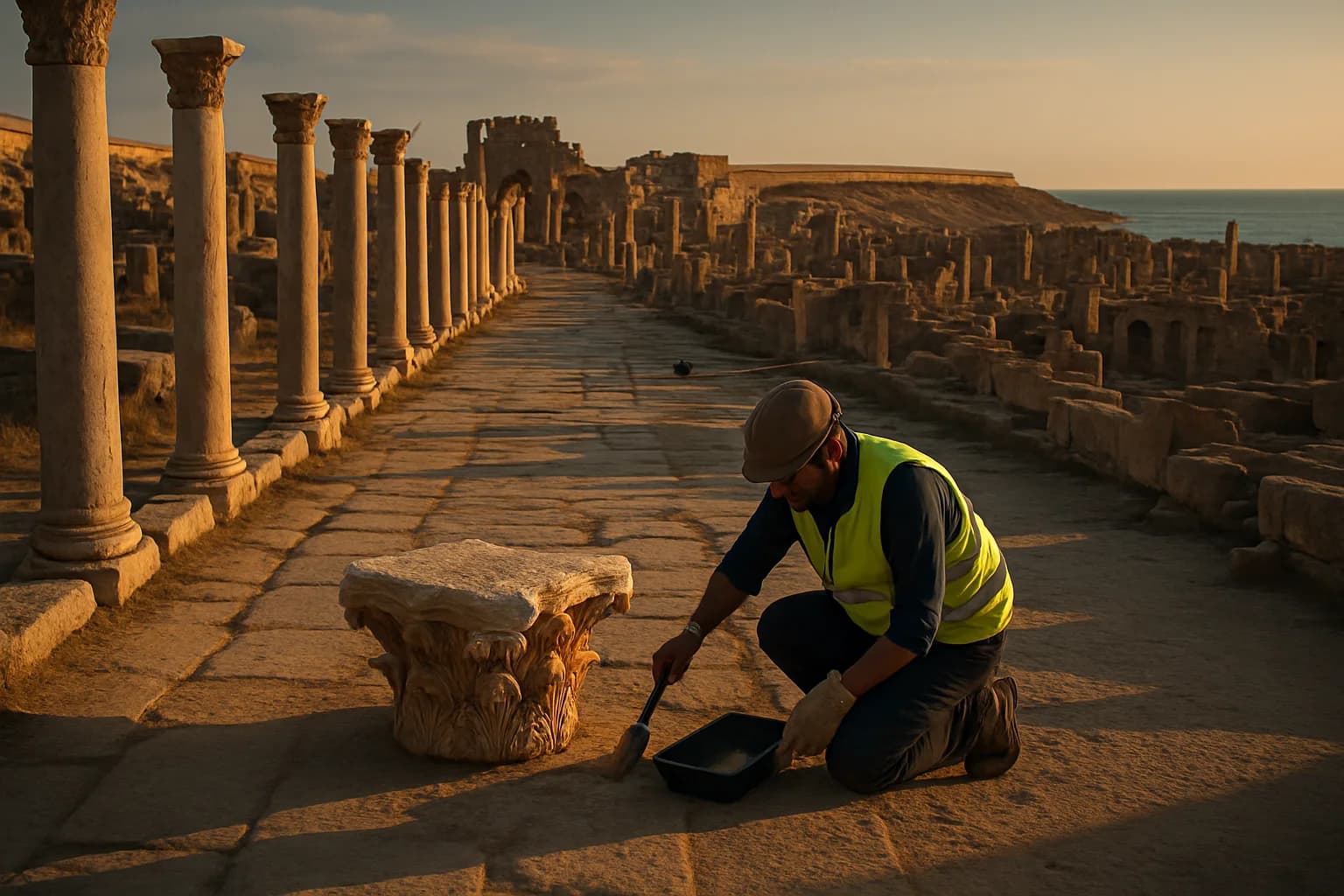
Çeşme-Bağlararası is a Bronze Age settlement on the western coast of Anatolia, in a region deeply connected to the islands and maritime networks of the Aegean. Excavated ceramics and architecture show that the community participated in exchanges linking western Anatolia with the Cyclades and Minoan Crete. What makes the site exceptional, however, is the sequence of volcanic ash and tsunami deposits preserved within its occupation layers.
In a major study published in the Proceedings of the National Academy of Sciences, Vasıf Şahoğlu and an international team reported volcanic ash, tsunami debris, the articulated skeleton of a young person and the remains of a dog in deposits associated with the Late Bronze Age Thera eruption. Sedimentological evidence suggested several inundation phases rather than a single simple wave. The discovery provided some of the clearest archaeological evidence that the Santorini eruption affected communities far beyond the immediate volcanic island.
What is new in August 2026?
According to The Times on 7 August 2026, researchers have obtained new radiocarbon information from the human remains in the tsunami layer. The individual is described as being about fifteen or sixteen years old. The reported result places the death near 1500 BCE and indicates that it may be no earlier than the closing decades of the sixteenth century BCE.
That matters because the absolute date of the Thera eruption remains one of the most persistent chronological problems in Mediterranean archaeology. Many radiocarbon and tree-ring models favour a date in the later seventeenth or early sixteenth century BCE, while archaeological synchronisms have at times supported lower chronologies. A person who died during the tsunami could, in principle, provide a much more direct time marker than redeposited charcoal or other organic material.
Why can a human skeleton be more informative than charcoal?
Radiocarbon dating is only as useful as its archaeological context. Wood can carry an “old wood” problem: a beam may come from a tree that had already lived for centuries before it was cut, and it may have been reused before burning. Seeds can be redeposited. Tsunamis are especially capable of eroding older deposits and mixing them into younger destruction layers.
Human bone is tied much more closely to the moment of death. If stratigraphy, trauma and sedimentology all demonstrate that an individual died during a particular tsunami, then the radiocarbon age of the skeleton should be closely related to the disaster. Yet bone is not automatically perfect. Marine reservoir effects can distort dates when an individual consumed substantial marine food, contamination must be ruled out, and calibration choices affect the final probability distribution. Stable-isotope analysis of diet therefore becomes essential in a coastal population such as Çeşme.
Why is the Thera eruption so important to chronology?
The Late Bronze Age eruption that reshaped Santorini was one of the largest volcanic events experienced by prehistoric Mediterranean societies. Akrotiri was buried beneath volcanic material, tephra spread over parts of the Aegean and tsunami deposits have been identified at several coastal locations. Dating the eruption is important not only to volcanology but also to the chronological relationship between Minoan Crete, the emerging Mycenaean world, Egypt’s New Kingdom and eastern Mediterranean trade.
A shift of several decades can alter how imported pottery, royal reigns, destruction horizons and cultural transitions are synchronized between regions. The argument is therefore not merely about naming the year of an eruption. It is about the framework used to arrange much of the second millennium BCE eastern Mediterranean.
Would a later eruption date explain the decline of Minoan Crete?
This is where caution is particularly necessary. Minoan civilization did not disappear in a single moment. Several Cretan palace centres were destroyed or transformed around the middle of the fifteenth century BCE, and Mycenaean influence subsequently became much more visible. The Thera eruption could have damaged ports, fleets, agricultural systems and regional commerce, creating prolonged economic stress. That possibility has been discussed for decades.
If the Çeşme victim genuinely moves the eruption closer to the fifteenth-century political changes on Crete, the chronological gap between disaster and transformation would become smaller. That would make a causal connection more plausible to investigate, but it would still not prove that the volcano “destroyed the Minoans.” Archaeological collapses are usually multi-causal and can involve earthquakes, warfare, political competition, climate pressure, migration and changes in trade as well as natural hazards.
Why are human victims so rare at Akrotiri?
Akrotiri on Santorini is often called the “Pompeii of the Aegean” because multi-storey buildings, streets, wall paintings and objects were preserved beneath volcanic deposits. Unlike Pompeii, however, excavations have not produced large numbers of bodies. One possibility is that earthquakes or early eruptive phases gave residents enough warning to leave before the most destructive stage of the eruption.
The Çeşme-Bağlararası victim is therefore particularly valuable. A human death found hundreds of kilometres from the volcano, in a sedimentary context associated with the resulting tsunami, turns a geological event into a directly documented human disaster. The earlier PNAS research had already demonstrated the exceptional archaeological context; the new dating potentially adds a much sharper chronological dimension.
Does the reported date contradict the established radiocarbon chronology?
At first glance it creates tension with models that place the eruption around 1620–1600 BCE. But radiocarbon dating does not normally produce a single exact calendar year. Measurements are calibrated against curves that generate ranges and probability distributions. Different samples can overlap in complex ways, especially around plateaus in the calibration curve.
The original Çeşme work itself produced broad date ranges from material in the tsunami sequence. Some samples could have been reworked by the energetic event. A newly dated skeleton may reduce that problem, but the final interpretation will depend on the laboratory measurement, diet correction, calibration model and statistical treatment. Until the peer-reviewed paper is available, “Thera erupted in 1500 BCE” would go much further than the present evidence allows.
What evidence should researchers test next?
The strongest chronological model would combine several independent lines of evidence. Tephra chemistry should securely match the Çeşme ash to the Thera eruption. Sedimentology should establish the order and energy of tsunami waves. Multiple short-lived organic samples from sealed contexts should be dated independently. Human stable isotopes should quantify any marine component in the diet. Pottery sequences should also be compatible with the same chronological window.
Researchers can then use Bayesian modelling to integrate stratigraphy and radiocarbon probabilities rather than treating each date in isolation. This multidisciplinary approach resembles the logic used to reconstruct other complex ancient technologies and events, such as the Antikythera Mechanism: no single observation is sufficient when several independent kinds of evidence can test one another.
What can we say with confidence today?
We can confidently say that Çeşme-Bağlararası preserves Late Bronze Age volcanic ash and tsunami deposits linked by the research team to the Thera event, and that a human skeleton was recovered in this disaster sequence. Those facts are already significant and were established in peer-reviewed research.
The new 2026 radiocarbon claim should be described more carefully. It is a potentially important result that may favour a later chronology than some widely accepted models, but it remains part of a study reported as being under peer review. Its methods, confidence intervals, dietary corrections and relationship with other dates must be evaluated before the broader Aegean chronology can be rewritten.
Why Çeşme could become a key chronological site
Many famous debates over the Thera eruption rely on samples from Santorini itself or on indirect synchronisms elsewhere in the Mediterranean. Çeşme offers something different: a mainland coastal settlement with occupation layers, imported cultural material, volcanic ash, tsunami sediment and a human victim in one archaeological sequence.
That combination can link geological time, human biography and material-culture chronology in an unusually direct way. If the new date survives peer review and independent testing, Çeşme-Bağlararası may become one of the most important anchor sites for the entire Late Bronze Age Aegean chronology.
Conclusion
The young tsunami victim from Çeşme-Bağlararası does not yet “solve” the date of the Thera eruption. The new radiocarbon result instead provides something scientifically more valuable: a strong test of existing models. A human death, tsunami sediment, volcanic ash and a Bronze Age settlement are preserved in the same archaeological story. Once the full peer-reviewed analysis is available, researchers will be able to judge whether this individual genuinely requires the eruption to be placed later than the dominant high chronologies. If it does, the consequences will reach far beyond Santorini, affecting how archaeologists synchronize much of the second-millennium BCE eastern Mediterranean.
Frequently asked questions
Who was the Çeşme-Bağlararası tsunami victim?
The new report describes an individual about fifteen or sixteen years old whose remains were recovered from debris associated with the Thera-related tsunami sequence.
Has the Thera eruption now been definitively dated to 1500 BCE?
No. The reported bone date raises the possibility of a later chronology, but the study is still described as under peer review and must be tested against other radiocarbon, archaeological and geological evidence.
Did the Thera eruption destroy Minoan civilization?
It may have caused major regional disruption, but there is no consensus that a single volcanic event directly caused the later political transformation of Minoan Crete.
Why is Çeşme-Bağlararası so important?
It combines volcanic ash, tsunami deposits, Bronze Age occupation evidence and a directly associated human victim in one stratigraphic sequence, offering an unusually powerful opportunity to connect geology with human chronology.
Sources and further reading
- The Times, 7 August 2026 — new dating of the Çeşme-Bağlararası tsunami victim
- Şahoğlu et al., PNAS — Volcanic ash, victims, and tsunami debris from the Late Bronze Age Thera eruption
- Ankara Friends of ARIT / Ankara University — Çeşme-Bağlararası and the Thera eruption
- Scientific Reports, 2023 — Therasia olive evidence and Thera eruption dating
Frequently asked questions
Who was the Çeşme-Bağlararası tsunami victim?
The new report describes an individual about fifteen or sixteen years old whose remains were recovered in debris associated with the Thera-related tsunami sequence.
Is the Thera eruption now definitively dated to 1500 BCE?
No. The new result may favour a later chronology, but the study remains under peer review and requires comparison with other independent evidence.
Did the eruption destroy Minoan civilization?
It may have caused severe disruption, but the later transformation of Minoan Crete cannot currently be attributed to the eruption alone.
Why is Çeşme-Bağlararası important?
It preserves volcanic ash, tsunami sediment, human remains and Bronze Age occupation evidence within one archaeological sequence.
Source trail
Selected references and research starting points
- The Times, 7 August 2026
- Şahoğlu et al., PNAS 119, 2022
- Ankara Friends of ARIT / Ankara University
- Scientific Reports, 2023
The list is a research trail. Specific claims should be checked against the cited edition, object record or publication.
Keep exploring: Use the topic hub for closely related articles or browse the full archive instead of starting a new search.