Roman Shipwreck with Hundreds of Amphorae Found off Sicily: What Does the Cargo Reveal?
A Republican-era Roman wreck off Mazara del Vallo carries hundreds of amphorae whose mixed origins may illuminate Mediterranean trade between Italy, the Adriatic and North Africa.
What was found off Mazara del Vallo?
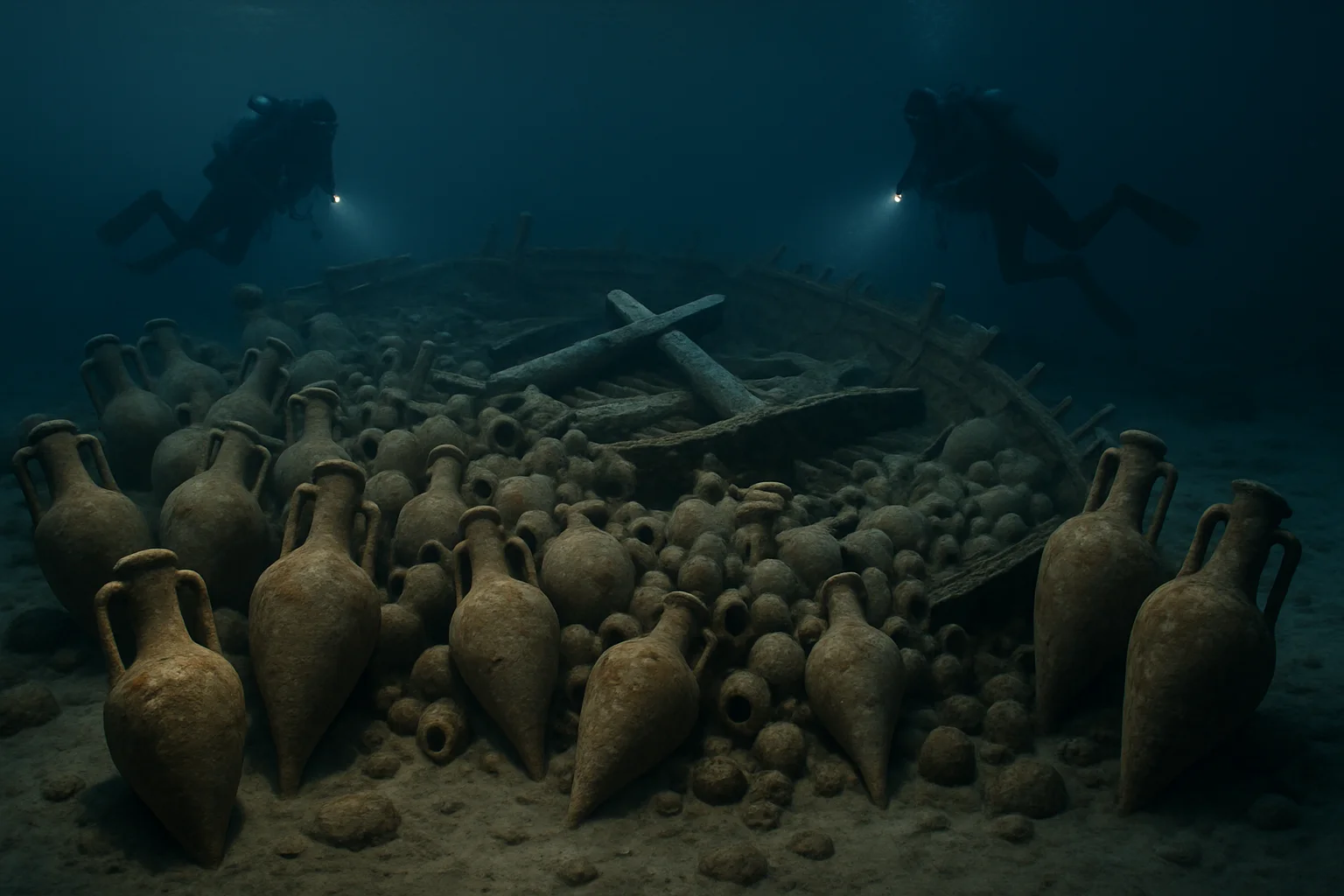
Reports published on 10 August 2026 place the wreck roughly 4.8 kilometres from Mazara del Vallo, at a depth of about 46 metres. The visible cargo zone measures approximately 21 metres long, 6 metres wide and 2 metres high. Hundreds of transport amphorae cover the site, together with two large lead anchor stocks and a lead pipe, or fistula.
To a casual observer the wreck may look like a heap of jars. To an underwater archaeologist, however, the distribution of those containers is a record of commercial behaviour. Amphora shape, fabric, stamps and residue can reveal production zones, contents, loading practices and sometimes the sequence of ports visited by a vessel.
Why is the wreck dated to the Roman Republic?
The preliminary date falls between the second and first centuries BCE, a period when Roman political power and Italian commercial production were expanding rapidly across the western Mediterranean. Wine, olive oil, fish products and other commodities circulated in quantities that left a substantial archaeological signature in ports, settlements and shipwrecks.
Amphora typology is one of the principal dating tools. Dressel 1 vessels in particular are strongly associated with late Republican Italian wine exports. The Italian Ministry of Culture’s national catalogue also records Lamboglia-type commercial wine amphorae from Mazara del Vallo dating to the first century BCE. The shipwreck’s final chronology will depend on detailed ceramic study, stamps, organic residues and any preserved timber.
What did Dressel 1A amphorae usually carry?
Dressel 1A is among the best-known transport containers of the late Roman Republic. It is commonly linked to wine produced in central and western Italy. Its tall body, pronounced shoulders and pointed base were suitable for dense packing aboard merchant ships, where amphorae could be stabilised in racks or nested in layers.
Typology does not prove the contents of an individual vessel. Amphorae could be reused, and archaeologists increasingly rely on resin traces, absorbed lipids, pollen, tartaric acid and other residues to test historical assumptions. Even so, the geographical distribution of Dressel 1 amphorae makes them a key proxy for the scale of Italian wine commerce.
Why does Lamboglia 2 suggest another commercial connection?
Lamboglia 2 amphorae are commonly associated with the Adriatic basin and eastern Italian production. Their presence alongside Dressel 1A containers would therefore suggest a cargo assembled from more than one production zone. The ship may have loaded at multiple ports, departed from a redistribution centre, or carried goods gathered by merchants working through a network of intermediaries.
Roman trade should not be imagined as a simple one-way system in which Rome exported goods directly to provincial consumers. Coastal shipping, regional merchants, secondary ports and transshipment centres were essential. Sicily occupied a strategic position between the Italian peninsula, North Africa, Sardinia, Iberia and the eastern Mediterranean.
Why are Neo-Punic amphorae especially interesting?
Neo-Punic amphora forms preserve North African ceramic and commercial traditions after Roman conquest. The destruction of Carthage in 146 BCE did not erase Punic economic practices overnight. Instead, many production regions, workshops and maritime links continued under new political conditions and were gradually incorporated into the Roman imperial economy.
If the reported Neo-Punic vessels genuinely belong to the same primary cargo, their association with Italian and Adriatic amphorae would be especially valuable. It would show different ceramic traditions operating simultaneously within a connected Republican market rather than as isolated regional systems.
What can the lead anchor stocks tell us?
Two large lead anchor stocks have also been reported. Ancient anchors could combine wood, stone and metal. A heavy lead stock helped orient an anchor correctly on the seabed so that its arms could grip. Such components can provide clues about the vessel’s equipment and operating scale.
They cannot, by themselves, provide a precise tonnage. Archaeologists need hull dimensions, keel structure, planking and construction joints to estimate carrying capacity reliably. If substantial timber survives beneath the amphora mound, the wreck may eventually reveal not only what the ship carried but also which shipbuilding tradition produced it.
Why is the lead pipe significant?
A lead pipe has been listed among the finds. Romans used lead fistulae extensively in water systems, but its function here remains uncertain. It could have belonged to the ship, formed part of the cargo, or entered the site through a later depositional event.
Context will decide. Its exact position relative to the amphorae, any stamps on the metal and compositional analysis could clarify whether it was part of the wreck’s primary assemblage. This is a useful reminder that underwater archaeology depends on spatial relationships, not simply on collecting individual objects.
Why was Sicily central to Mediterranean shipping?
Sicily lies at one of the Mediterranean’s natural crossroads. The Strait of Messina controls traffic between the Tyrrhenian and Ionian seas, while western Sicily faces the routes linking Italy with North Africa and the western basin. Mazara del Vallo sits within a coastal landscape historically connected to Punic and Roman centres such as Lilybaeum.
After Roman expansion, Sicily became strategically important not only in military terms but also as a major agricultural zone. Shipwrecks illuminate the daily mechanics of that economy more directly than literary sources: which containers moved together, how ships were loaded, where products were made and how mixed commercial cargoes circulated.
How is this wreck different from Antikythera?
Our earlier ODYOMUH investigation of the Antikythera shipwreck focused on an exceptional technological object and luxury cargo. Mazara del Vallo may prove important for almost the opposite reason. Hundreds of ordinary transport jars can expose the scale and organisation of routine trade.
Archaeology does not depend only on unique masterpieces. Repetitive objects often produce stronger economic evidence because they can be classified statistically. A large amphora assemblage can reveal proportions of production zones, probable commodity mixes and patterns of commercial integration that no single prestige artefact could provide.
What happens next at the site?
The priority will be documentation and protection. Underwater teams can build a photogrammetric 3D model, map the amphora distribution and identify vulnerable areas before deciding what should be raised. Excavating every object immediately is rarely desirable. Artefacts that have remained in seawater for two millennia require desalination and controlled conservation once brought to the surface.
Ceramic petrography and chemical analysis can locate manufacturing centres. Residue analysis may identify wine, oil, fish products or other contents. Stamps and graffiti can reveal names or commercial marks. If wood survives, radiocarbon dating, dendrochronology and construction analysis could refine the chronology and origin of the ship itself.
What could the cargo tell us about the late Republican economy?
The most interesting possibility is that the wreck represents an integrated rather than a single-origin cargo. Different amphora traditions aboard one ship could document a commercial system in which commodities moved through intermediate hubs and were combined before onward shipment. Such a model fits a Mediterranean economy built from regional producers, brokers, ports and coastal redistribution.
That matters historically because the late Republic was a period of enormous political disruption: conquest, civil conflict, slavery and land concentration transformed production. Maritime archaeology provides the material counterpart to those written histories. A merchant wreck shows how economic integration worked at the level of containers, routes and cargo handling rather than senators and armies.
Why preservation matters more than treasure hunting
The visual impact of hundreds of amphorae can encourage “treasure ship” language, but archaeological value depends on preserving context. Removing jars without recording their positions would destroy evidence about loading sequence and cargo organisation. Even apparently identical amphorae may contain different residues, stamps or fabrics.
The best outcome is therefore not the fastest recovery but a controlled research programme. Sicily’s underwater heritage has already demonstrated how wrecks can reshape interpretations of Republican commerce. The regional authorities’ recent work on the Capo Mulini wreck, for example, used archaeometric analysis to reconsider the origins of cargo amphorae and trading routes around the Strait of Messina.
Conclusion
The Mazara del Vallo wreck offers a potentially exceptional view of Mediterranean commerce around two millennia ago. If the preliminary identification of Dressel 1A, Lamboglia 2 and Neo-Punic amphorae is confirmed, the ship will provide material evidence for commercial links joining Italy, the Adriatic, Sicily and North Africa during the Roman Republic. Its value lies not in imagined treasure but in the integrity of the cargo: hundreds of ordinary containers that may preserve an entire trading network on the seabed.
Frequently asked questions
How old is the Mazara del Vallo Roman shipwreck?
Preliminary assessments date it to the second or first century BCE, making it roughly 2,100–2,200 years old.
What was found on the wreck?
Reports describe hundreds of amphorae, two large lead anchor stocks and a lead pipe.
What did the amphorae contain?
Several reported types are strongly associated with wine trade, but residue analysis is required before the contents of individual vessels can be confirmed.
Why is the wreck important?
The mixture of amphora traditions may reveal how several Mediterranean production regions were connected within a single late Republican trading network.
Sources and further reading
Frequently asked questions
How old is the Mazara del Vallo Roman shipwreck?
Preliminary assessments date it to the second or first century BCE, roughly 2,100–2,200 years ago.
What was found on the wreck?
Hundreds of amphorae, two large lead anchor stocks and a lead pipe have been reported.
What did the amphorae contain?
Several types are associated with wine trade, but laboratory residue analysis is needed to confirm individual contents.
Why is the wreck important?
Its mixed amphora assemblage may document connections among Italian, Adriatic and North African production zones within late Republican trade.
Source trail
Selected references and research starting points
- 10 August 2026 Mazara del Vallo shipwreck report
- Italian Ministry of Culture National Archaeological Catalogue
- Regione Siciliana underwater archaeology research
The list is a research trail. Specific claims should be checked against the cited edition, object record or publication.
Keep exploring: Use the topic hub for closely related articles or browse the full archive instead of starting a new search.