1.4-Million-Year-Old Footprints: Did Paranthropus boisei Travel in Groups?
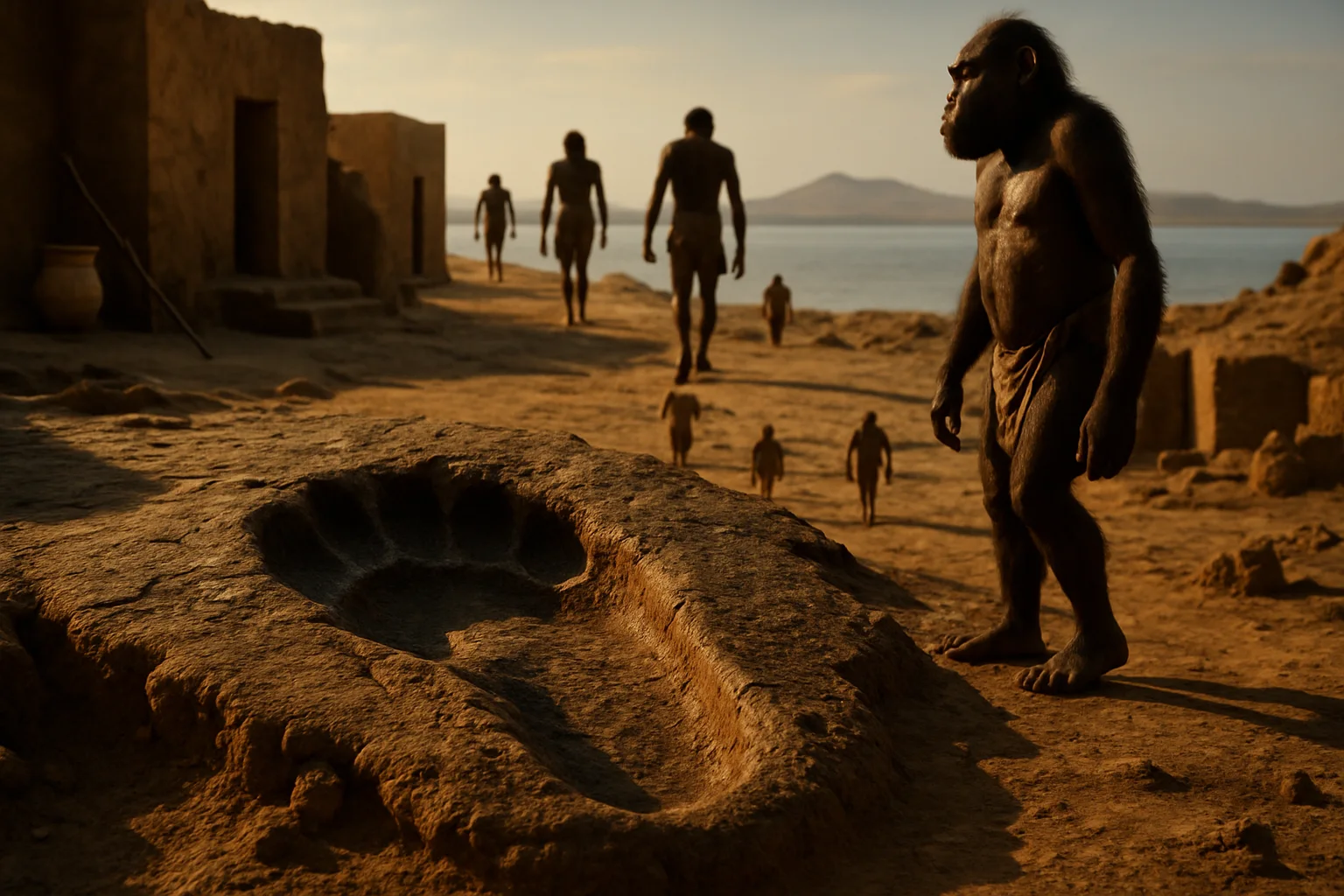
Fossil footprints from northern Kenya record eight adult Paranthropus boisei individuals moving along the same lakeshore and suggest the species could grow much larger than expected.
Where and when were the footprints discovered?
The tracks come from East Turkana in northern Kenya, within the internationally important Koobi Fora paleoanthropological landscape. Repeated changes in lake level, rapid sediment deposition and layers of volcanic ash created unusually precise records of ancient environments. Fossil skulls, jaws, limb bones, stone tools and footprint surfaces from multiple hominin species occur across the same basin.
Smithsonian geologist Kay Behrensmeyer and Kenyan colleagues first recognized the footprint surface in 1978 after noticing a deep hippopotamus track in an excavation trench. The full scientific potential of the site became clear only after renewed excavation and modern three-dimensional documentation. The 2026 study combines historical field records with photogrammetry, experimental walking data and comparative anatomy.
Why are the tracks attributed to Paranthropus boisei?
A footprint does not carry a species label, so attribution depends on anatomy and movement. Researchers examine the orientation of the big toe, the shape of the arch, heel depth, pressure beneath the forefoot and the path the foot followed as it pushed away from the ground. These traits can then be compared with other trackways from the region that have been associated with Homo erectus and Paranthropus boisei.
Analytical methods developed by the team in 2024 showed that the two track types could be distinguished through apparent foot anatomy and gait. The newly described prints have the flatter profile and movement pattern that best match P. boisei. The assignment is therefore a strongly supported anatomical inference rather than absolute identification from bones attached to the tracks.
Who was Paranthropus boisei?
Paranthropus boisei lived in eastern Africa from roughly 2.3 million to 1.2 million years ago. It belonged to a robust, now-extinct branch of the hominin family. Wide cheekbones, enormous molars and a skull built to anchor powerful chewing muscles once inspired the nickname “Nutcracker Man.” Later dental wear and isotope studies showed that its diet was more complex and included substantial quantities of grasses, sedges and other plant foods.
The species shared East African landscapes with early members of the genus Homo. This overlap matters because human evolution was not a simple ladder in which one species replaced another in sequence. Several hominin lineages with different bodies, diets and technologies lived at the same time and sometimes used the same habitats.
What do the footprints reveal about body size?
Complete skeletons of P. boisei are extremely rare. Traditional estimates of height and mass rely on isolated limb bones or proportions borrowed from better-known species. Footprints provide an independent line of evidence because foot length, width and stride can be related to overall body dimensions.
The largest tracks imply body sizes approaching 1.8 metres and about 75 kilograms. Those figures are larger than many earlier reconstructions and suggest that some adult males were comparable in size to contemporary Homo erectus. The result also widens the known variation within the species. Researchers still account for uncertainty caused by soft mud, the mathematical equations used to convert foot size into stature and the indirect identification of sex.
What does the presence of eight individuals mean?
The team assigned the 21 tracks to at least eight different individuals. Their preservation on one sediment surface means they were made within a very short geological interval. Similar orientation and close proximity suggest that the individuals crossed the lakeshore at the same time or followed one another soon afterward.
Most reconstructed body sizes fit adults, and several appear large enough to be males. The authors therefore discuss a possible all-male association comparable in broad terms to bachelor groups in some living primates. The tracks cannot reveal kinship, communication or a lasting social bond. The animals may have been cooperating, travelling together or simply converging on water and food. Group movement is a reasonable interpretation, but a detailed social system remains hypothetical.
How do footprints preserve locomotion?
The pressure path from heel to big toe shows that the track-makers were committed terrestrial bipeds. P. boisei was already regarded as bipedal from skeletal anatomy, but the tracks record the action itself. Its foot was not identical to that of a modern human, yet the heel strike and forward push were suited to efficient walking on the ground.
Bones establish what a body could potentially do. A trackway records what an individual actually did for a few seconds. Step width, direction, speed and the transfer of weight can survive in mud that later hardens into rock. This is why researchers describe footprints as “fossil behavior.”
Why were Lake Turkana shorelines important?
Lake margins concentrated water, edible plants, grazing animals and raw materials, making them attractive to hominins. They were also dangerous places used by hippopotamuses, crocodiles and large carnivores. Hippo and antelope prints on the same surface show that the track-makers crossed an active ecological corridor rather than an empty beach.
Hundreds of hominin footprints from East Turkana span more than 100,000 years. Their repeated occurrence suggests that lakeshores were regularly used habitats. Drinking, harvesting wetland plants, following animal resources and transporting stone could all have drawn different hominins to the same narrow routes.
Did Paranthropus and Homo erectus share this landscape?
Track sites around Koobi Fora indicate that Paranthropus boisei and hominins with a more Homo erectus-like foot occupied the same lake basin. A 2024 study documented two distinct track anatomies on a surface formed within hours or days. The new study adds a different dimension by focusing on possible coordination among several Paranthropus individuals.
The evidence does not tell us whether encounters between the species were peaceful or competitive. Their diets differed in important ways, but both needed water and safe routes through the shoreline. No conflict is preserved in these tracks. What they demonstrate is a diverse hominin community in which several human relatives repeatedly used the same environment.
Why is this discovery important for human evolution?
Paranthropus is often treated as a specialized evolutionary dead end and discussed mainly through its jaws and teeth. The footprint surface restores the rest of the animal: a large-bodied, capable biped moving through a shared landscape, possibly alongside companions. It shows that evolutionary success cannot be measured only by whether a lineage survived to the present.
The study also demonstrates why trace fossils complement bones and tools. A skull can reveal chewing anatomy, and a stone tool can reveal technology, but a line of footprints can show several individuals occupying one place at one moment. That narrow time resolution is exceptionally rare in the deep past.
What remains uncertain?
Several conclusions remain probabilistic. Species identity is based on track morphology rather than an associated skeleton. Sex is inferred from size, and body mass is calculated through comparative equations. The group interpretation depends on the tracks being near-simultaneous and similarly directed. Each step is supported by data, but none should be presented as absolute certainty.
Future excavations may expose additional tracks, including smaller individuals, and refine the spatial relationship between trackways. Experimental work with human and non-human primate feet can improve estimates of speed and pressure. New fossils may also provide limb proportions that make body-size calculations more accurate.
To compare another society reconstructed from its physical environment, read our feature on Çatalhöyük and Neolithic community life, or browse all recent research in the ODYOMUH archive.
Frequently asked questions
How old are the footprints?
They are approximately 1.43 million years old, based on the dated geological and volcanic layers around the track surface.
Did Paranthropus boisei definitely make them?
The foot anatomy and gait best match P. boisei, although species attribution from footprints always retains some uncertainty.
How large was Paranthropus boisei?
The largest tracks suggest some individuals may have reached about 1.8 metres in height and roughly 75 kilograms.
Do the footprints prove complex social life?
They strongly suggest coordinated or near-simultaneous group movement, but they cannot reveal the group’s duration, relationships or purpose.
Sources and further reading
- Hatala and colleagues, “Insights into hominin body size, locomotion, and behavior from Early Pleistocene trackways in northern Kenya”, Proceedings of the National Academy of Sciences, 27 July 2026, DOI: 10.1073/pnas.2530996123.
- Max Planck Institute for Evolutionary Anthropology, “Fossil footprints reveal body size and group dynamics of 1.4-million-year-old human relative”, 27 July 2026.
- Smithsonian Institution, “Fossil Footprints Reveal That an Ancient Human Relative Was Larger Than Previously Thought and Traveled in Groups”, 27 July 2026.
- National Museums of Kenya and Turkana Basin Institute, Koobi Fora research resources.
Source trail
Selected references and research starting points
- Proceedings of the National Academy of Sciences, DOI 10.1073/pnas.2530996123
- Max Planck Institute for Evolutionary Anthropology, 27 July 2026
- Smithsonian Institution, 27 July 2026
- National Museums of Kenya
The list is a research trail. Specific claims should be checked against the cited edition, object record or publication.
How this page is handled: Evidence, interpretation and modern speculation are separated. Material corrections are reflected in the article date.