Romania’s First Neanderthal Bone Tools: What 83 Fragments from the Carpathians Reveal
A reanalysis of more than 10,000 animal bones from Abri 122/1200 has identified 83 pieces modified through use, providing the first clear evidence of Neanderthal bone-tool technology in Romania.
What did the new study actually find?
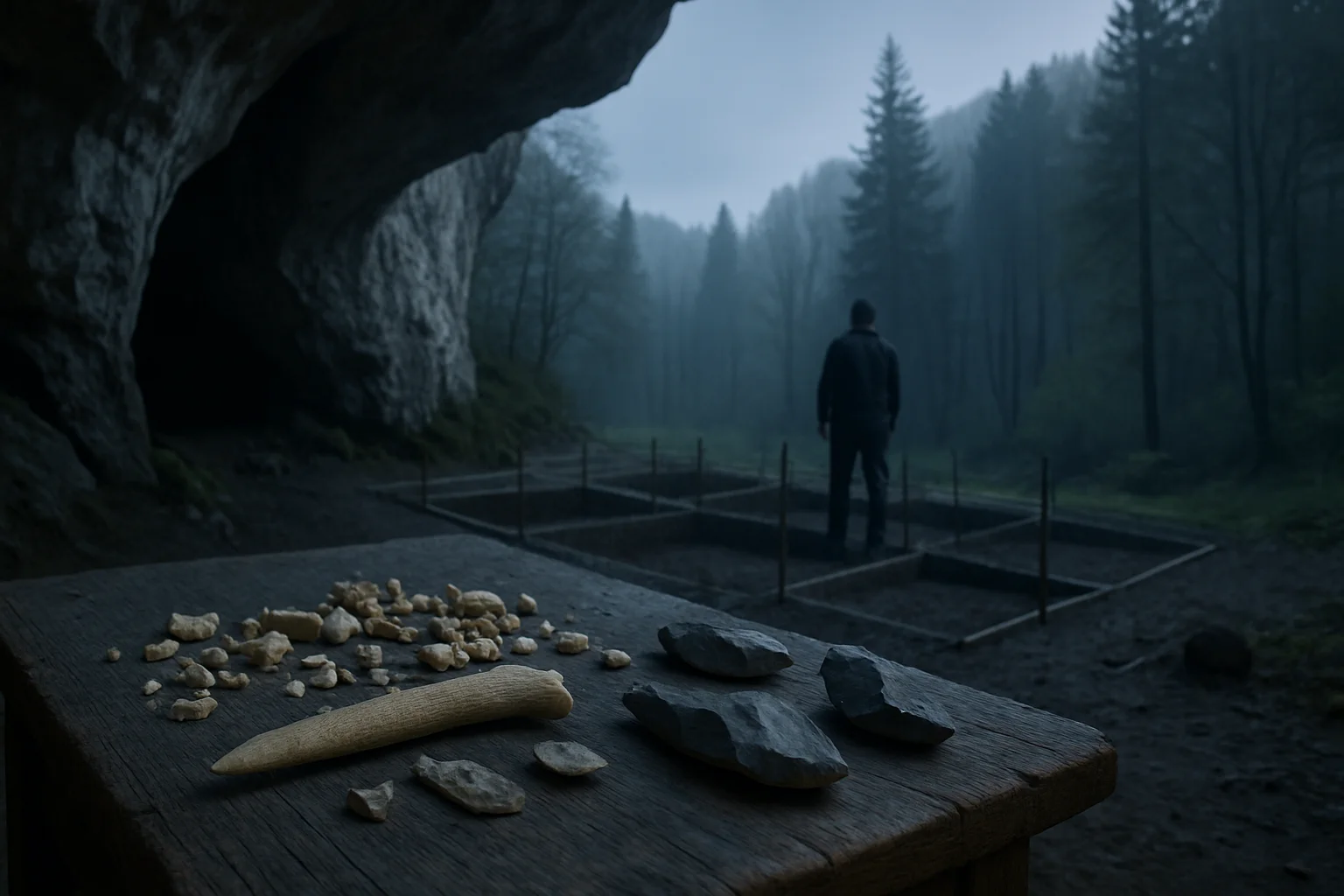
Researchers examined more than 10,000 faunal remains from Abri 122/1200 and identified 83 pieces with modifications interpreted as the result of human use. These traces include rounded and polished working ends, patterned microscopic scratches, impact scars and worn edges produced by repeated mechanical contact. Some fragments appear to have been used to retouch stone tools, while others may have worked hides or plant material, acted as wedges, or served as simple percussors.
The key point is not simply the number 83. Most of these objects are not elegant, standardized implements. They are pieces of animal bone selected when needed, used for a practical task and then discarded. Archaeologists describe this as expedient technology. Because such tools can look almost indistinguishable from ordinary food refuse, they are easy to miss unless every fragment is recovered and examined at high magnification.
Where is Abri 122/1200?
Abri 122/1200 lies in the limestone landscape of the Vârghiș Gorges in the eastern Carpathians of Romania. The Middle Paleolithic shelter was occupied at different times between roughly 230,000 and 60,000 years ago, placing its archaeological deposits within the long period of Neanderthal presence in Europe. Previous work at the site had already documented stone tools and the remains of large animals, including woolly rhinoceros and bison.
What had been missing was a convincing bone-tool assemblage. Neanderthal bone technologies are known from western Europe, Crimea, the Caucasus and as far east as the Altai region, yet the Carpathian record appeared comparatively empty. The new study suggests that this apparent absence may tell us as much about archaeological recovery methods as it does about prehistoric behavior.
Why were these tools overlooked?
Excavation standards have changed dramatically over the last century. Earlier archaeologists often prioritized complete bones, diagnostic anatomical parts and visually impressive artifacts. Small splinters could be discarded, left in spoil heaps or classified simply as fragmented fauna. Unfortunately, expedient bone tools are especially likely to occur among precisely those unremarkable pieces.
The Romanian study therefore carries a methodological warning: absence in the archaeological record is not always absence in the past. Screen size, collection policy, storage decisions and research questions all shape what becomes visible. This lesson is familiar elsewhere in prehistoric archaeology. Our earlier discussion of the Lake Turkana fossil footprints, for example, showed how traces of movement can reveal behavior that skeletal remains alone cannot preserve.
How can researchers tell a bone was used as a tool?
Animal bone can acquire marks in many ways. Butchery creates cuts; carnivore teeth leave pits and scores; trampling, sediment pressure and water movement can alter surfaces as well. A single polished patch is therefore not sufficient proof of tool use. The researchers combined microscopic use-wear analysis with experimental archaeology to distinguish these processes.
Modern bone pieces were used in controlled tasks involving scraping, pressing, striking and rubbing. Their surfaces were then examined and compared with the ancient fragments. Archaeologists looked at the location, orientation and density of microscopic traces as well as the geometry of fractures and impact areas. Matching patterns make it possible to argue that a fragment functioned as a retoucher, wedge, scraper-like tool or hammer rather than being accidentally damaged.
What kinds of bone tools did Neanderthals make?
Neanderthal bone technology was more varied than the old stereotype of a purely stone-based toolkit suggests. Across Europe, researchers have identified bone retouchers used to maintain stone edges, smoothers, scraping implements and carefully shaped lissoirs associated with hide working. The Abri 122/1200 assemblage is different in emphasis because most pieces appear to have been quickly selected and used with little formal shaping.
Expedient does not mean cognitively simple. Bone has mechanical properties that differ from stone. It can be resilient, slightly elastic and better suited to certain controlled impacts or surface-working tasks. Choosing it at the appropriate moment implies practical knowledge of materials. The toolmaker did not need to transform every object into a standardized artifact; sometimes the efficient decision was to pick up a suitable fragment and put it directly to work.
What were the 83 fragments used for?
The assemblage contains several functional categories. Some bones bear concentrated battering and crushing traces consistent with retouching chipped-stone edges. Others show wear from rubbing or scraping softer materials. Wedge-like pieces may have helped split or separate material, while two specimens were interpreted as straightforward hammers or percussors.
Several fragments may have had more than one function during their use lives. That matters because archaeological typologies can encourage us to assign one label to one object, while prehistoric users may have treated tools more flexibly. A bone could begin as a percussor, later become a wedge and finally be discarded as an insignificant splinter.
What does this say about Neanderthal intelligence?
For much of the nineteenth and twentieth centuries, Neanderthals were portrayed as rigid, brutish people with limited technology. Archaeology has steadily dismantled that image. Evidence now documents controlled fire use, sophisticated hunting, pigment use, personal ornamentation in some contexts, spatial organization and complex choices among raw materials. The Romanian bone tools fit within this broader revision.
It would still be too simplistic to convert the discovery into a slogan such as “Neanderthals were exactly like us.” Archaeology cannot measure intelligence directly. What it can demonstrate is behavioral capacity. At Abri 122/1200, Neanderthals appear to have recognized useful properties in bone, applied it to several tasks and produced quick technological solutions adapted to immediate needs. That is evidence for flexible decision-making rather than a fixed, single-material toolkit.
Why do the Carpathians matter?
The Carpathian region forms a major environmental corridor between central and eastern Europe. During repeated glacial and interglacial cycles, its valleys, uplands and cave systems would have shaped animal migration and human movement. Yet Neanderthal research has historically been dominated by famous sites in France, Spain, Italy and parts of western Eurasia.
The Romanian evidence suggests that regional differences may partly reflect the history of research. If small bone fragments from older excavations were not routinely retained or examined for use wear, other Carpathian tools could already exist in museum drawers. Reassessment of stored faunal collections may therefore change maps of Neanderthal technology without a single new excavation trench being opened.
Why are the researchers looking for DNA next?
One unusual feature of Abri 122/1200 is that it contains strong archaeological evidence of Neanderthal-period activity but no confirmed Neanderthal human remains. The team is therefore turning to sedimentary DNA and further laboratory work. Genetic traces can sometimes survive in cave sediments even when identifiable human bones are absent, providing an independent way to test who used a site.
Dating and species identification of the animal bones will also help separate phases of activity more precisely. If the 83 used fragments can be tied to narrower chronological horizons, researchers may be able to ask whether bone technology changed with climate, prey availability or shifts in stone-tool traditions. Modern Paleolithic archaeology increasingly depends on combining lithics, fauna, microscopic wear, sediments and biomolecular evidence rather than relying on a single spectacular artifact.
Why the study matters beyond Neanderthals
The work illustrates a broader principle in archaeology: new discoveries can emerge from old collections. Museums and research stores contain millions of fragments excavated decades ago. New microscopy, experimental reference collections, residue analysis and digital documentation allow researchers to ask questions that the original excavators could not.
The same process occurs in text-based archaeology. Re-examining the Hattusa cuneiform archives can produce new linguistic and historical connections even though the tablets were excavated long ago. At Abri 122/1200, the source is not writing but microscopic wear. In both cases, interpretation advances when old evidence is approached with better tools and different questions.
Could more Neanderthal bone tools be hiding in collections?
That possibility is one of the study’s most consequential implications. If the Romanian record looked empty because small fragments were overlooked, similar biases may affect other regions. Collections assembled before systematic fine-screening and modern zooarchaeological protocols are obvious candidates for review. Even excavation spoil from older campaigns may contain material that was once judged too insignificant to save.
This does not mean every polished fragment will become a Neanderthal tool. Reanalysis must remain conservative because natural and cultural processes can mimic one another. The strength of the Romanian study lies in combining large-scale screening, microscopy and experimental comparison rather than relying on appearance alone.
Conclusion
The 83 modified bones from Abri 122/1200 add a new technological dimension to the Neanderthal record of the Carpathians. They show that animal bone was not merely the residue of hunting and consumption. It could become a retoucher, scraper, wedge or hammer when a task required it. Just as importantly, the discovery demonstrates how archaeological methods shape our picture of the past. Technologies that seem regionally absent may sometimes be hidden in plain sight among small fragments that earlier generations did not know to value. Romania’s first clear Neanderthal bone-tool assemblage is therefore both a story about prehistoric ingenuity and a reminder that archaeological collections can still contain discoveries decades after excavation.
Frequently asked questions
Are these the first Neanderthal bone tools found in Romania?
The study presents the Abri 122/1200 assemblage as the first clear and systematic evidence of Neanderthal bone-tool use in Romania.
How many bones showed evidence of use?
Researchers screened more than 10,000 animal bones and identified 83 fragments with convincing anthropogenic modification and use-wear traces.
What were the tools used for?
Proposed functions include retouching stone tools, scraping or working softer materials, wedging, hammering and other short-term practical tasks.
Have Neanderthal human remains been found at the shelter?
No confirmed Neanderthal skeletal remains have yet been recovered, so the team is also investigating sedimentary DNA and other biomolecular evidence.
Sources and further reading
Frequently asked questions
Are these the first Neanderthal bone tools found in Romania?
The study presents the Abri 122/1200 assemblage as the first clear systematic evidence of Neanderthal bone-tool use in Romania.
How many bones showed evidence of use?
More than 10,000 faunal remains were screened and 83 fragments showed convincing traces of human use.
What were the tools used for?
They were probably used for stone-tool retouching, scraping, wedging, hammering and other expedient tasks.
Were Neanderthal human remains found?
No confirmed human remains have yet been recovered; sedimentary DNA and other analyses are being pursued.
Source trail
Selected references and research starting points
- Mărgărit et al., Journal of Quaternary Science (2026), DOI: 10.1002/jqs.70098
- Phys.org, 11 August 2026
The list is a research trail. Specific claims should be checked against the cited edition, object record or publication.
Keep exploring: Use the topic hub for closely related articles or browse the full archive instead of starting a new search.