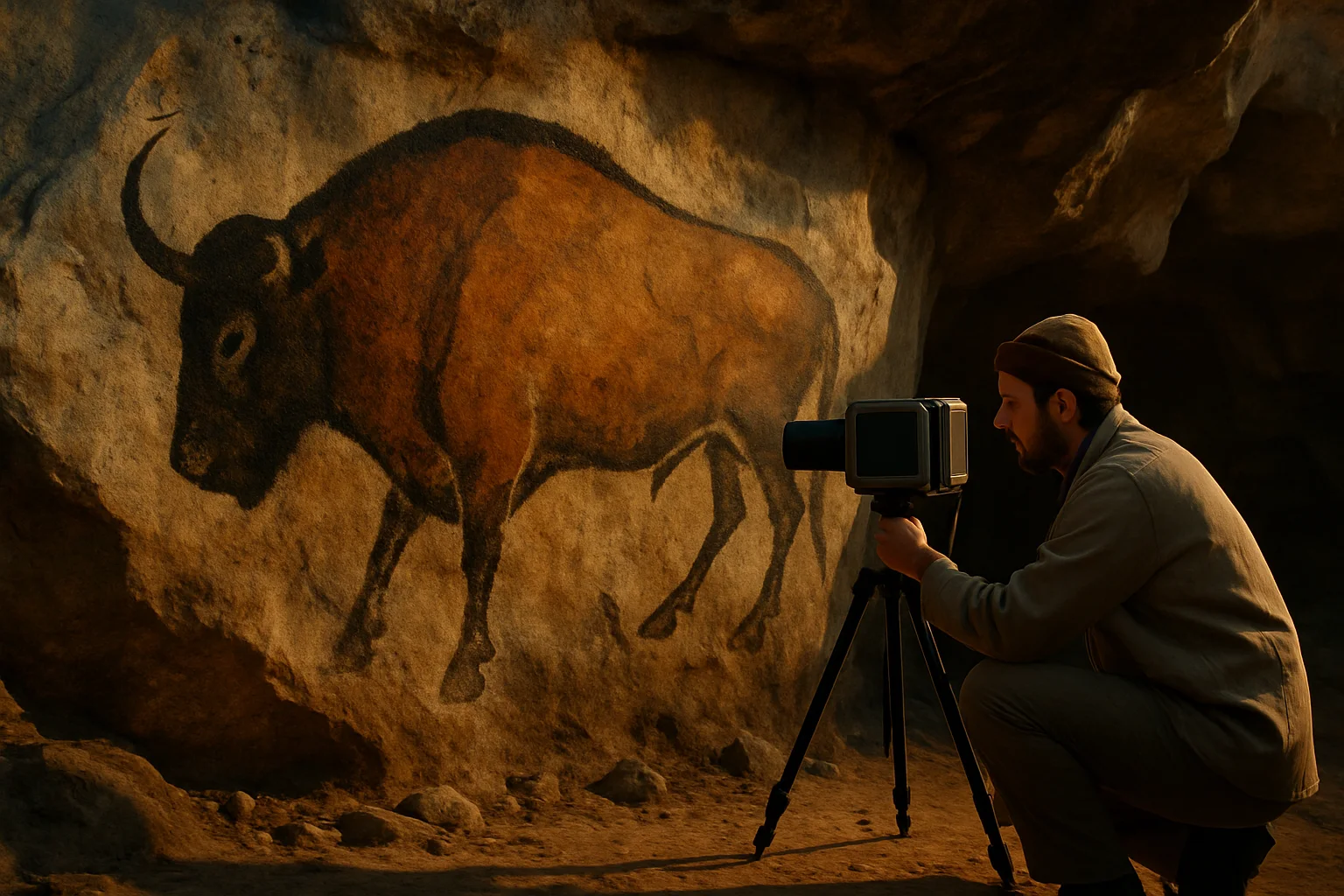
Font-de-Gaume Cave Art Directly Dated for the First Time
Hidden charcoal in Font-de-Gaume pigments dates a bison to about 13,000 years ago and reveals that the cave’s mask figure was altered across millennia.
Why is Font-de-Gaume important?
Font-de-Gaume lies near Les Eyzies in the Vézère Valley of southwestern France, a landscape that also contains Lascaux, Combarelles and Rouffignac. Its walls preserve bison, horses, mammoths, deer and geometric signs. The cave is especially valued for polychrome figures, deliberate use of natural rock relief and complicated superimposed compositions.
The site entered scientific discussion in 1901, but the precise age of many images remained uncertain. Stylistic comparisons often assigned them to the Magdalenian period. Style, however, is not a direct clock. Similar conventions can persist or return, and a decorated cave need not have been completed during one visit or even one cultural phase.
Why is cave art difficult to date?
Radiocarbon dating measures carbon-14 in material that was once alive. Charcoal, bone and plant-based binders may therefore be dated. Manganese and iron oxides, by contrast, are mineral pigments with no organic carbon. Many black images in the Dordogne were thought to have been drawn entirely with these minerals, apparently making direct dating impossible.
Archaeologists consequently relied on hearths found on cave floors, nearby bones or stylistic sequences. Yet a fire beneath a wall does not necessarily belong to the same visit as the painting above it. By identifying measurable carbon inside the paint itself, the new study substantially narrows that uncertainty.
How was the hidden charcoal identified?
The team analyzed black pigments with Raman microspectrometry and hyperspectral imaging. Raman analysis records molecular vibrational signatures produced when laser light interacts with a material. Hyperspectral imaging maps a surface across many wavelengths, separating substances that appear identical to the human eye.
Both techniques revealed carbon particles distributed consistently through the painted lines. Their alignment with the figures supported the conclusion that they were an original ingredient rather than soot from visitors, modern contamination or later graffiti. Researchers then received exceptional permission to remove microscopic samples for accelerator mass spectrometry radiocarbon dating.
How old is the bison?
The bison sample produced a calibrated range of 13,461–13,162 years before present. In the “cal BP” convention, present is defined as 1950. The image was therefore created roughly around 11,500 BCE, near the end of the Ice Age. This result is slightly later than some earlier style-based estimates.
Even a modest chronological shift matters. Archaeological models of animal choice, line technique and spatial organization often depend on phases separated by only centuries or a few millennia. A direct date allows researchers to test whether the Font-de-Gaume bison was genuinely contemporary with similar images elsewhere.
Why is the “mask” more surprising?
Samples from separate parts of the mask-like figure produced three ranges: approximately 15,981–15,121, 15,297–14,246 and 8,993–8,590 calibrated years before present. Those spans are far too widely separated to represent one artist working during a brief episode.
The strongest interpretation is that later groups returned to the image. Initial lines may have been made near the closing stages of the Ice Age, other elements added later and final interventions carried out in the early Holocene. Font-de-Gaume can therefore be understood not simply as a prehistoric gallery but as a persistent place of memory where generations encountered and reinterpreted earlier marks.
How does this change our view of prehistoric art?
Cave art is often presented as a closed package belonging to one archaeological culture. The new dates show that a single wall could accumulate work by people living in different periods. A figure's present appearance may combine successive acts of drawing, repainting and selective preservation.
This possibility matters beyond Font-de-Gaume. If apparently mineral pigments in other caves contain overlooked carbon, many figures dated only by style may become directly measurable. A larger series of secure dates could reveal how quickly artistic traditions changed, how ideas moved between regions and whether certain caves retained significance across major climatic and social transitions.
What are the limits of the method?
Radiocarbon dating does not answer every question. Charcoal could derive from wood already old when burned, producing the “old wood effect.” Extremely small samples require strict contamination control. A date also applies only to the sampled stroke; researchers should not assume that every line in a complex figure was made at the same time.
Chemical mapping, microscopic study, archaeological context and stylistic analysis must therefore be combined. This is the principal strength of the Font-de-Gaume project: the team first demonstrated that carbon was genuinely embedded in the original pigment and only then removed the smallest possible sample for dating.
Why the calibrated dates matter
Raw radiocarbon ages are not identical to calendar years because atmospheric carbon-14 has varied through time. Calibration compares measurements with independently dated records such as tree rings. Reporting calibrated ranges makes the bison and mask results comparable with climatic events, settlement phases and other dated archaeological contexts.
The dates cross a period of profound environmental change. Communities experienced the final millennia of the Pleistocene and the transition into the warmer Holocene. Repeated use of the same underground image suggests that cultural attachment to place could survive major changes in landscape and subsistence.
Internal reading
For another example of behavior reconstructed from direct traces rather than bones alone, see our article on the 1.4-million-year-old Lake Turkana footprints.
Frequently Asked Questions
Where is Font-de-Gaume Cave?
It is in the Dordogne region of southwestern France, near Les Eyzies in the Vézère Valley.
How old is the dated bison?
The direct radiocarbon result places it between 13,461 and 13,162 calibrated years before present.
Was the mask made in one period?
Probably not. Samples from different sections produced dates separated by thousands of years, indicating repeated modification.
Why could the black paint not be dated before?
It was assumed to consist only of carbon-free manganese or iron oxides. Chemical imaging detected a small charcoal component.
Can this technique be used in other caves?
Yes. Non-destructive imaging can first screen pigments for carbon, potentially opening direct dating opportunities for images previously considered undatable.
References
- Reiche, I. et al. “Radiocarbon dating and chemical imaging of carbon black–based Paleolithic cave art in the Dordogne region (France).” Proceedings of the National Academy of Sciences, 2026. DOI: 10.1073/pnas.2524751123.
- CNRS. “Hidden charcoal reveals the true age of ancient cave paintings.” 28 July 2026.
- Centre des monuments nationaux. Scientific and conservation information for Font-de-Gaume Cave.
How this page is handled: Evidence, interpretation and modern speculation are separated. Material corrections are reflected in the article date.