
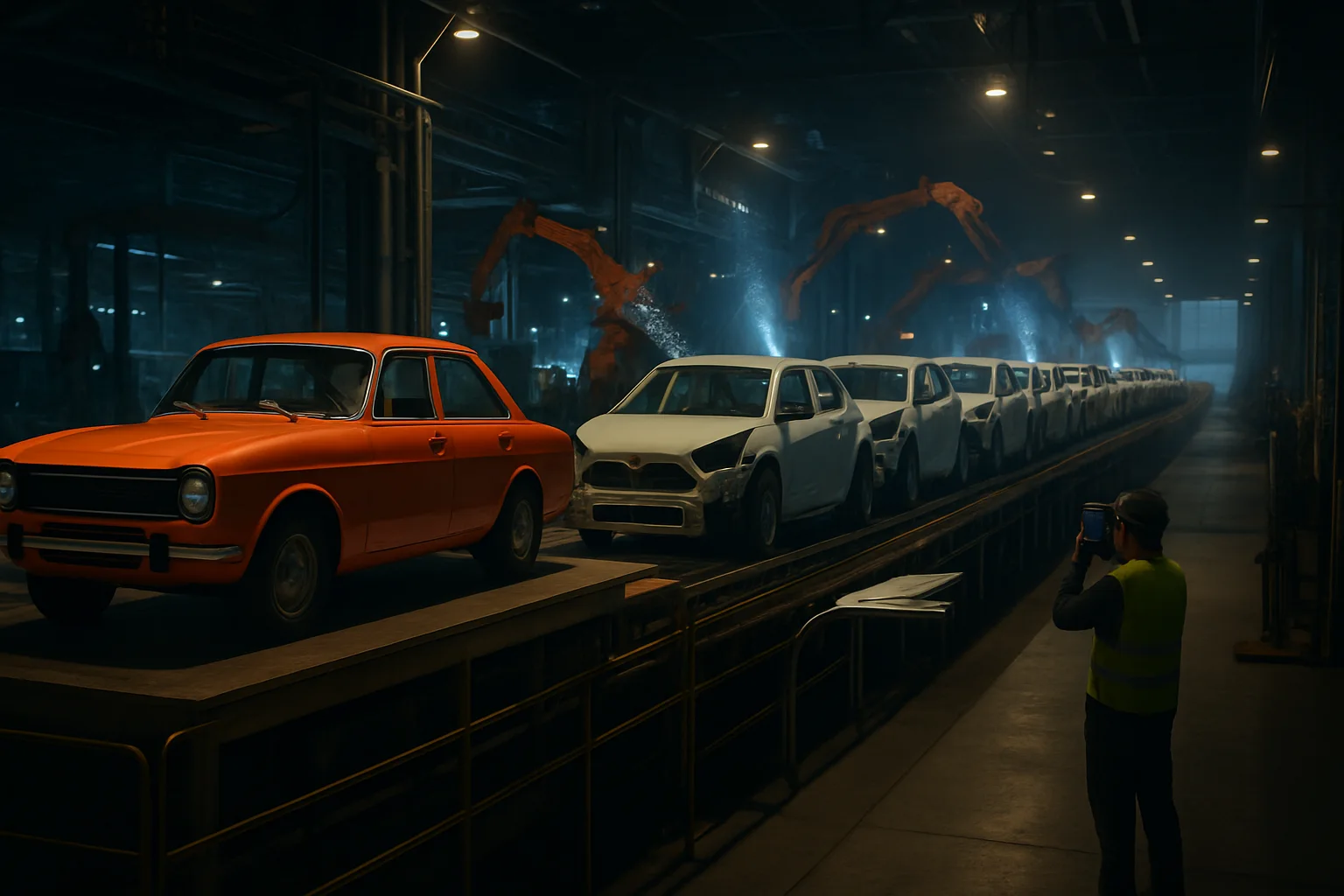
How Turkey Became a Car Factory for Europe: From Devrim and Anadol to Hybrid C-HR
From 1950s truck assembly and the Devrim experiment to Anadol, Bursa’s export plants and hybrid C-HR, this article traces Turkey’s rise as an automotive hub.
Why “Production” Is Back in the Headlines
In recent months Turkish news feeds have been full of phrases like “global automaker eyes Turkey for production” and debates over what counts as “Made in Europe.” At the same time, EU plans to tighten the definition of Europe-made cars have put a spotlight on Turkey’s role in European supply chains.([aa.com.tr](https://www.aa.com.tr/tr/ekonomi/deikten-abnin-otomobilde-made-in-europe-planina-turkiye-uyarisi/3968313))
By 2023 Turkey was producing about 1.5 million motor vehicles a year, ranking 13th worldwide. A large majority of those vehicles and components are exported, historically with around 80–85% going to EU member states. This is a long way from the days when the country could barely support a handful of domestic prototypes.
How did Turkey move from a small, import-dependent market to a country where Renault, Fiat, Ford, Toyota, Hyundai and a domestic EV brand all build vehicles for Europe? The answer lies in a layered history of failed experiments, strategic joint ventures, customs union politics and a dense ecosystem of suppliers and workers.
Early Experiments: TOMTAŞ, Ford and Devrim
The roots of automotive production in Turkey go back further than many assume. In 1925 the state-backed TOMTAŞ factory was founded to build aircraft, automobiles and engines, but it struggled in the interwar economic climate and never became a large-scale car producer.
In 1929 Ford opened an assembly plant in Istanbul that could output around 48 cars a day, but production was cut short by the Great Depression of the 1930s. The real foundations of the modern industry were laid in the 1950s, when Turkish Willys-Overland began assembling Jeeps for the army and Türk Otomotiv Endüstrisi A.Ş. built trucks for the domestic market.([taysad.org.tr](https://www.taysad.org.tr/tr/turk-otomotiv-sanayi-ve-taysadin-tarihcesi))
In this climate, the most famous early attempt at a fully domestic car was Devrim (“Revolution”). In 1961 engineers at the state railway workshops in Eskişehir designed and built four sedan prototypes in a matter of months. The project proved that local engineers could design a car from scratch, but it never entered serial production. Demand was tiny, and there was no dealer, service or parts network to sustain a new brand.([taysad.org.tr](https://www.taysad.org.tr/tr/turk-otomotiv-sanayi-ve-taysadin-tarihcesi))
From Assembly Lines to a Domestic Brand: The Anadol
While Devrim remained a one-off symbol, the private sector pursued a different path: licensed assembly as a stepping stone to a domestic brand. Koç Group’s Otosan plant, founded in 1959 in Istanbul, initially assembled Ford trucks and cars under licence. For industrialist Vehbi Koç, however, this was only an intermediate stage toward a “Turkish car” that could be mass-produced.([anadolturkey.com](https://www.anadolturkey.com/web/tr/anadol-hakknda/tarihce.html))
Through a deal with Britain’s Reliant, Otosan developed the Anadol, which entered serial production on 19 December 1966. The first A1 model had a fiberglass body over a steel chassis and used Ford engines and transmissions, parts that were increasingly localised as Otosan expanded its capabilities.([aa.com.tr](https://www.aa.com.tr/tr/gundem/anadol-55-yil-once-turkiye-yollarina-cikti/2516624))
Production continued until 1984. According to Anadolu Agency, a total of 93,188 Anadol vehicles were built, roughly one-third of them pick-ups and the rest passenger cars.([aa.com.tr](https://www.aa.com.tr/tr/gundem/anadol-55-yil-once-turkiye-yollarina-cikti/2516624)) Technically modest and never a major export success, the Anadol nevertheless provided a crucial learning platform: it trained engineers and workers, encouraged the growth of supplier firms and proved that a car brand assembled in Turkey could meet everyday needs.
The Bursa Triangle: Tofaş, Oyak-Renault and the Turn to Exports
By the late 1960s the industrial city of Bursa was emerging as the heart of Turkey’s car industry. In 1968 Tofaş was founded as a joint venture between Koç Holding and Fiat, and the Murat 124 went into production in 1971. Within a few years, these cars were being exported to markets like Egypt, turning Tofaş into one of Turkey’s first serious car exporters.([tofas.com.tr](https://www.tofas.com.tr/en/AboutTofas/TofasTimeline))
In 1969 the Oyak-Renault plant was established in Bursa to produce Renault 12s and later models. Today the same site runs ultrafast, robot-heavy lines making Clio and Dacia Duster models. A 2025 report by Le Monde describes a car rolling off the line roughly every 56 seconds, with more than 70% of output exported.([lemonde.fr](https://www.lemonde.fr/en/economy/article/2025/12/22/in-turkey-renault-s-vast-factory-anchors-a-booming-auto-hub-geared-toward-europe_6748737_19.html))
Le Monde’s data underline Bursa’s centrality: in 2024 the province produced around 434,000 vehicles, and the wider region accounted for about 40% of Turkey’s total automotive exports, which reached nearly €32 billion that year.([lemonde.fr](https://www.lemonde.fr/en/economy/article/2025/12/22/in-turkey-renault-s-vast-factory-anchors-a-booming-auto-hub-geared-toward-europe_6748737_19.html)) Around these anchor plants, hundreds of suppliers cluster within a 200-kilometre radius, making Marmara not just an industrial zone but a dense automotive ecosystem.
Customs Union, Global Value Chains and the Shift East
Turkey’s 1996 customs union with the EU was another turning point. Presentation material from the Automotive Manufacturers Association (OSD) shows how liberalisation in the 1980s, followed by customs union and WTO membership in the 1990s, paved the way for a rapid increase in capacity, production and exports in the 2000s.([tubitak.gov.tr](https://tubitak.gov.tr/tubitak_content_files/EUREKA/kore/TR/OSD.pdf))
By 2004 Turkey was exporting some 518,000 vehicles a year, mostly to EU markets. In 2008 production passed 1.1 million units, placing Turkey among the top 15 producers globally.([tubitak.gov.tr](https://tubitak.gov.tr/tubitak_content_files/EUREKA/kore/TR/OSD.pdf)) This dovetailed with a wider global shift, as automakers moved production from high-cost Western European plants to lower-cost yet geographically close locations. Turkey, with its existing industrial base, customs union status and large young workforce, was well placed to benefit.
By the 2010s the Marmara region – especially Bursa, Kocaeli and Sakarya – hosted multiple major car plants and hundreds of suppliers. The automotive sector had become a cornerstone of Turkey’s export-led growth model, with more than $35 billion in motor vehicles and components exported in some years.
Suppliers, Wages and Turkey’s Competitive Edge
Turkey’s rise as a production base rests on three pillars: a deep supplier network, relatively low labour costs and a culture of flexible manufacturing. TAYSAD, the association of automotive suppliers, traces the industry back to 1950s truck assembly and notes how it evolved into a web of hundreds of firms making everything from pressed steel and seats to electronics and glass.([taysad.org.tr](https://www.taysad.org.tr/tr/turk-otomotiv-sanayi-ve-taysadin-tarihcesi))
Le Monde’s reporting from the Oyak-Renault plant offers a snapshot of this ecosystem. According to the article, 40–50% of vehicle content is sourced locally, and some 80% of suppliers are within 200 kilometres of the factory. Wages at the plant are reported to be slightly above Turkey’s net minimum wage but remain around four times lower than comparable jobs in France.([lemonde.fr](https://www.lemonde.fr/en/economy/article/2025/12/22/in-turkey-renault-s-vast-factory-anchors-a-booming-auto-hub-geared-toward-europe_6748737_19.html))
This combination makes Turkey highly attractive for global automakers, but also leaves the sector exposed to external shocks, currency swings and shifts in trade policy. Official data and OSD analyses show how sharply production and exports can fall during global recessions, underlining both the sector’s importance and its vulnerability.([tubitak.gov.tr](https://tubitak.gov.tr/tubitak_content_files/EUREKA/kore/TR/OSD.pdf))
The Electric and Hybrid Turn: Old Plants, New Roles
The past decade’s biggest structural shift in automotive has been electrification, and Turkish plants have been drawn into that transition. Since 2016 Toyota’s factory in Sakarya has produced the C-HR crossover alongside the Corolla; the C-HR was the first hybrid-powered vehicle built in Turkey.([newsroom.toyota.eu](https://newsroom.toyota.eu/toyota-c-hr-production-starts-in-europe/))
In a 2023 press release Toyota Motor Europe announced that the second-generation C-HR, including a plug-in hybrid version, and its batteries would be built at the same Sakarya plant, making it Toyota’s first European facility to produce plug-in hybrids and battery packs.([newsroom.toyota.eu](https://newsroom.toyota.eu/toyota-motor-manufacturing-turkey-to-become-toyotas-first-european-plant-to-produce-plug-in-hybrid-vehicles-and-batteries/)) Ford Otosan, meanwhile, has committed around €2 billion to new electric and plug-in-hybrid commercial vehicles at its Kocaeli plants, already Europe’s largest producer of light commercial vehicles.([fordotosan.com.tr](https://fordotosan.com.tr/tr/kurumsal/ford-otosan-hakkinda/tarihce))
Hyundai’s Assan plant in Izmit, with an annual capacity above 200,000 units, exports compact models across Europe and the Middle East, generating roughly €1.5 billion in export revenue each year.([invest.gov.tr](https://www.invest.gov.tr/tr/whyturkey/SuccessStories/Sayfalar/hyundai.aspx)) On the domestic side, the Togg factory in Gemlik, opened in 2022, symbolises Turkey’s bid to move from contract manufacturing into branded, fully electric vehicles of its own.
“Made in Europe” and Turkey’s Place in the Chain
Against this backdrop, the EU’s evolving “Made in Europe” framework has become a key concern for Turkish producers. A joint letter by major European automakers to EU institutions proposed lowering the local value-added threshold for a car to qualify as “Made in Europe” from 85% to 70%, arguing that the stricter level would discourage investment and raise costs.([aa.com.tr](https://www.aa.com.tr/tr/ekonomi/deikten-abnin-otomobilde-made-in-europe-planina-turkiye-uyarisi/3968313))
Turkish business representatives stress that, thanks to the customs union and dense supplier ties, Turkey already functions as an extension of Europe’s automotive industry. They warn that excluding Turkey from the “Made in Europe” definition could harm both EU manufacturers and Turkish plants.([aa.com.tr](https://www.aa.com.tr/tr/ekonomi/deikten-abnin-otomobilde-made-in-europe-planina-turkiye-uyarisi/3968313)) At the same time, draft discussions in the Turkish press have highlighted scenarios in which vehicles made in Turkey would still be treated as “European production,” depending on the final text.([arabalar.com.tr](https://www.arabalar.com.tr/haberler/turkiyede-uretilen-araclar-avrupa-uretimi-sayilacak))
These debates are not just about labels; they cut to the question of whether Turkey will remain a complementary node in Europe’s industrial network or become a more precarious, semi-detached production outpost in a fragmenting global economy.
Society on the Assembly Line: Factory Towns and Industrial Memory
Automotive production is also a social and cultural phenomenon. In Bursa, new neighbourhoods grew around organised industrial zones serving Tofaş and Oyak-Renault. In Kocaeli, the landscape of ports, highways and worker housing reflects decades of investment by Ford and Hyundai. In Sakarya, Toyota’s arrival reshaped local labour markets and attracted scores of suppliers.
Old Anadol cars still kept running by enthusiasts, the surviving Devrim prototype visited by school groups, and retired workers’ stories from the line all form part of Turkey’s industrial memory. For historians, they show that the country’s transformation into a car factory for Europe is not only an economic story, but also one about class formation, urbanisation and everyday life.
Conclusion: New Plants, Old Questions
Today Turkey is woven into the global car industry: it hosts major plants for Renault, Fiat, Ford, Toyota, Hyundai and others, and also fields its own electric brand. The path from 1950s Jeep assembly to 2020s plug-in-hybrid C-HRs and electric SUVs is the product of long-term industrial policy, private investment and workers’ skills, not of a single decision or company.
In the coming years, EU regulation, competition from China and the US, domestic demand and tax policy will all shape Turkey’s position in this network. History suggests that once a country accumulates engineering know-how and a dense supplier base, these assets are hard to dislodge – but not immune to change. The arc that runs from Devrim’s orphaned prototypes through the Anadol and Murat 124 to today’s export-oriented hybrids explains why, for now, Turkey is more than an assembly shop: it is one of Europe’s key car factories.
Frequently asked questions
When did automotive production start in Turkey?
The modern automotive industry in Turkey took shape in the 1950s, with Willys-Overland assembling Jeeps and Türk Otomotiv Endüstrisi A.Ş. producing trucks. Earlier attempts included the TOMTAŞ factory in 1925 and a Ford assembly plant in Istanbul in 1929, but both were short-lived. The first fully domestic prototype car, Devrim, was built in Eskişehir in 1961 but never entered mass production.([taysad.org.tr](https://www.taysad.org.tr/tr/turk-otomotiv-sanayi-ve-taysadin-tarihcesi))
Why is the Anadol important in Turkey’s car history?
Anadol, mass-produced between 1966 and 1984, is widely regarded as Turkey’s first domestic-brand passenger car built in significant numbers. Around 93,000 units were manufactured, including both cars and pick-ups. Developed by Otosan with design input from Britain’s Reliant and powered by Ford engines, it helped train engineers and workers and stimulated the growth of a local supplier base, even though it was not a major export success.([aa.com.tr](https://www.aa.com.tr/tr/gundem/anadol-55-yil-once-turkiye-yollarina-cikti/2516624))
Why has Bursa become a major automotive hub?
Bursa became central to Turkey’s car industry after Tofaş and Oyak-Renault opened plants there in 1968 and 1969. Those factories, combined with a dense network of nearby suppliers, turned the city into a major production and export base. In 2024 alone, Bursa produced about 434,000 vehicles, and the wider region accounted for roughly 40% of Turkey’s automotive exports, which reached a record of nearly €32 billion.([tofas.com.tr](https://www.tofas.com.tr/en/AboutTofas/TofasTimeline))
How has Turkey entered the electric and hybrid vehicle era?
Turkey’s first hybrid car built domestically was the Toyota C-HR, whose production started in 2016 at Toyota’s Sakarya plant. In 2023 Toyota Motor Europe confirmed that the second-generation C-HR plug-in hybrid and its batteries would also be produced there, making the site Toyota’s first European plug-in-hybrid and battery plant. Ford Otosan is investing heavily in electric and plug-in-hybrid commercial vehicles in Kocaeli, while the Togg factory in Gemlik builds fully electric cars under a Turkish brand.([newsroom.toyota.eu](https://newsroom.toyota.eu/toyota-c-hr-production-starts-in-europe/))
What could the EU’s "Made in Europe" rules mean for Turkish plants?
Draft EU rules on what qualifies as "Made in Europe" for cars focus on how much of a vehicle’s value is created within the EU. Major European automakers have asked to lower the threshold from 85% to 70%, arguing that the stricter level would undermine competitiveness. Turkish business groups warn that excluding Turkey from this definition could harm both EU manufacturers and Turkish producers, given their deep integration through the customs union and supply chains. The final wording will determine whether cars assembled in Turkey can be counted as European-made for regulatory purposes.([aa.com.tr](https://www.aa.com.tr/tr/ekonomi/deikten-abnin-otomobilde-made-in-europe-planina-turkiye-uyarisi/3968313))
Sources and further reading
- Türk Otomotiv Sanayi ve TAYSAD'ın Tarihçesi — TAYSAD (Taşıt Araçları Tedarik Sanayicileri Derneği), unknown
- Automotive industry in Turkey — Wikipedia, 2026-06-09
- Anadol, 55 yıl önce Türkiye yollarına çıktı — Anadolu Ajansı, 2022-02-27
- The Automotive Industry in Turkey — Otomotiv Sanayii Derneği (OSD) / TÜBİTAK, unknown
- In Turkey, Renault's vast factory anchors a booming auto hub geared toward Europe — Le Monde, 2025-12-22
- Toyota Motor Manufacturing Turkey to become Toyota’s first European plant to produce plug-in-hybrid vehicles and batteries — Toyota Motor Europe, 2023-01-30
- DEİK'ten AB'nin otomobilde "Made in Europe" planına Türkiye uyarısı — Anadolu Ajansı, 2026-06-12
Keep exploring: Use the topic hub for closely related articles or browse the full archive instead of starting a new search.