Mljet Byzantine Shipwreck: Who Owned the Gold Found in the Adriatic?
Gold buckles, coins and an imperial signet ring from a seventh- or eighth-century wreck off Croatia suggest that the vessel carried an elite passenger or official entourage.
What was found in the Mljet shipwreck?
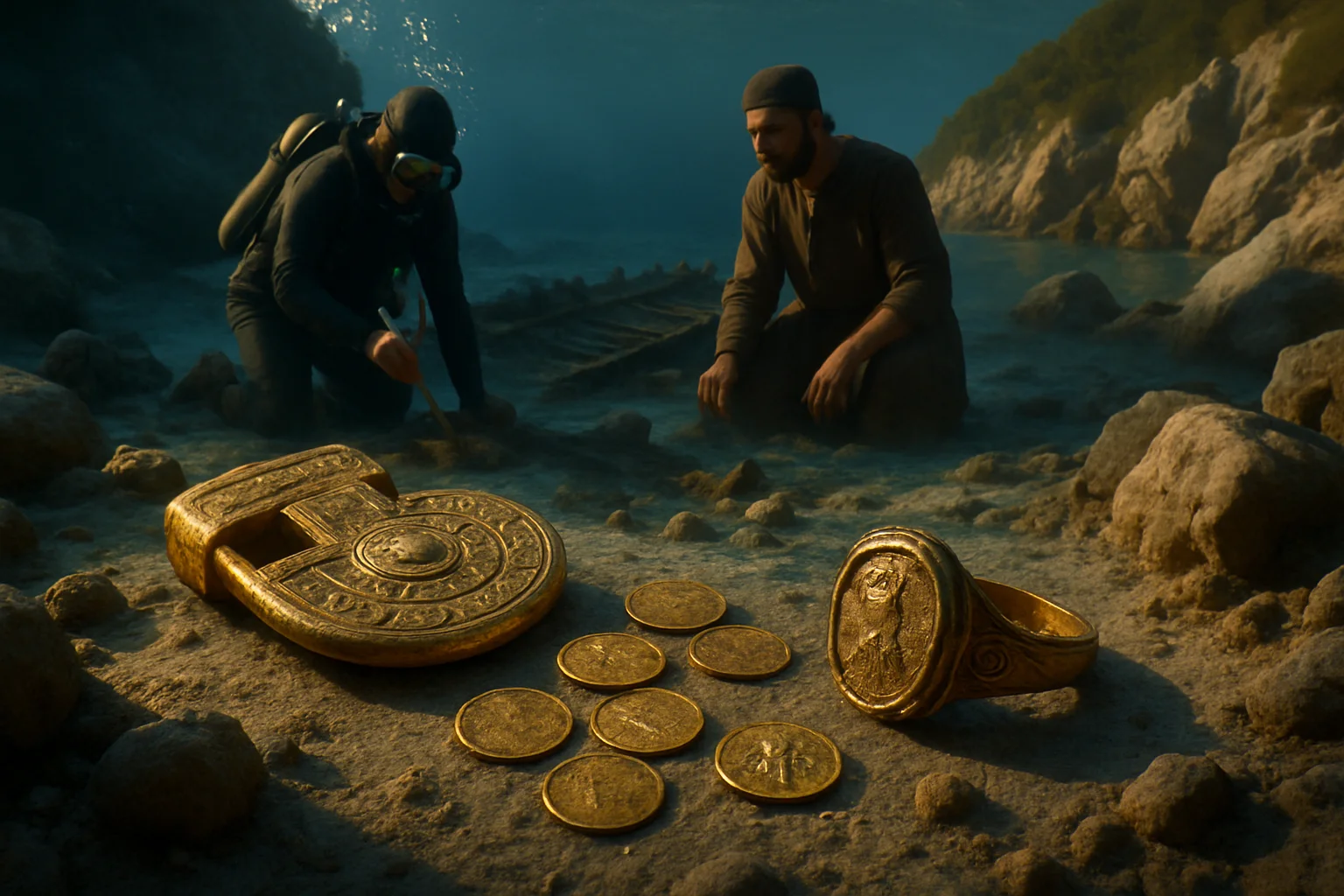
The wreck lies near Polače on Mljet Island, off Croatia’s southern Adriatic coast. Underwater archaeologists have worked at the site for roughly a decade, documenting the hull and recovering objects through slow, controlled excavation. On 23 July 2026 the team publicly presented the results of that long investigation and dated the vessel broadly to the seventh or eighth century.
The most striking finds include gold coins associated with the Heraclian dynasty, buckles decorated with rubies, emeralds and pearls, other gold ornaments, and a gold signet ring carrying an image of the emperor. Such objects are not typical personal possessions of an ordinary crew. Together they raise the possibility that a senior official, military commander, wealthy aristocrat or imperial representative was travelling aboard the vessel.
Why do archaeologists think it was more than a merchant ship?
Many ancient shipwrecks are identified mainly through cargo: amphorae, pottery, stone, metal ingots or everyday equipment. The Mljet wreck stands out because several recovered objects functioned as visible markers of rank. Gem-set buckles belonged to elite dress, while a signet ring could communicate identity, authority and connection to the imperial order.
This does not prove that the vessel was a dedicated state ship. The gold may have belonged to one passenger, several travellers, a diplomatic delegation or a protected group of valuables. The distribution of objects across the wreck, together with hull construction and cargo evidence, will be essential for distinguishing between these possibilities.
Why is more than 600 grams of gold significant?
According to researchers from the Croatian Conservation Institute, the recovered gold weighs more than 600 grams after cleaning and restoration. The team described it as the largest quantity of gold yet documented from a shipwreck in the Mediterranean. Weight alone does not determine historical importance, but the combination of quantity, craftsmanship and official imagery makes the assemblage exceptional.
Gold served several purposes during long-distance travel. Coins provided portable wealth and could support payments, provisioning or emergency expenses. Jewellery displayed social rank. A seal ring could validate documents and represent delegated power. Finding these categories together suggests a voyage in which personal, administrative and economic functions overlapped.
What was happening in the Byzantine world?
The seventh and early eighth centuries were an age of profound transformation. The eastern Roman state had emerged from exhausting wars with the Sasanian Empire only to lose major eastern territories during the Arab conquests. In the Balkans, new political communities challenged imperial control, while Constantinople struggled to defend cities, tax routes and maritime connections.
Yet the empire did not simply stop moving. Ships continued to carry officials, soldiers, money, luxury goods, correspondence and religious objects through the Aegean and Adriatic. Mljet occupied a useful position on coastal routes connecting the eastern Mediterranean with Italy. The wreck therefore offers a material snapshot of mobility during a period often described primarily through warfare and territorial loss.
What do the Heraclian coins tell us?
The coins are linked to four emperors of the Heraclian dynasty and provide an important chronological framework. Coins, however, could circulate for years or decades after minting. Archaeologists cannot assign an exact wreck date simply by identifying the latest coin. Pottery, timber analysis, shipbuilding details and the wider artefact assemblage must also be considered.
Even with that caution, the coins illuminate the movement of imperial gold. High-value currency supported military payments, taxation, diplomacy and long-distance exchange. Its presence aboard the Mljet vessel demonstrates that the Adriatic remained connected to broader Byzantine fiscal and political networks.
Why is the imperial signet ring important?
A signet ring was not merely decorative. It could be pressed into wax or another sealing material to authenticate a document, secure a container or identify the authority behind a message. An imperial image on a gold ring would have carried an especially strong symbolic charge.
The ring should not be described as the emperor’s personal property without further evidence. Imperial symbols circulated among officials, officers and people attached to the court. Detailed study of the iconography, inscription, metalwork and parallels from controlled archaeological contexts may eventually narrow the owner’s status.
Why did the underwater excavation take so long?
Underwater archaeology is constrained by depth, currents, visibility, weather and the limited time that divers can safely remain at work. Every object must be recorded before removal, because its position may explain how cargo was stored or how the ship broke apart. Excavation can therefore advance only a small distance during each season.
Conservation continues after recovery. Salt must be removed from metal and ceramic objects. Waterlogged wood is especially vulnerable because it can shrink, crack or collapse when exposed to air. The decade-long pace at Mljet reflects the need to protect evidence rather than a lack of progress.
What does the wreck add to Byzantine history?
The Mljet ship reminds us that Byzantium was held together not only by armies, churches and imperial ceremonies but by maritime transport. Officials, orders, coinage, gifts and elite possessions moved by sea. A wreck captures that system at the moment of failure, preserving objects that would otherwise have reached their destination and disappeared into ordinary use.
Stanford archaeologist Justin Leidwanger has described the site as critical for studying the end of the late Roman world and the formation of the medieval Mediterranean. Its value lies not in explaining the entire empire through one accident, but in showing how routes remained active while political geography was fragmenting.
Frequently asked questions
Where was the Mljet Byzantine shipwreck found?
It lies near Polače on Mljet Island, off the southern coast of Croatia in the Adriatic Sea.
How old is the wreck?
Archaeologists date it broadly to the seventh or eighth century, roughly 1,200 to 1,400 years ago.
How much gold was recovered?
The conserved objects weigh more than 600 grams in total.
Was an emperor travelling on the ship?
There is no evidence for that conclusion. The finds indicate a high-status traveller, but the person’s identity is unknown.
Sources and further reading
- Reuters, “Byzantine gold objects help archaeologists uncover past of ship wrecked off Croatia”, 23 July 2026.
- Croatian Conservation Institute, Department of Underwater Archaeology.
- Justin Leidwanger, Stanford University, research on Mediterranean maritime archaeology.
- Oxford Dictionary of Byzantium, entries on maritime routes and imperial administration.
- Jonathan Harris, The Lost World of Byzantium.
Keep exploring: Use the topic hub for closely related articles or browse the full archive instead of starting a new search.