A 9,000‑Year‑Old Workshop at Çayönü Tepesi: Neolithic Malachite, Copper and Early Production
A ~5 m² malachite‑and‑copper workshop announced from Çayönü Tepesi in 2026 offers new evidence about Neolithic production spaces, resource access and the deep history of Anatolian metallurgy.
1. What was found?
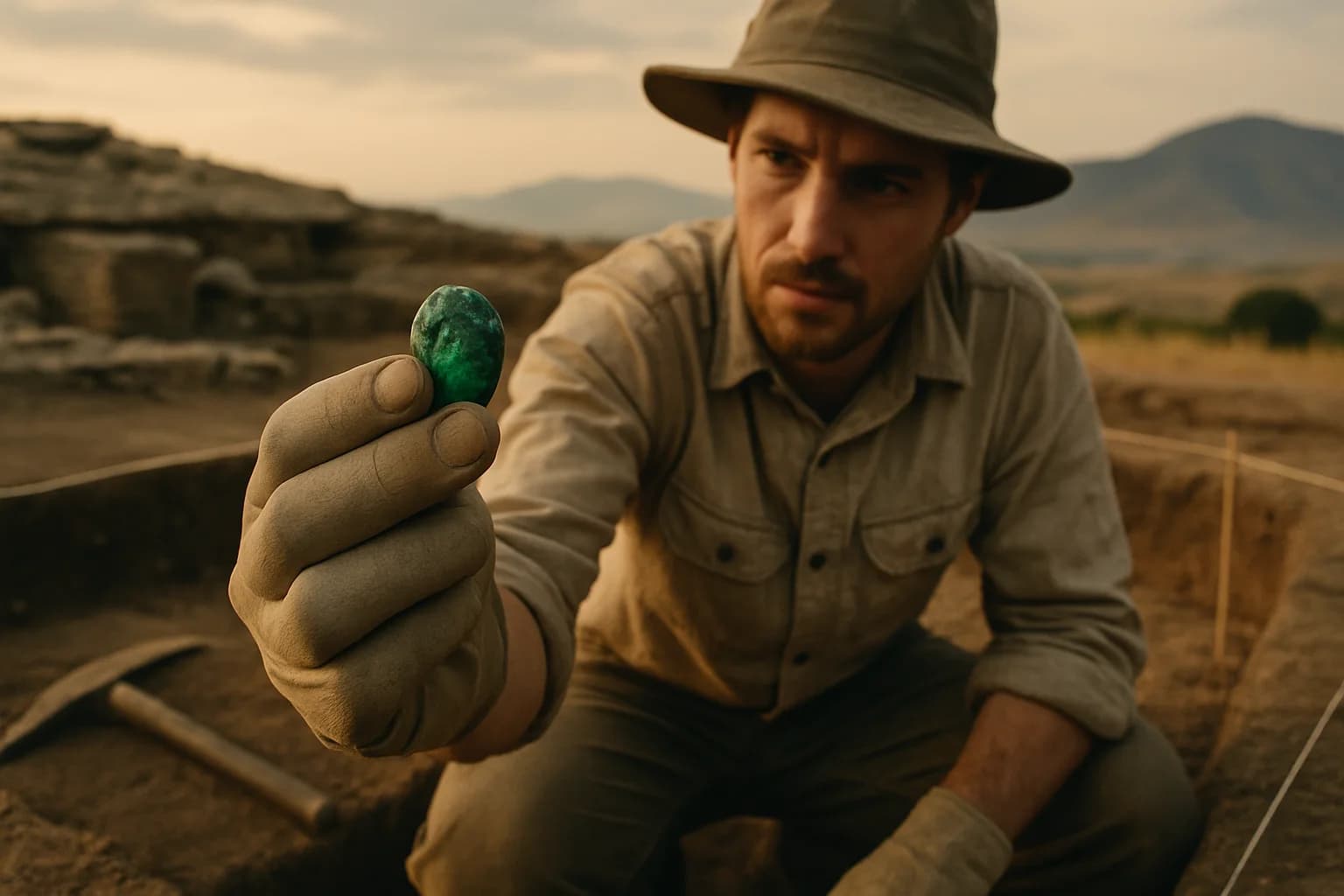
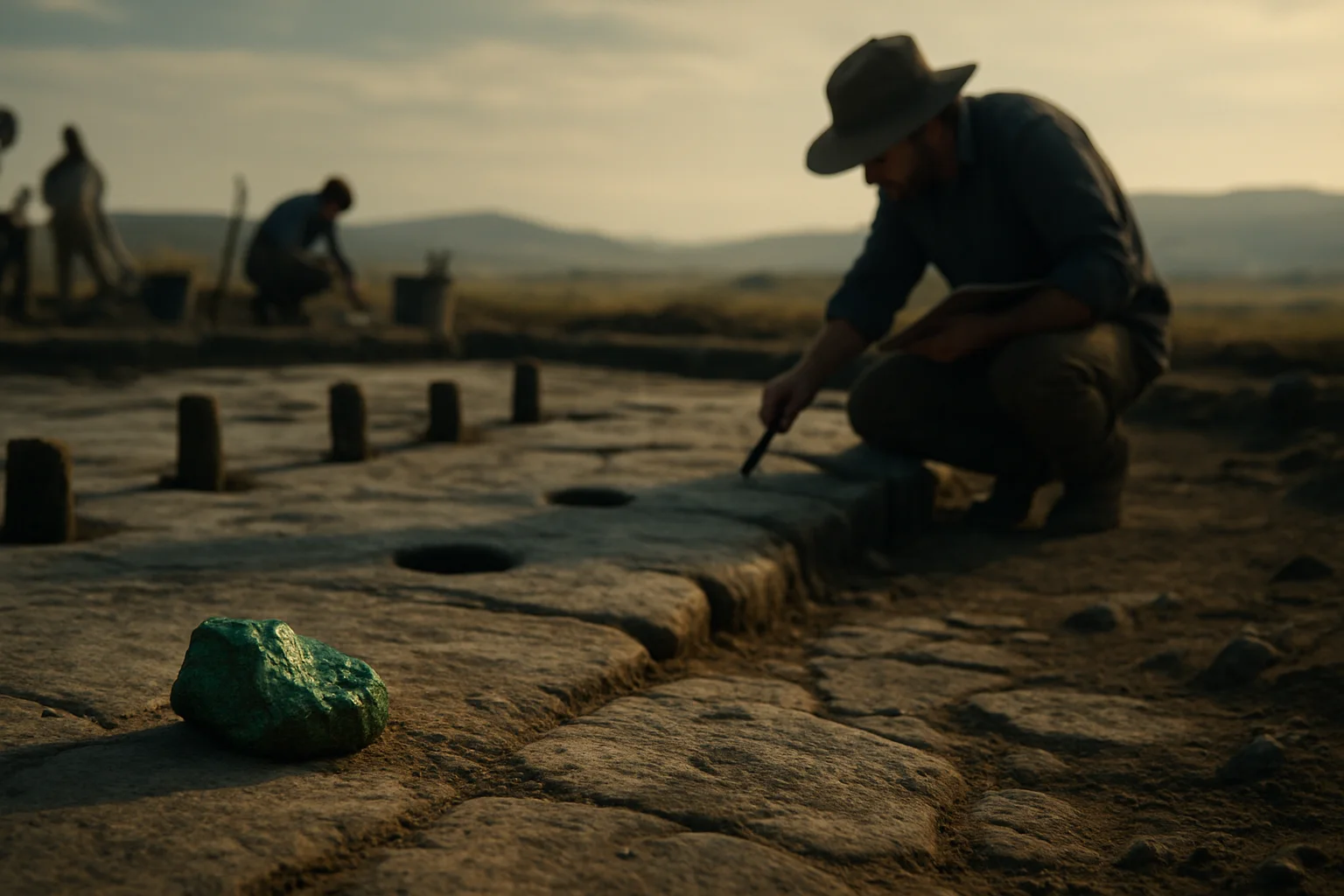
Excavators exposed a small stone‑paved surface bordered by at least six postholes. Within and around this space they recorded c. 40 malachite pieces (18 at the centre and ~24 nearby) alongside small copper beads and copper object fragments. Authorities and the excavation team described the assemblage as a "workshop" or "workplace," provisionally dated to c. 6900–6800 BCE. (Anadolu Agency; Çayönü project site).
2. Çayönü’s place in Neolithic research
Çayönü Tepesi has long been central to debates about the Neolithic in Anatolia: deep stratigraphy with early Pre‑Pottery Neolithic levels, distinctive 'grill' and 'cell' houses, and ritual architecture. The site’s research history stretches from mid‑20th century campaigns to contemporary fieldwork led by Savaş Sarıaltun since 2024 (Çayönü project site).
3. The finds in technical detail
Published press and field notes list malachite fragments at different stages of working, processed malachite pieces, and several small copper beads or metallic residues. The co‑occurrence of raw and worked material within a defined architectural context suggests multiple stages of production—storage, reduction, finishing—happened in the same limited space (Anatolian Archaeology; Hürriyet Daily News).
4. Why malachite matters
Malachite is a copper carbonate mineral often used for ornament and pigment in prehistory. Its presence alongside copper objects may indicate either a joined role in symbolic economy (green decorative pieces) or a technical role in early copper practices. Distinguishing symbolic vs. technical uses will require microscopic and chemical analysis.
5. The architecture: evidence for a purpose-built workspace
The paved surface and arrangement of postholes hint at a deliberately organised work area. Excavation director statements propose that the posts supported a simple shelter or shade, which would improve working conditions and suggest planned, repeated use—characteristics of specialised craft spaces rather than incidental manufacture.
6. Dating and uncertainty
Public statements give an initial date range of 6900–6800 BCE. The published press releases do not yet include full radiocarbon tables, sample contexts, or laboratory identifiers. Until those technical data and peer‑reviewed reports are available, the dating should be read as a preliminary assessment derived from field stratigraphy and initial dating programs.
7. Regional context: Ergani ores and Anatolian networks
The Ergani area is historically associated with copper sources. Earlier academic literature has long signalled Anatolia’s early experiments with native copper and malachite. If geochemical provenance studies link the workshop’s materials to Ergani sources, this would confirm local resource use; alternately, a more distant source would point to wider exchange networks.
8. What this adds to the story of early metallurgy
Çayönü’s workshop is notable because it ties production architecture to the long sequence of Neolithic occupation at the site. Rather than isolated finds of metal bits, here we have spatial organisation and an assemblage that documents several production phases—evidence that craft specialisation in mineral and metal working had a sustained material signature in some Neolithic communities.
9. Scientific steps ahead
Researchers will subject samples to micro‑XRF, SEM‑EDS, petrography and metalography to determine composition and working techniques. Radiocarbon dating of short‑lived samples and Bayesian sequencing will refine the chronology. Provenance work could employ lead isotope or trace‑element fingerprinting to test source hypotheses.
10. Final assessment: cautious excitement
Small in area but rich in implication, the Çayönü workshop expands our view of how Neolithic communities organised production and used mineral resources. It will only enter the technical historiography fully once peer‑reviewed reports and laboratory datasets appear; until then, it remains a carefully reported and promising discovery that underscores the longue durée of Anatolian technical traditions.
Sources: official project information from the Çayönü team, Anadolu Agency reporting, Anatolian Archaeology analysis, Hürriyet Daily News and relevant academic background literature on early Anatolian metallurgy.
Frequently asked questions
Is the Çayönü workshop definitely 9,000 years old?
Field announcements give c. 6900–6800 BCE as the working date. These are preliminary; final confirmation depends on published radiocarbon samples and laboratory reports.
Does finding malachite prove they smelted copper there?
Not necessarily. Malachite can be used for decoration or pigment as well as linked to copper working. Metallurgical analyses are required to show whether on‑site smelting, annealing or cold‑working occurred.
Will the finds be published in academic journals?
That is the normal expectation. The excavation team and project site indicate further laboratory analyses and forthcoming publications; peer‑reviewed articles will provide the full technical details.
How does this relate to other 2026 Turkish archaeological discoveries?
2026 has been active for fieldwork across Turkey (e.g., Pompeiopolis mosaics, Side avenues). Çayönü’s find is part of a season that is refining local and regional chronologies and revealing diverse threads of material culture and technology.
Sources and further reading
- 9,000-year-old mining workshop found in Türkiye — Anadolu Agency (AA), 2026-09-01
- Çayönü Tepesi — Kazı Başkanları / Tarihçe (project site) — Çayönü Tepesi Project (official site), accessed 2026-09-09
- 9000-Year-Old Malachite and Copper Workshop Discovered at Çayönü Tepesi — Anatolian Archaeology (news/analysis), 2026-09-01
- The chronological outline of Anatolian metallurgy (contextual academic reference) — Mineral Research and Exploration Bulletin (via DergiPark), 1990 (paper accessed 2026)
- 9,000‑year‑old mining workshop found in Diyarbakır — Hürriyet Daily News, 2026-09-03
- Pompeiopolis and other 2026 Turkish archaeological reports (context: region-wide 2026 season) — Anatolian archaeology reporting and regional press aggregation, 2026-09-02
Keep exploring: Use the topic hub for closely related articles or browse the full archive instead of starting a new search.