
The Frankfurt Silver Inscription: The Oldest Christian Evidence North of the Alps?
A 3.5-centimetre silver amulet from a Roman grave at Nida preserves an 18-line Latin text that may push material evidence for Christianity north of the Alps back by decades.
What is the Frankfurt Silver Inscription?
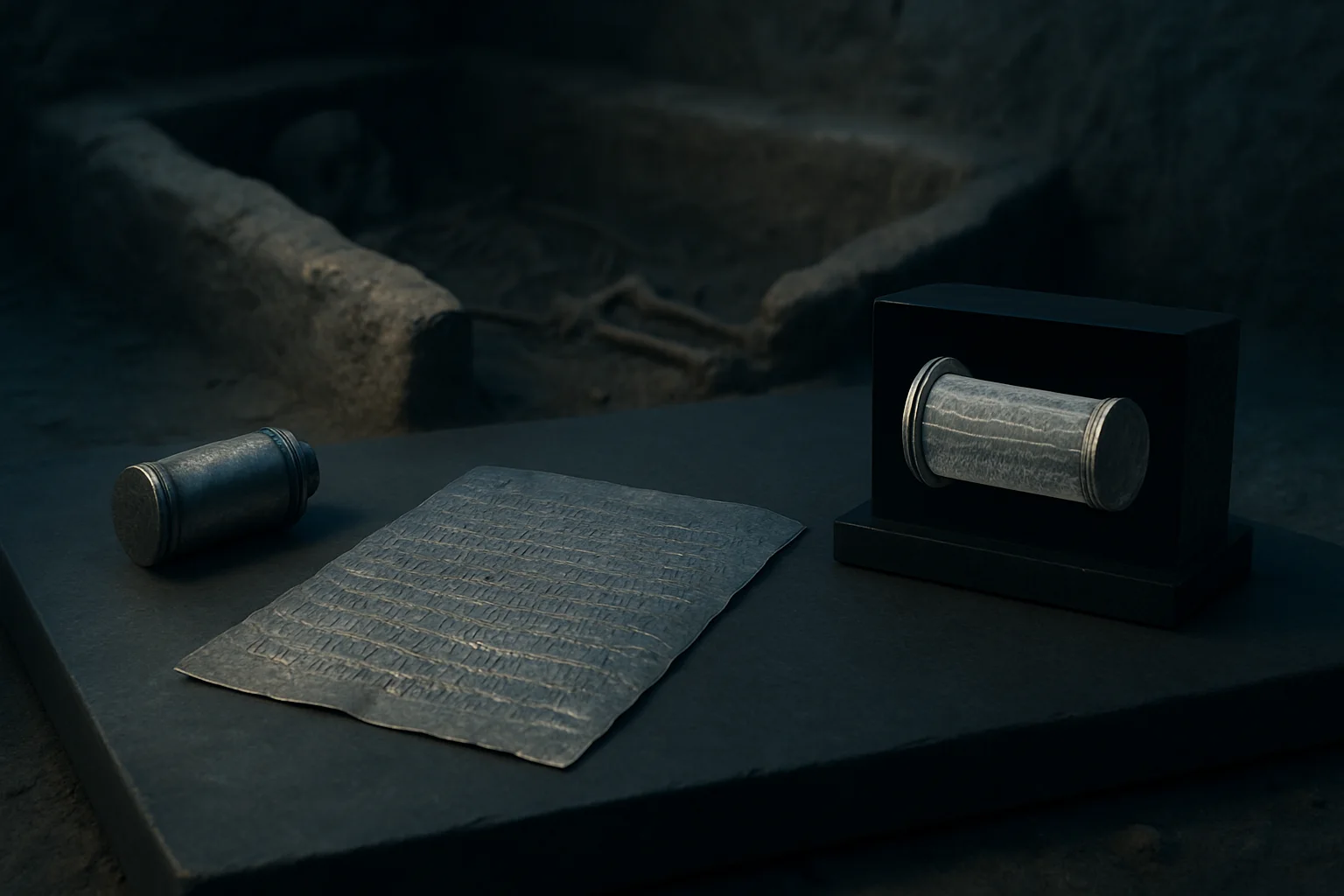
The object is a silver amulet capsule only 3.5 centimetres long. Inside it was a wafer-thin sheet of silver, tightly rolled and inscribed with eighteen lines of Latin. Archaeologists found the capsule near the neck of a man aged roughly thirty-five to forty-five in a Roman-period grave. Its position suggests that he wore it during life and was buried with it still hanging from his neck.
The historical importance lies in the words rather than the metal. The text invokes Jesus Christ as the Son of God, mentions Saint Titus and adapts language associated with Paul’s Letter to the Philippians. Unlike many protective amulets from Late Antiquity, it does not combine Christian language with Jewish divine names, pagan gods or named demons. Specialists therefore describe it as an unusually clear expression of Christian devotion for the third century.
Where was the amulet discovered?
Rescue excavations took place in 2017 and 2018 at Heilmannstrasse 10 in Frankfurt’s Praunheim district before construction of a private house. The site formed part of a cemetery serving Nida, the Roman predecessor of modern Frankfurt. Roman law placed cemeteries outside settlements, often along approach roads, and this burial ground had been known through scattered discoveries since the nineteenth century.
Nida was the capital of the Civitas Taunensium and developed into a major centre north of the River Main near the Roman frontier. The cemetery contained glass vessels, jewellery, beads and numerous pairs of shoes placed beside the dead. These objects connect the burials with high-quality funerary customs seen in larger Roman centres along the Rhine. The silver capsule was the most remarkable individual discovery.
Why is the grave dated to AD 230-270?
The inscription contains no explicit year. Archaeologists dated it through context: burial practice, associated glass and other objects, parallels from nearby graves and the occupation history of Nida. The Archaeological Museum Frankfurt and Goethe University place the grave broadly between AD 230 and 270.
That range is decisive. Most secure material evidence for Christian life in the northern Alpine provinces belongs to the fourth century. If the Nida burial is correctly dated, the amulet moves explicit archaeological evidence for an individual Christian in the region back by fifty to one hundred years. It does not, however, prove that a large organised congregation existed in the city.
How was the fragile inscription read?
After about eighteen centuries underground, the silver foil was crushed, folded and brittle. Physically unrolling it would almost certainly have broken the sheet into fragments and destroyed the relationship between its letters. Microscopy and conventional X-rays showed that writing was present, but they could not reveal a reliable continuous text.
In May 2024, the Leibniz Centre for Archaeology in Mainz scanned the roll with a high-resolution computed tomograph. The resulting three-dimensional dataset recorded hidden surfaces inside the compressed metal. Specialists separated the layers and virtually flattened them. Latin epigrapher Markus Scholz of Goethe University then reconstructed the eighteen lines like a puzzle, consulting theological historians where wording was uncertain. Some damaged margins remain open to alternative restorations.
What does the text say?
The inscription begins with a probable invocation of Saint Titus and the triple acclamation “holy, holy, holy.” It names Jesus Christ as Son of God and Lord of the world, asks for protection against attacks or afflictions and presents the object as a means of safeguarding the person who submits to Christ’s will.
Its conclusion states that heavenly, earthly and subterranean beings bend their knees before Jesus Christ and that every tongue confesses him. This closely echoes Philippians 2:10-11. The object is not a miniature Bible. It combines prayer, protective formula and confession of faith. The owner appears to have adapted the widespread Roman practice of wearing amulets to a distinctly Christian vocabulary.
Why is its exclusively Christian character unusual?
Protective texts from the Roman and Late Antique worlds often cross religious boundaries. A single amulet might invoke Jesus, Hebrew divine names, archangels, pagan deities and magical characters. Such combinations show that lived religion did not always follow the sharp categories later imposed by theologians and historians.
The Frankfurt inscription contains no reference to Yahweh, Israelite patriarchs, Raphael, Gabriel, Michael, pagan gods or named demons. “Purely Christian” is therefore a comparative description of its vocabulary. It does not mean that every later Christian doctrine is present, nor does it eliminate debate over whether protective amulets occupied an ambiguous zone between prayer and magic.
How does the find change the history of Christianity?
Christianity did not spread through the Roman Empire in neat, evenly expanding circles. Soldiers, merchants, enslaved people, officials, craftspeople and migrants carried beliefs through ports, frontier settlements and rural estates. Nida was a mobile, culturally mixed town close to the imperial frontier. A Christian individual there in the mid-third century is historically plausible, but clear archaeological proof had been missing.
The amulet shows that Christian devotion around the Rhine and Main did not begin only after imperial support in the fourth century. Private networks could have carried the religion earlier. Yet headlines calling its owner “the first Christian north of the Alps” should be treated carefully. Archaeology identifies the earliest currently known explicit evidence, not the first person who ever held the belief.
Who was the man buried with it?
Osteological analysis indicates an adult male aged approximately thirty-five to forty-five. His name, occupation, origin and path to Christianity are unknown. Wearing the capsule at the neck shows that it mattered personally. Because the text was sealed inside a small container, it offered protection while keeping the statement of faith largely invisible.
Christian persecution in the third century was not constant or equally intense throughout the empire. Risk varied by emperor, local administration and political crisis. It would be misleading to imagine the man facing execution every day. Nevertheless, he practised before Christianity received official favour, and public identification could carry social and legal consequences.
What remains uncertain?
Several damaged letters and words may be reconsidered as imaging and segmentation improve. Metallurgical analysis could identify the source and manufacture of the silver, while examination of the engraving may reveal whether a local specialist or a travelling scribe produced it. Further study of the cemetery could show whether the man was isolated or part of a small Christian network.
The object also demonstrates the wider value of digital archaeology. Computed tomography can recover text from artefacts that cannot safely be opened, including sealed containers, corroded metal rolls and carbonised manuscripts. In this case, a virtual procedure preserved the original while transforming an unreadable lump into a historical document.
Related reading
For another form of everyday writing in the Roman world, read our study of Pompeii graffiti and daily life. For a recent case in which architectural analysis changed the interpretation of a Roman room, continue with the Fuente Álamo Roman library.
Frequently Asked Questions
Is it definitely the oldest Christian evidence north of the Alps?
It is regarded as one of the earliest securely dated and explicitly Christian material finds in the region. The claim refers to currently known evidence, not necessarily the first Christian person who lived there.
Does the foil contain a biblical manuscript?
No. It is a protective prayer and confession of faith, although its closing formula echoes Philippians 2:10-11.
Can the amulet be seen by the public?
It has been displayed in the permanent exhibition of the Archaeological Museum Frankfurt since December 2024.
Why was it not physically unrolled?
The compressed foil was too brittle. Opening it mechanically would have destroyed the inscription, so researchers unfolded it virtually from CT data.
Sources
- Archaeological Museum Frankfurt, “Frankfurt Silver Inscription,” permanent exhibition and research dossier.
- Goethe University Frankfurt, “Oldest Christian testimony found north of the Alps,” December 12, 2024.
- Archaeological Museum Frankfurt, detailed questions and answers on the find, grave and inscription.
- Popular Mechanics, renewed international report, August 1, 2026.
Frequently asked questions
Where was the Frankfurt Silver Inscription found?
It was recovered from grave 134 in the Heilmannstrasse cemetery of Roman Nida, now within Frankfurt-Praunheim.
How old is the inscription?
The grave context is dated approximately AD 230-270.
How was the rolled silver sheet read?
Researchers scanned it with high-resolution computed tomography and digitally unfolded the compressed layers without physically opening the fragile foil.
Source trail
Selected references and research starting points
- [object Object]
- [object Object]
- [object Object]
- [object Object]
The list is a research trail. Specific claims should be checked against the cited edition, object record or publication.
Keep exploring: Use the topic hub for closely related articles or browse the full archive instead of starting a new search.