Blood Moon or Measured Moon? The 27–28 August 2026 Eclipse and Anatolia’s Eclipse Records
A historical look at the 27–28 August 2026 partial lunar eclipse: NASA visibility data, Ottoman-era eclipse records and Anatolian folklore examined together.
1. The scientific outline of the 27–28 August 2026 eclipse
NASA's eclipse pages list a partial lunar eclipse on 28 August 2026 UTC. Their catalogs provide exact timings, magnitude and global visibility maps that amateur and professional observers can use to plan viewing. For observers in the Europe/Istanbul time zone, the NASA schedules indicate when the Earth's shadow will begin to cover and then uncover the lunar disk. ([eclipse.gsfc.nasa.gov](https://eclipse.gsfc.nasa.gov/OH/OH2026.html))
2. 'Blood moon': popular phrase vs. atmospheric physics
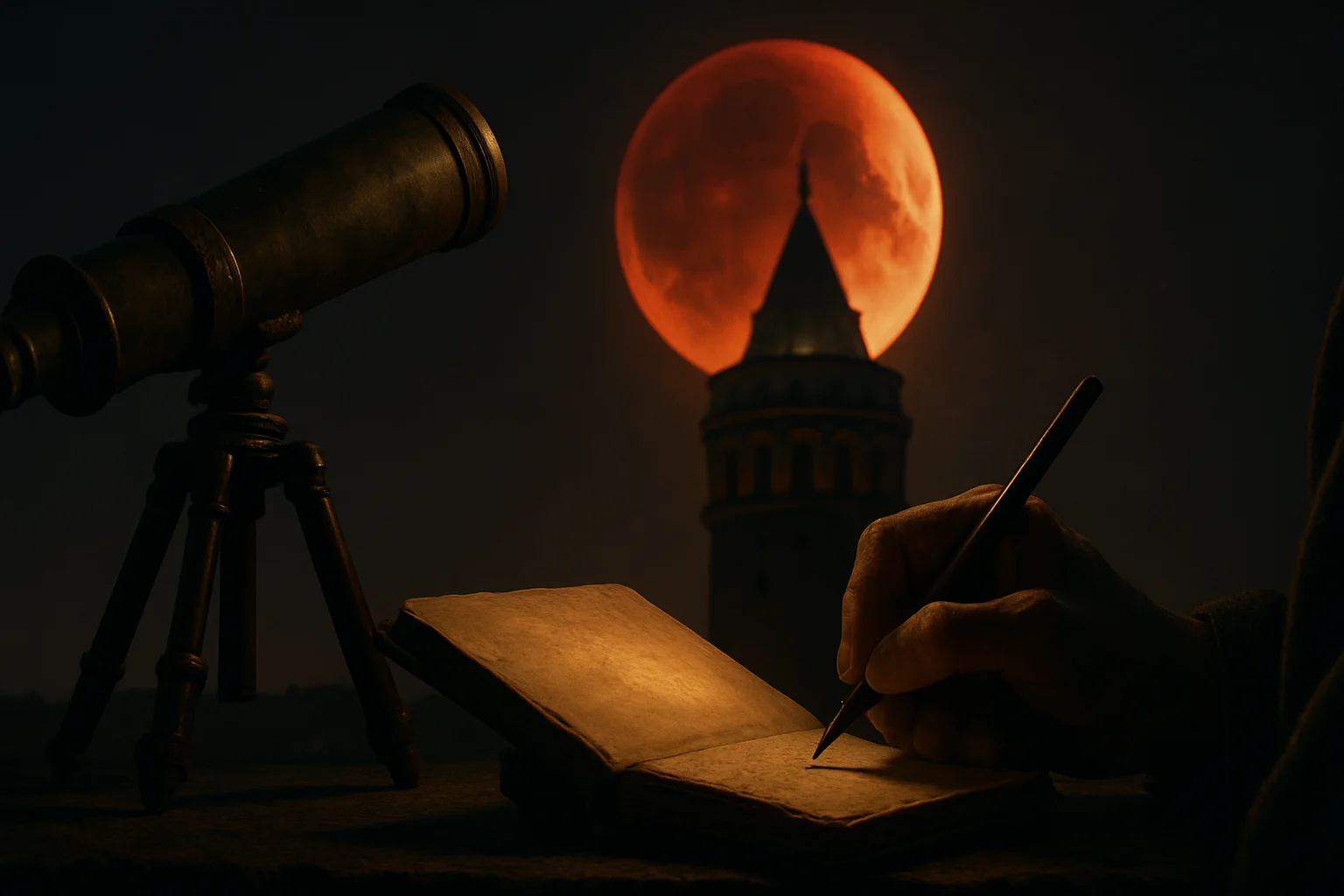
‘Blood moon’ is a popular shorthand for a reddish Moon seen during some eclipses. Scientifically, the red color results from sunlight refracted through Earth's atmosphere; shorter (blue) wavelengths scatter, while longer (red) wavelengths pass through and illuminate the Moon. Popular articles often pair the phrase with apocalyptic or prophetic narratives; reliable science-writing explains the optical cause. ([sciencefocus.com](https://www.sciencefocus.com/space/blood-moon-lunar-eclipse-myths-from-around-the-world))
3. Ottoman and Anatolian records of lunar eclipses
Manuscripts and calendar registers from the Ottoman world show systematic attention to eclipses from the 16th century onward. An AVESİS-hosted study examines eclipse notations in Ottoman calendar books between 1550 and 1710, indicating both practical (calendar-making) and observational motivations for recording eclipses. These sources show institutionalized observation rather than only sporadic chronicle entries. ([avesis.istanbul.edu.tr](https://avesis.istanbul.edu.tr/yayin/1fabfd29-2b7a-4ae1-aee2-f960092286e1/eclipse-records-in-ottoman-calendars-monitoring-solar-and-lunar-events-1550-1710))
4. Institutional observers: müneccimbashis, calendar-makers and the palace
Calculating and recording eclipse times were tasks linked to the palace and scholarly institutions. Müneccimbashis and calendar astronomers were responsible for providing accurate timetables for religious observances and administrative needs. Over centuries, these roles blended scientific calculation with statecraft and ritual timing. Scholarly works trace how these functions continued into the 19th century, even as European instruments began to influence local practice. ([dergipark.org.tr](https://dergipark.org.tr/tr/download/article-file/1185089))
5. Instruments and calculation methods in historical context
Historical sources point to volvelles, astronomical tables and other mathematical aids in Ottoman contexts. While early methods derived from Arabic-Persian and classical sources, contact with European instruments introduced new tools. Studies of instrument collections and surviving manuals document how eclipse prediction and timing were performed in different centuries. ([researchgate.net](https://www.researchgate.net/publication/342790521_A_Scientific_Tour_among_the_Mathematical_Instruments_in_the_Collection_of_the_Bibliotheque_nationale_de_France))
6. Why historical eclipse records matter to science
Chronicles and scientific notes about eclipses serve modern researchers in dating events and testing astronomical models. Because lunar eclipses can be computed retroactively with high precision, a recorded eclipse date and a description can anchor historical chronologies or help verify past observations—hence their value is not only cultural but also scientific. Cambridge-published research on Arabic chronicles offers examples of such usage. ([cambridge.org](https://www.cambridge.org/core/journals/bulletin-of-the-school-of-oriental-and-african-studies/article/abs/records-of-lunar-eclipses-in-medieval-arabic-chronicles/27A5ADCD710A2F5699709F1293A5401D))
7. Folklore and public response in Anatolia
Across Anatolia, historical responses to eclipses mixed ritual, superstition and learned explanations. Religious leaders often sought to calm public fears, leading communal prayers or prescribed rites. Folkloric motifs—from omens to symbolic readings—coexisted with the more technical, calendrical dimension of eclipse recording. Contemporary observers in 2026 are heirs to this layered cultural response. ([dergipark.org.tr](https://dergipark.org.tr/tr/pub/cuilah/article/1637908))
8. Practical tips for 2026 observers
NASA's visibility maps and timeline are the primary planning tools: they show when Earth's penumbra and umbra affect the Moon for any given longitude and latitude. For clear viewing in Turkey, select a site with a wide eastern-to-southern horizon and minimal light pollution. A tripod-mounted camera and a small telescope amplify detail; but the naked eye will clearly detect the darkness and any red hues if weather permits. ([eclipse.gsfc.nasa.gov](https://eclipse.gsfc.nasa.gov/OH/OH2026.html))
9. Conclusion: A single sky, multiple traditions
The 27–28 August 2026 eclipse offers a moment where precision astronomy and long-standing observation traditions meet. Modern datasets from NASA give exact times and maps; Ottoman and medieval Anatolian records show how past societies observed, calculated and interpreted the same phenomena. Observers tonight will join a lineage of watchful readers of the sky—armed now with both centuries of notes and instruments that earlier observers could only imagine.
Frequently asked questions
Will the August 2026 eclipse be visible from Istanbul?
NASA's visibility maps indicate that parts of Turkey will be able to see the partial eclipse; check the NASA 2026 eclipse page for precise UT times and convert to Europe/Istanbul local time. Clear skies are essential for a good view.
Is a reddish Moon during an eclipse dangerous to view?
No. Unlike solar eclipses, lunar eclipses are safe to view with the naked eye. Telescopes and binoculars can enhance detail but are not necessary for safety.
How reliable are Ottoman eclipse records for modern historians?
They are valuable but must be critically assessed: some entries are observational, some calendrical or ritual. When corroborated with independent sources, they help refine chronologies and understand observational practices.
What causes variations in how red the Moon appears?
Atmospheric conditions—such as dust, volcanic aerosols or pollution—change the amount and quality of red light refracted into Earth's shadow, making some eclipses appear darker or more blood-red than others.
Sources and further reading
- Eclipses During 2026 — NASA / Goddard Space Flight Center — Eclipse Web Site, 2026
- Lunar Eclipses: 2021–2030 (Visibility and Data) — NASA / Goddard Space Flight Center — Eclipse Web Site, 2021
- Eclipse Records in Ottoman Calendars: Monitoring Solar and Lunar Events (1550–1710) — İstanbul Üniversitesi AVESİS (academic repository), 2024
- Records of lunar eclipses in medieval Arabic chronicles — Bulletin of the School of Oriental and African Studies (SOAS) / Cambridge Core, 2008
- Blood moon: lunar eclipse myths from around the world — BBC Science Focus Magazine, 2018
- Osmanlı astronomisinde tutulma hesapları ve gözlem (1800–1922) — thesis overview — Tezara / Turkish theses repository, 2021
Keep exploring: Use the topic hub for closely related articles or browse the full archive instead of starting a new search.