
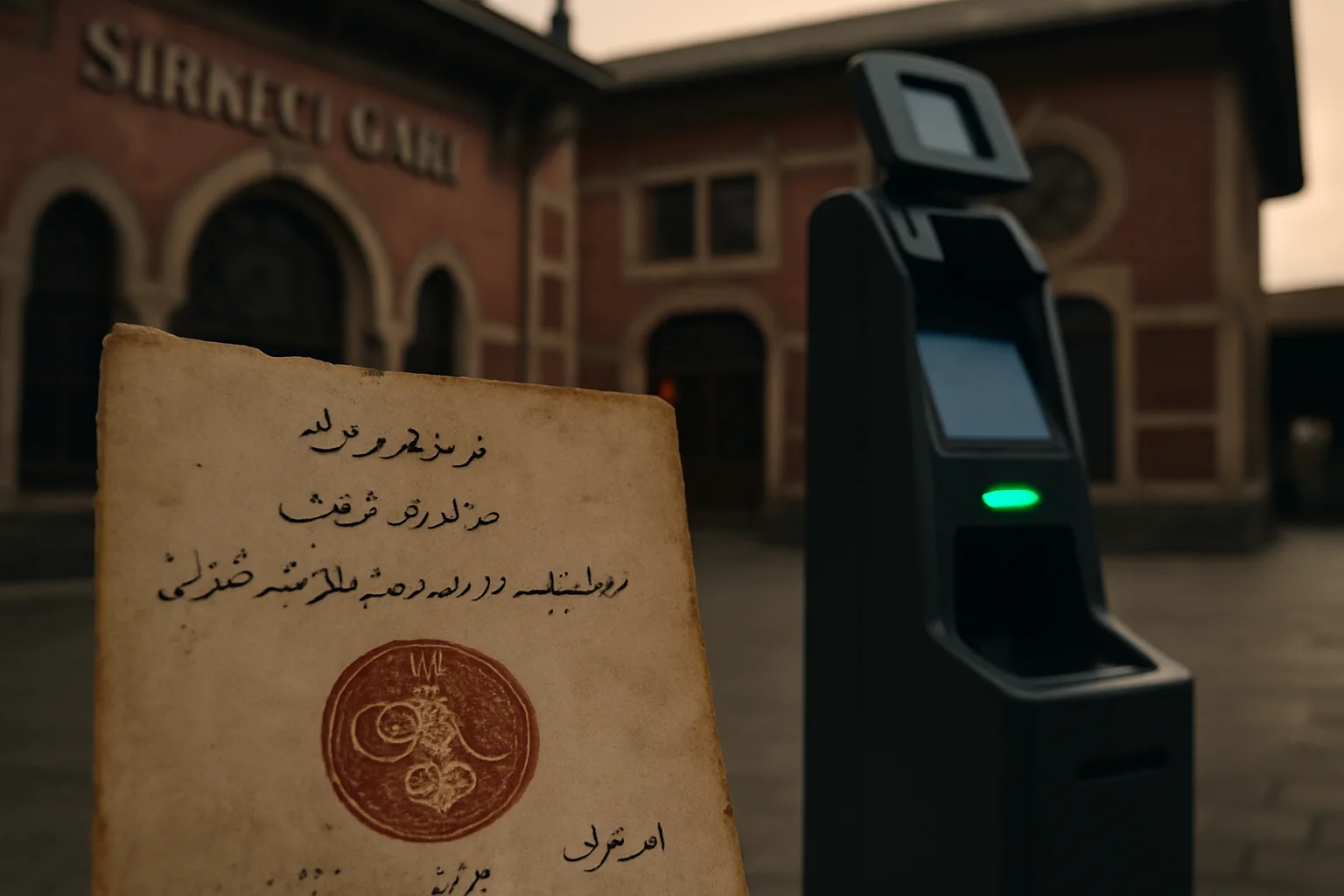
Entry/Exit System and the Long History of the Passport: From Ottoman Tezkere to EES
Through the EU's 2025–2026 EES rollout, this piece traces the long history of passports and border control from Ottoman mürur tezkeresi and the 1911 Passport Law to contemporary biometric border systems.
1. Contemporary background: what is EES and when did it start?
The European Union's Entry/Exit System (EES) is a centralized digital mechanism for recording entries and exits of third-country nationals across Schengen external borders. It launched progressively on 12 October 2025 and became fully operational on 10 April 2026. Managed by eu-LISA, EES aims to replace manual passport stamps for short stays (90 days within 180 days) with biometric registration (photo and fingerprints) and standardized records across participating states.
2. Why it matters for Turkey
Although Turkey is not a Schengen member, EES affects travelers from Turkey who cross Schengen borders. Debates in Turkey about 'giriş/çıkış sistemi' have focused on longer queues, the collection and sharing of biometric data, and operational adjustments at airports and land crossings. In short, EES reshapes the travel experience and raises questions about data governance that resonate in Turkish public debate.
3. Recording movement: the Ottoman roots
The administrative impulse to regulate movement long predates digital databases. In the Ottoman Empire, documents such as 'yol hükmü' evolved into the 'mürur tezkeresi' in the 19th century. From the mid-1800s onward, a sequence of regulations (notably in 1867, 1884 and 1894) culminated in the 1911 Passport Law, which established procedures more recognizably similar to modern passport regimes.
4. Republican transformations in border administration
The Republic of Türkiye inherited Ottoman documentary practices and reframed them within the legal and bureaucratic architecture of the nation-state. Passports and consular services became instruments of citizenship administration as well as border control; international agreements also began to shape how borders were policed and mobility was regulated.
5. From stamps to biometrics: technological change
Technological changes—photography, secure printing, fingerprinting, and automated facial recognition—have successively redefined what a passport is and what crossing a border entails. Systems like EES are the latest iteration, embedding border control into networked information systems rather than isolated checkpoints.
6. Privacy, law and public debate
Centralized biometric recording generates legal and ethical debates: how long are data kept, who can access them, and what remedies exist for errors? In the EU the discussions during EES implementation included data-retention limits, data access governance and operational safeguards; similar themes appear in Turkish public conversations as travelers experience the new procedures.
7. Operational realities: delays and adaptation
Reports from several European airports described longer processing times during the early months of EES deployment. Such teething problems—training staff, configuring kiosks, informing travelers—are common in transitions to new border technologies, and they echo historical transitions from handwritten registers to stamped passports.
8. Geopolitics of borders: cooperation and leverage
Border management is not merely technical; it has geopolitical dimensions. Turkey–EU cooperation on migration and border security since 2016 shows how technical systems (data-sharing, screening) become part of diplomatic bargaining. EES contributes technical capacity but also reshapes negotiation spaces where mobility and security intersect.
9. What history teaches us about today's choices
Historical perspectives show continuity: the state’s need to know who moves in and out has been constant, while instruments and scales of control have changed. The critical questions remain institutional: which rules govern access to movement data, how transparent are procedures, and how are individual rights balanced with collective security?
10. Final reflections: technology, continuity and accountability
EES exemplifies how contemporary border technology is best understood as a new layer atop a long administrative history. Observing past shifts—muhur ve tezkere (seals and permits), paper passports, and now biometrics—helps us ask the right questions about governance, rights, and the social consequences of recording movement. The current debate should therefore combine operational detail (how systems work at airports) with a historical eye on institutional design and accountability.
Frequently asked questions
When did the EES become fully operational?
The EES was progressively introduced from 12 October 2025 and became fully operational across Schengen external borders on 10 April 2026.
Does EES apply to travellers from Turkey?
Turkey is not part of Schengen, but travellers from Turkey entering Schengen countries are subject to EES controls at those borders.
What kinds of historical documents preceded modern passports in the Ottoman Empire?
Documents such as 'yol hükmü' and later 'mürur tezkeresi' served to regulate movement; reforms in the late 19th and early 20th centuries culminated in a 1911 Passport Law.
What are the main concerns about biometric entry/exit systems?
Key concerns include data protection (storage duration, access), accuracy of biometric matching, operational delays at borders, and legal remedies for mistakes.
Sources and further reading
- Entry-Exit System - Migration and Home Affairs - European Commission — European Commission, accessed 2026-09-07
- Entry Exit System: Smarter Borders from October 2025 — European External Action Service (EEAS) - Delegation to Türkiye, 2025-10-12
- The European Union’s entry/exit system (summary) — EUR-Lex — EUR-Lex (European Union Law), accessed 2026-09-07
- The Entry/Exit System: Implementation and first results — European Parliament Think Tank — European Parliament - EPRS, 2026
- Belgelerle Türk Turizm Tarihi / Devlet-i Aliyye (Osmanlı) Pasaportu — Anatolia: Turizm Araştırmaları Dergisi (DergiPark), 2022
- Diplomatic Archives of the Republic of Türkiye (Hazine-i Evrak - archive portal) — Republic of Türkiye Directorate for Diplomatic Archives, accessed 2026-09-07
Keep exploring: Use the topic hub for closely related articles or browse the full archive instead of starting a new search.