A Long History of Foreign Troops in Cyprus: From Ottoman Garrisons to the 1960 Guarantee System and the UN Buffer Zone
Why are there still Turkish, Greek, British and UN troops in Cyprus? This article traces their presence from the Ottoman conquest to the 1960 Treaties and UNFICYP.
Why is military presence in Cyprus back in the news?
In recent days, the foreign minister of the Turkish Republic of Northern Cyprus, Tahsin Ertuğruloğlu, has described the Turkish military presence on the island as “vital”, during a visit by Turkey’s Land Forces commander to the Turkish Cypriot Peace Forces Command.([aa.com.tr](https://www.aa.com.tr/tr/dunya/kktc-disisleri-bakani-ertugruloglu-kibristaki-turk-askeri-varligi-hayati-bir-onem-tasiyor/4034632/4034632)) Such statements, along with periodic changes of command, regularly revive public debate in Turkey and Cyprus about why troops are still there and under what legal basis.
Rather than arguing for one political position, this article steps back to ask a different question: how did Cyprus become so heavily militarised in the first place? From Ottoman rule to British bases, the 1960 Treaties, UNFICYP and the aftermath of 1974, today’s deployments sit atop centuries of competing garrisons.
A strategic island that keeps attracting armies
Cyprus is the third-largest island in the Mediterranean, after Sicily and Sardinia. It lies roughly 70 km south of the Turkish coast and commands sea routes towards the Levant and Egypt.([islamansiklopedisi.org.tr](https://islamansiklopedisi.org.tr/kibris)) Geologically, it is often described as an extension of the Taurus mountain system, tying it physically as well as historically to Anatolia.
This position made Cyprus attractive to empires that wanted to project power across the Eastern Mediterranean. Copper deposits, agricultural land and good harbours created economic value, while the same harbours served as launching pads for campaigns towards Syria-Palestine and Egypt. From Roman and Byzantine times through Lusignan and Venetian rule, each power maintained significant garrisons on the island.
From the Ottoman conquest to a garrison island (1570–1878)
The Ottoman Empire’s conquest of Cyprus unfolded in the context of its struggle with Venice for control of the Eastern Mediterranean. Ottoman forces captured Nicosia in September 1570 and accepted the surrender of Famagusta in August 1571, bringing the island under imperial control.
Ottoman administrators quickly organised Cyprus as a militarised frontier province. Janissary and sipahi units were stationed in strategic castles and ports, and fiscal records from the 1570s and 1580s show substantial allocations for these garrisons.([jstor.org](https://www.jstor.org/stable/j.ctt9qfp86)) Beyond formal troops, the island became enmeshed in the wider world of Mediterranean corsairing, with Christian and Muslim pirates using its inlets and bays.
For Istanbul, keeping a strong garrison on Cyprus was a way to shield the southern Anatolian coast and to restrain Western fleets. For Venice, Spain and later other European powers, this same garrison turned the island into a potential threat to their trade and naval movements. The basic pattern was set: whoever held Cyprus sought to host enough troops there to deter its rivals.
British rule and imperial bases (1878–1960)
In the late nineteenth century, Cyprus shifted from Ottoman to British hands. The 1878 Cyprus Convention gave London control of the island’s administration while it remained, on paper, Ottoman territory; with the outbreak of the First World War and Ottoman entry on the opposite side, Britain unilaterally annexed Cyprus in 1914 and made it a Crown Colony in 1925.([islamansiklopedisi.org.tr](https://islamansiklopedisi.org.tr/kibris))
For the British Empire, Cyprus was a forward operating base along the routes to the Suez Canal, the Middle East and India. Ports, airfields and signals stations turned the island into an important hub for the Royal Navy and Royal Air Force in the Eastern Mediterranean. During the Second World War it played a role in air and intelligence operations against Axis forces.
As anti-colonial movements grew, the security landscape changed. The EOKA campaign for union with Greece targeted British military and police installations in the 1950s, prompting further militarisation and emergency regulations. In this period, Cyprus became not only an imperial asset but also a site of violent struggle against that same imperial presence.
The 1960 Republic, the Guarantee system and three kinds of troops
The Zurich and London agreements of 1959 paved the way for an independent, bi-communal Republic of Cyprus, established on 16 August 1960. One of the cornerstones of the new constitutional order was the Treaty of Guarantee, signed between Cyprus, Greece, Turkey and the United Kingdom.
The Treaty committed the three guarantor states to respect and ensure the independence, territorial integrity and constitutional order of Cyprus, explicitly prohibiting union with any other state or partition. A separate Treaty of Alliance provided for the stationing of small Greek and Turkish contingents on the island: roughly 950 Greek (ELDYK) and 650 Turkish (TURDYK) troops.
In parallel, the United Kingdom retained sovereignty over two military areas, the Sovereign Base Areas of Akrotiri and Dhekelia, which remained under British control. As a result, by the early 1960s Cyprus hosted the armed forces of the new republic, two small national contingents from Greece and Turkey, and substantial British bases.
UNFICYP and the birth of the Green Line
The early years of the Republic were marred by intercommunal tensions and violence between Greek Cypriots and Turkish Cypriots. Following serious clashes in 1963–64, the UN Security Council adopted Resolution 186 on 4 March 1964, establishing the United Nations Peacekeeping Force in Cyprus (UNFICYP).
Initially mandated for three months, UNFICYP has since been renewed every six months, becoming one of the UN’s longest-running peacekeeping operations. Its mandate is to prevent a recurrence of fighting, contribute to the maintenance and restoration of law and order, and facilitate a return to normal conditions.([digitallibrary.un.org](https://digitallibrary.un.org/record/118480/files/%5EST_%5EDPI_850--DPI_850-EN.pdf)) Over time, the mission’s visible footprint became the buffer zone that runs across the island – popularly known as the “Green Line”, after the line first drawn on a map of Nicosia by a British officer.
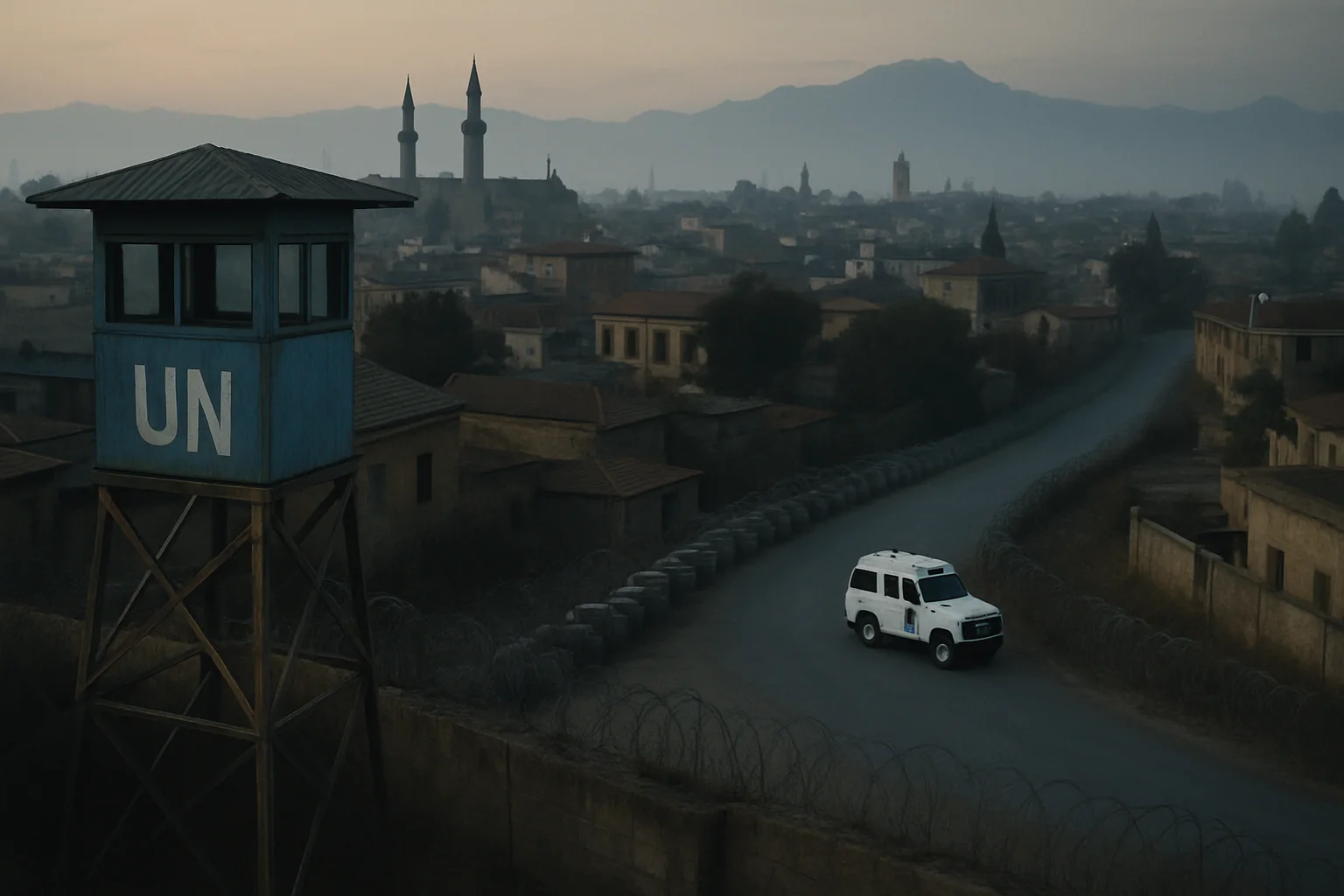
In the heart of the capital, today’s Ledra Street crossing illustrates the paradox of this arrangement: tourists and locals cross on foot between north and south, while UN soldiers monitor a strip of alleyways, sandbags and watchtowers just a few metres away.
1974, partition in practice and a heavily militarised north
In July 1974, a coup in Nicosia backed by the military regime then ruling Greece sought to achieve enosis, union with Greece, and effectively overthrew the constitutional order protected by the Treaties. Citing its rights and duties under the Treaty of Guarantee, Turkey launched a military intervention. Fighting ended with the island de facto divided into a Turkish Cypriot north and a Greek Cypriot south.
Since then, Turkish Armed Forces and Turkish Cypriot security forces have been deployed in the north, while the National Guard of the Republic of Cyprus and Greek units remain in the south. Estimates of Turkish troop numbers vary: a 2009 report by the UK House of Commons Foreign Affairs Committee cited figures between 21,000 and 24,000 soldiers,([publications.parliament.uk](https://publications.parliament.uk/pa/cm200809/cmselect/cmfaff/196/19604.htm)) while more recent reporting by international news agencies refers to more than 35,000.([apnews.com](https://apnews.com/article/01564a406e06f3bdabc798f2b0da6c66)) These levels have led some analysts to describe northern Cyprus as one of the most militarised areas in the world, relative to its civilian population.
Numbers and narratives: security for whom?
Debates about military presence in Cyprus are not only about numbers but also about narratives. For many Turkish Cypriots and Turkish officials, the memory of clashes in the 1960s and the events of 1974 underpin the view that Turkish troops provide a security umbrella and deterrent.([aa.com.tr](https://www.aa.com.tr/tr/dunya/kktc-disisleri-bakani-ertugruloglu-kibristaki-turk-askeri-varligi-hayati-bir-onem-tasiyor/4034632/4034632)) Many Greek Cypriot political actors, by contrast, regard the large Turkish military footprint as a symbol of occupation and insist that a comprehensive settlement should include substantial demilitarisation or complete withdrawal of foreign troops.
UN reports and outside observers such as the UK Parliament have repeatedly pointed to the risks created by dense military deployments along a long ceasefire line: minor violations or misunderstandings can escalate quickly.([digitallibrary.un.org](https://digitallibrary.un.org/record/118480/files/%5EST_%5EDPI_850--DPI_850-EN.pdf)) At the same time, in the absence of a political settlement, both communities worry that a sudden security vacuum would leave them vulnerable in a moment of crisis. This tension helps explain why security and guarantees remain among the most sensitive chapters in every round of peace talks.
Peacekeeping, the buffer zone and everyday life
Over six decades, UNFICYP has become woven into the island’s daily routines as well as its high politics. The mission patrols the buffer zone, investigates incidents along the ceasefire lines and facilitates practical arrangements – from farming and water management in the zone to demining and the restoration of cultural heritage sites.([publications.gov.cy](https://publications.gov.cy/en/publications/2024/06/19/60-years-unficyp-1964-2024/))
In Nicosia’s old town, houses whose gardens back directly onto the buffer zone have windows facing UN observation posts, while streets end abruptly in barrels, barbed wire and faded warning signs. The result is a landscape in which military infrastructure, international peacekeeping and civilian life are tightly interwoven – a reminder that in Cyprus, militarisation is not confined to distant front lines.
Demilitarisation and future scenarios
In recent years, UN-sponsored negotiations have repeatedly wrestled with questions of guarantees and security. Some proposals envisage the complete withdrawal of Greek and Turkish mainland forces and a gradual demilitarisation of the island, possibly accompanied by a reconfigured international presence. Others argue for retaining a reduced version of the existing system, updated to reflect contemporary security concerns.
History suggests that whenever Cyprus has been perceived as a strategic vacuum, another power has sought to fill it – from the Ottomans to the British and, in a different way, through the 1960 Treaties and UN peacekeeping arrangements. Recognising this pattern does not predetermine today’s choices, but it does highlight what is at stake when discussions turn to troop levels, guarantees and the future of UNFICYP.
Ultimately, any durable settlement will require not only legal agreements and security clauses, but also a shift in how the island’s communities and the guarantor states think about safety. If security continues to be equated mainly with the permanent stationing of troops, demilitarisation will remain unlikely. If, however, trust-building, shared institutions and regional cooperation gain ground, the long history of foreign garrisons in Cyprus may finally give way to a different kind of peace.
Frequently asked questions
Why are there still Turkish, Greek, British and UN troops in Cyprus today?
The current picture is the outcome of several layers of arrangements: the 1960 Treaties of Establishment, Guarantee and Alliance, which provided for small Greek and Turkish contingents and for British Sovereign Base Areas; the creation of UNFICYP in 1964 to prevent renewed fighting; and the military deployments that followed the 1974 crisis and the island’s de facto division. All of these have been renewed or maintained in various forms up to the present.
What did the 1960 Treaty of Guarantee actually say?
The Treaty of Guarantee obliged Greece, Turkey and the United Kingdom to respect and ensure the independence, territorial integrity and constitutional order of the Republic of Cyprus, banning union with another state or partition. It allowed the guarantors to consult and, if joint action proved impossible, for each to take action with the sole aim of re-establishing the status quo. Lawyers and diplomats still disagree on whether this wording authorised unilateral military intervention in 1974.
What is UNFICYP and why is it still operating?
UNFICYP is the United Nations Peacekeeping Force in Cyprus, created in 1964 after intercommunal violence. Its mandate is to prevent a recurrence of fighting, help maintain law and order and support a return to normal conditions. Over time it has also dealt with humanitarian issues, cultural heritage and confidence-building measures. Because a comprehensive political settlement has not yet been reached, the UN Security Council has repeatedly renewed its mandate.
How many Turkish troops are estimated to be in northern Cyprus?
Exact figures are not officially published, so estimates vary. A 2009 report by the UK House of Commons Foreign Affairs Committee cited numbers between 21,000 and 24,000 soldiers, while more recent international reporting has mentioned more than 35,000. Different tallies depend on which units and support elements are counted and reflect the political sensitivities around the issue.
Why has Cyprus been so important strategically throughout history?
Cyprus sits close to the southern coast of Turkey and astride sea routes linking the Aegean, the Levant and Egypt. This location has made it valuable as a naval and air base for powers seeking to project force in the Eastern Mediterranean and the Middle East. Its resources and harbours added economic significance, but it is the ability to monitor and control nearby coasts and sea lanes that has repeatedly drawn empires and modern states to garrison the island.
Sources and further reading
- KKTC Dışişleri Bakanı Ertuğruloğlu: Kıbrıs'taki Türk askeri varlığı hayati bir önem taşıyor — Anadolu Ajansı
- KIBRIS — TDV İslâm Ansiklopedisi, 2022
- 60 years UNFICYP 1964-2024 — Government of Cyprus, 2024-06-19
- UNFICYP since 1974 (ST/DPI/850) — United Nations
- Visit to Cyprus – Foreign Affairs Committee — UK Parliament, 2009-02-06
- Cyprus History: 1960 Cyprus Treaty of Guarantee — Cypnet
- United Nations Peacekeeping Force in Cyprus — Wikipedia
- Turkey warns Cyprus' Israeli air defense system could destabilize island — Associated Press
Keep exploring: Use the topic hub for closely related articles or browse the full archive instead of starting a new search.