Marcus Aurelius’ Lost Campaign Camp: What Was Found at Šurany?
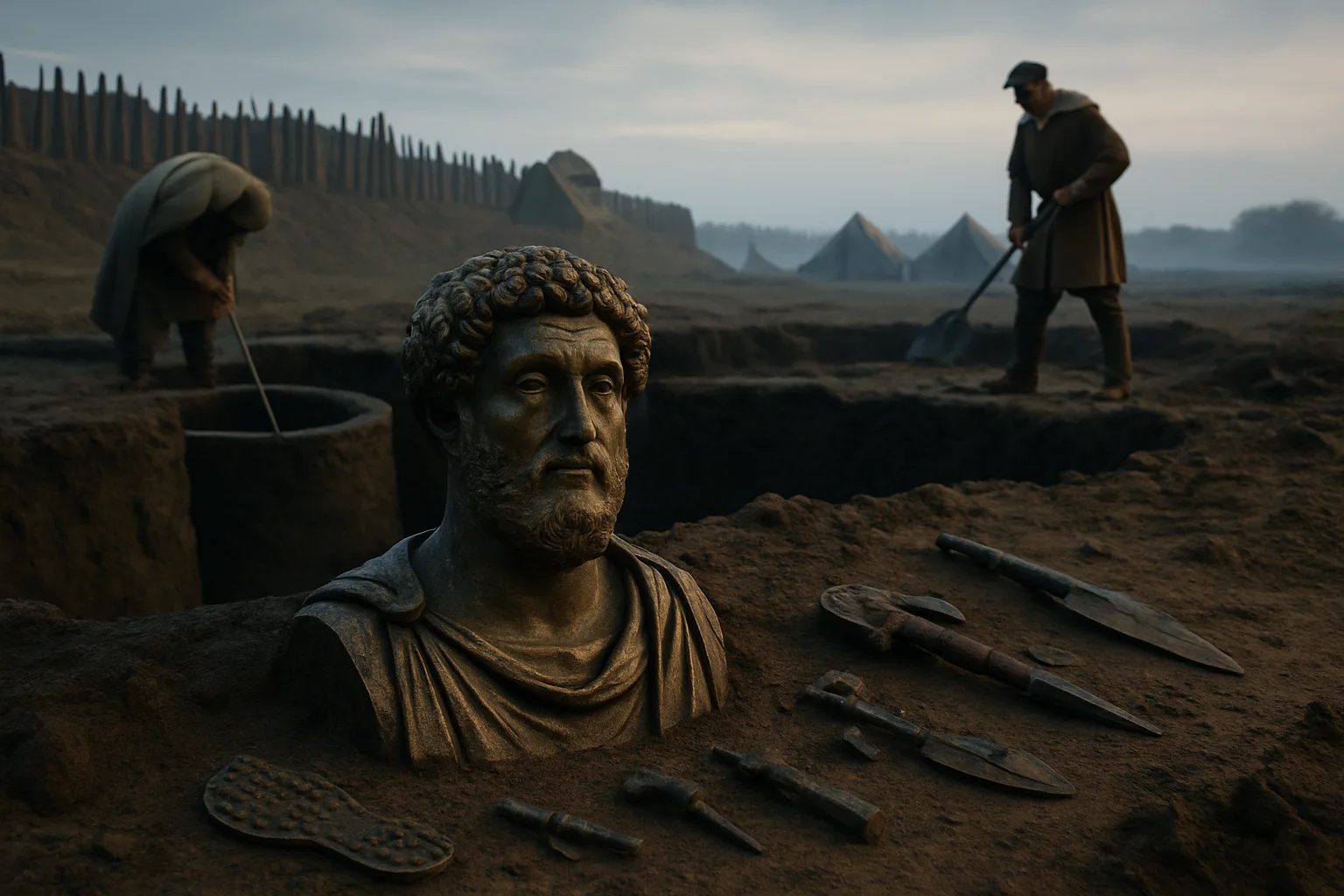
A Roman marching camp in Slovakia has revealed soldiers in wells and ditches, armour, weapons and preserved sandal nails from the age of the Marcomannic Wars.
Where was the Šurany Roman camp found?
The camp lies near the town of Šurany in the Nitra region of southwestern Slovakia, within the planned Šurany Industrial Park. Archaeologists from the Institute of Archaeology of the Slovak Academy of Sciences, working with MH Invest, have examined more than 150 hectares of the development area. The Roman camp is the most important discovery made during that extensive investigation.
Its position north of the Danube is historically significant. The permanent Roman frontier followed the river, but imperial armies repeatedly crossed into territories occupied by Germanic and other communities. The new camp provides direct evidence for one of those expeditions and fills a major gap in the archaeology of Roman activity in the Nitra region.
Why is the site linked to Marcus Aurelius?
The camp is dated to the second half of the second century and is probably associated with the Marcomannic Wars of A.D. 166-180. During these conflicts, Emperor Marcus Aurelius directed long campaigns against the Marcomanni, Quadi and allied groups along and beyond the Danube frontier. Coins, military fittings and the structure of the camp support this chronological framework.
Roman presence deep in the region is also documented by the famous inscription carved into the castle rock at Trenčín in A.D. 179. The Šurany camp adds an archaeological landscape to that written evidence, showing how troops moved, fortified temporary positions and suffered losses north of the imperial border.
What did the 7.4-hectare camp look like?
Roman marching camps were fortified bases built by armies during campaigns. They could be occupied for a night, a season or longer depending on military needs. The Šurany enclosure covers about 7.4 hectares. It is not a perfectly regular rectangle, but it contains the expected defensive elements: ditches, ramparts, fortifications and five gateways.
One gateway used a clavicula design, in which a curving ditch and bank channelled movement into the entrance while shielding it from a direct assault. This is the first example of that gate type identified in Slovakia. The feature demonstrates that even a temporary camp was laid out according to specialised Roman military engineering principles.
Why were bodies found in wells and ditches?
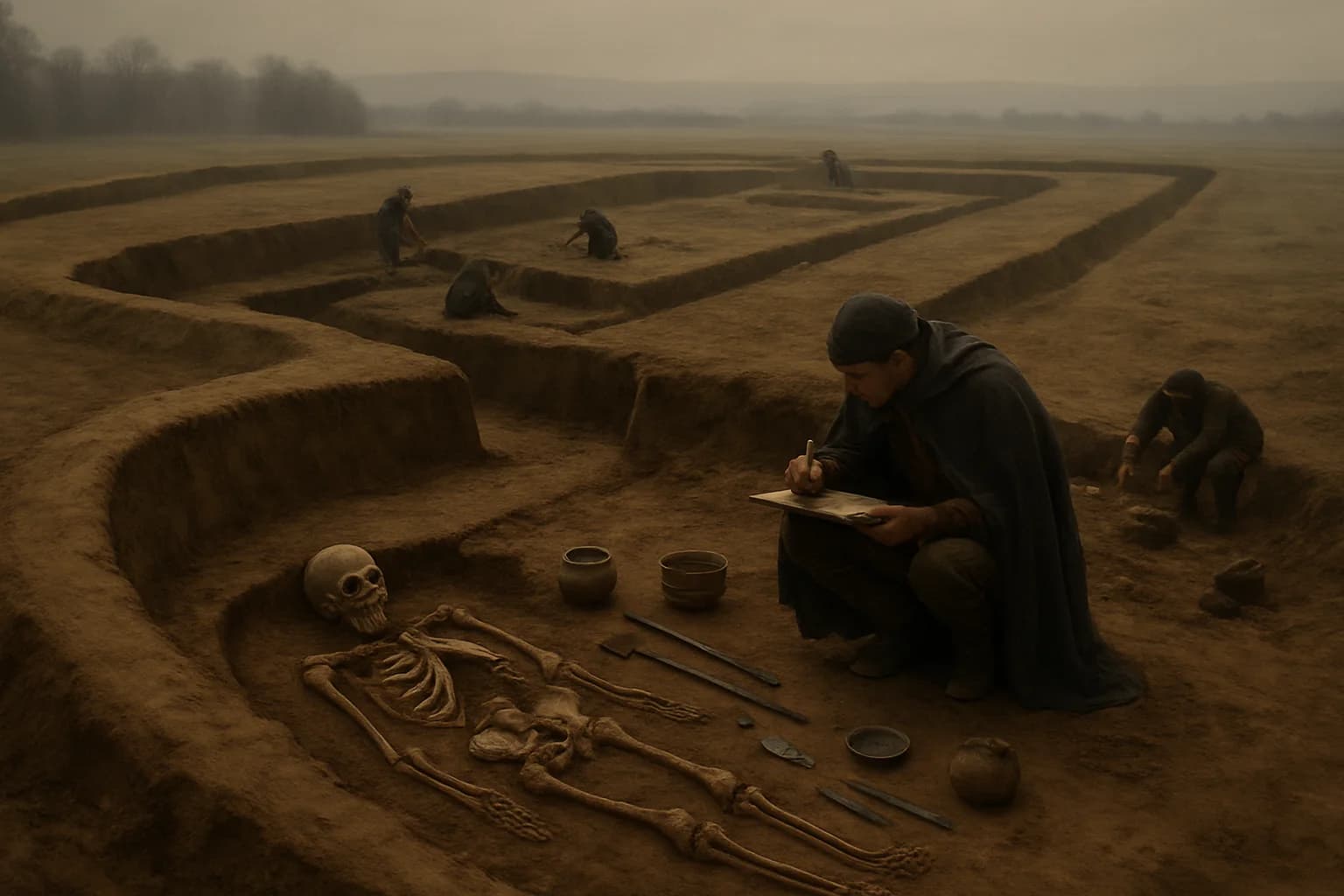
The most disturbing evidence comes from human remains placed in defensive ditches, wells and hastily dug shallow graves. Some skeletons were incomplete, while others remained associated with weapons, armour fittings and footwear. Researchers have provisionally suggested that many of the dead were Roman soldiers.
Such treatment differs from an organised military cemetery. It may reflect an attack, a battle, an epidemic, an emergency retreat or a rushed effort to dispose of bodies before abandoning the position. The cause cannot yet be determined. Trauma analysis, radiocarbon dating, ancient DNA and isotope studies will be needed to establish how the individuals died, where they grew up and whether they belonged to the same military unit.
What military equipment survived?
Finds include spearheads, arrowheads, helmet fragments, components of segmented and scale armour, legionary brooches, coins and iron hobnails from caligae, the heavy sandals associated with Roman troops. Their close relationship with the skeletal remains is one reason archaeologists identify many of the dead as soldiers.
The sandal evidence is especially vivid. Although the leather decayed, X-ray examination of soil blocks revealed the original arrangement of iron nails. Specialists may be able to reconstruct the outline and even estimate the size of individual footwear. A mass army becomes more human when archaeology preserves the shape of a single soldier’s shoe.
Why does the apparent lack of looting matter?
Metal equipment was valuable and was normally recovered from abandoned camps or battlefields. The survival of weapons and armour beside bodies may mean that the event unfolded quickly and that survivors could not return. It may also indicate that the camp was sealed by rapid infilling or that only parts of it escaped later scavenging.
Context will decide between those possibilities. A helmet beside a skull, hobnails in anatomical position and a weapon aligned with an arm carry different meanings from objects scattered in secondary deposits. Detailed excavation plans and laboratory analysis will therefore be more important than the dramatic objects viewed in isolation.
Why were the Marcomannic Wars a turning point?
The Roman Empire of the mid-second century was wealthy and extensive, but it was under growing pressure. The Antonine Plague reduced population and military manpower, while groups beyond the Danube crossed the frontier and at times penetrated deep into Roman territory. Marcus Aurelius spent much of his reign directing campaigns from the northern provinces.
Roman forces did not merely defend permanent forts. They crossed the river, built temporary camps, maintained supply routes and attempted to control hostile landscapes. Šurany is a physical record of that mobile warfare. It shows an army operating beyond the frontier and possibly suffering a disaster that forced the rapid abandonment of a carefully engineered position.
Was Marcus Aurelius personally at Šurany?
There is currently no direct evidence that the emperor stayed at this particular camp. An inscription, seal or object securely connected to his entourage would be required to make that claim. Many Roman formations operated across the region under subordinate commanders while Marcus Aurelius coordinated the wider war.
Calling it a “camp from the time of Marcus Aurelius” is accurate. Calling it his personal headquarters would go beyond the evidence. Archaeology often provides strong chronological connections without identifying a famous individual’s exact movements.
How could the discovery change Roman history?
The chance to investigate almost an entire marching camp is exceptionally rare. Many temporary Roman camps survive only as crop marks, partial ditches or features cut by later development. At Šurany, archaeologists can study the defensive circuit, gateways, internal zones, wells, bodies and equipment within a single landscape.
This completeness may reveal how many troops occupied the site, how long they stayed, where animals and supplies were kept, and how the camp ended. Isotope results could show whether soldiers came from the Balkans, Italy, the eastern Mediterranean or other provinces. Coins and pottery may narrow the occupation to a specific phase of the wars.
The site also demonstrates the value of large-scale rescue archaeology. Industrial development created the funding and access needed to expose a camp that fragmented land ownership and limited budgets might otherwise have left unexplored. The challenge now is to preserve the evidence, publish the results and communicate uncertainty without turning a complex discovery into a simple battle legend.
Frequently asked questions
How old is the Šurany Roman camp?
It dates to the second half of the second century, approximately 1,800 to 1,850 years ago.
How large was the camp?
It covered about 7.4 hectares and had five fortified gateways.
Were the skeletons Roman soldiers?
The associated weapons, armour and footwear support that interpretation, but laboratory analysis is still required.
Did Marcus Aurelius stay there?
No direct evidence proves that he did. The camp is connected to the wars fought during his reign.
Sources and further reading
- Institute of Archaeology, Slovak Academy of Sciences, “Roman military camp from the time of Marcus Aurelius discovered near Šurany”, 21 July 2026.
- Slovak Academy of Sciences news service, 20 July 2026.
- MH Invest archaeological research statements.
- Live Science, “Extremely rare Roman military camp found in Slovakia”, 23 July 2026.
- Cassius Dio, Roman History, books covering Marcus Aurelius and the Marcomannic Wars.
Keep exploring: Use the topic hub for closely related articles or browse the full archive instead of starting a new search.