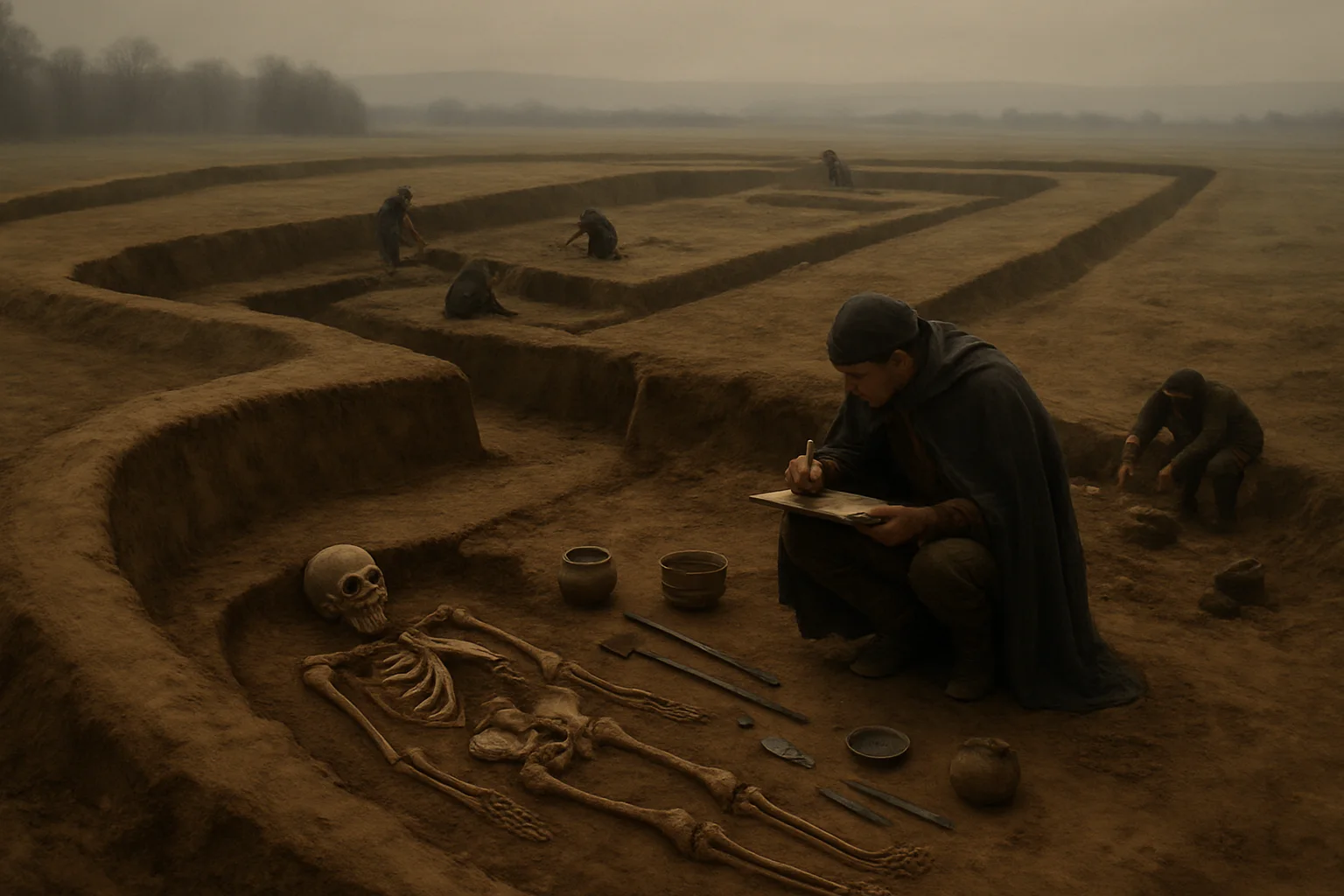
Marcus Aurelius’ Lost Campaign? Human Remains Found at the Šurany Roman Camp
A 7.4-hectare Roman marching camp in Slovakia may preserve evidence of a sudden military disaster during the Marcomannic Wars.
Why does the Šurany discovery matter?
Šurany lies north of the Danube, beyond the permanent frontier installations of the Roman Empire. Roman armies campaigning in this region depended on temporary field camps rather than only on stone forts. A marching camp preserved across most of its plan is therefore unusually informative. According to the Slovak Academy of Sciences, it is the first confirmed Roman military camp in the Nitra region and fills a major gap in the map of Roman activity north of the Danube during the final third of the second century.
The excavation forms part of archaeological work for the planned Šurany Industrial Park. Researchers have examined more than 150 hectares and are continuing intensive investigation across additional land around the camp. The scale matters because archaeology can document not merely isolated objects but the relationship between gates, roads, ditches, internal zones and deposits formed when the site went out of use.
What was a Roman marching camp?
Roman forces were trained to construct an organized camp at the end of a day's movement. Even a temporary enclosure could include a ditch, an earthen rampart, controlled gateways, tent lines, command space and areas for animals and supplies. These camps were not intended to resemble monumental stone forts. Their value lies in the direct evidence they provide for troop movement, military engineering, unit size and perceived danger.
At approximately 7.4 hectares, the Šurany enclosure was large enough to serve a substantial force. It would be unsafe, however, to convert area directly into a precise soldier count. Space requirements changed according to the number of animals, baggage, auxiliary troops, command units and the density of tents. Detailed mapping of internal features may eventually show whether the camp held part of a legion, a combined auxiliary force or a more mixed expeditionary group.
Why is the clavicula gateway important?
One of the most distinctive features is a clearly documented clavicula-style entrance, described as the first confirmed example of its type in Slovakia. In this arrangement, the ditch and rampart curve around the approach so that anyone entering must turn through a narrow and exposed passage. The design prevented a direct rush through the gate and placed attackers at a tactical disadvantage.
The presence of five entrances also provides clues about circulation and orientation. Roman camp roads normally connected gates with command and troop zones. Their alignment may reflect the direction from which the army arrived, the expected enemy position, nearby water and the route to the next camp. Geophysical survey, excavated ditch sections and artifact concentrations can be combined to reconstruct how the enclosure functioned.
What were the Marcomannic Wars?
The Marcomannic Wars were a prolonged series of conflicts between Rome and peoples north of the Danube, including the Marcomanni and Quadi, from AD 166 to 180. Marcus Aurelius spent much of the later part of his reign directing military operations along the frontier. The wars began amid severe pressure on Roman provinces and included incursions that reached northern Italy. Rome responded with large counter-campaigns beyond the established imperial border.
Areas of modern Slovakia are closely associated with the Quadi in ancient accounts and archaeological interpretation. Roman troops crossed the Danube and created temporary camps while operating in territories outside direct imperial administration. The Column of Marcus Aurelius in Rome depicts river crossings, camp building, battles and the movement of armies in northern landscapes. Šurany supplies the physical infrastructure behind those official images.
Why are the human remains unusual?
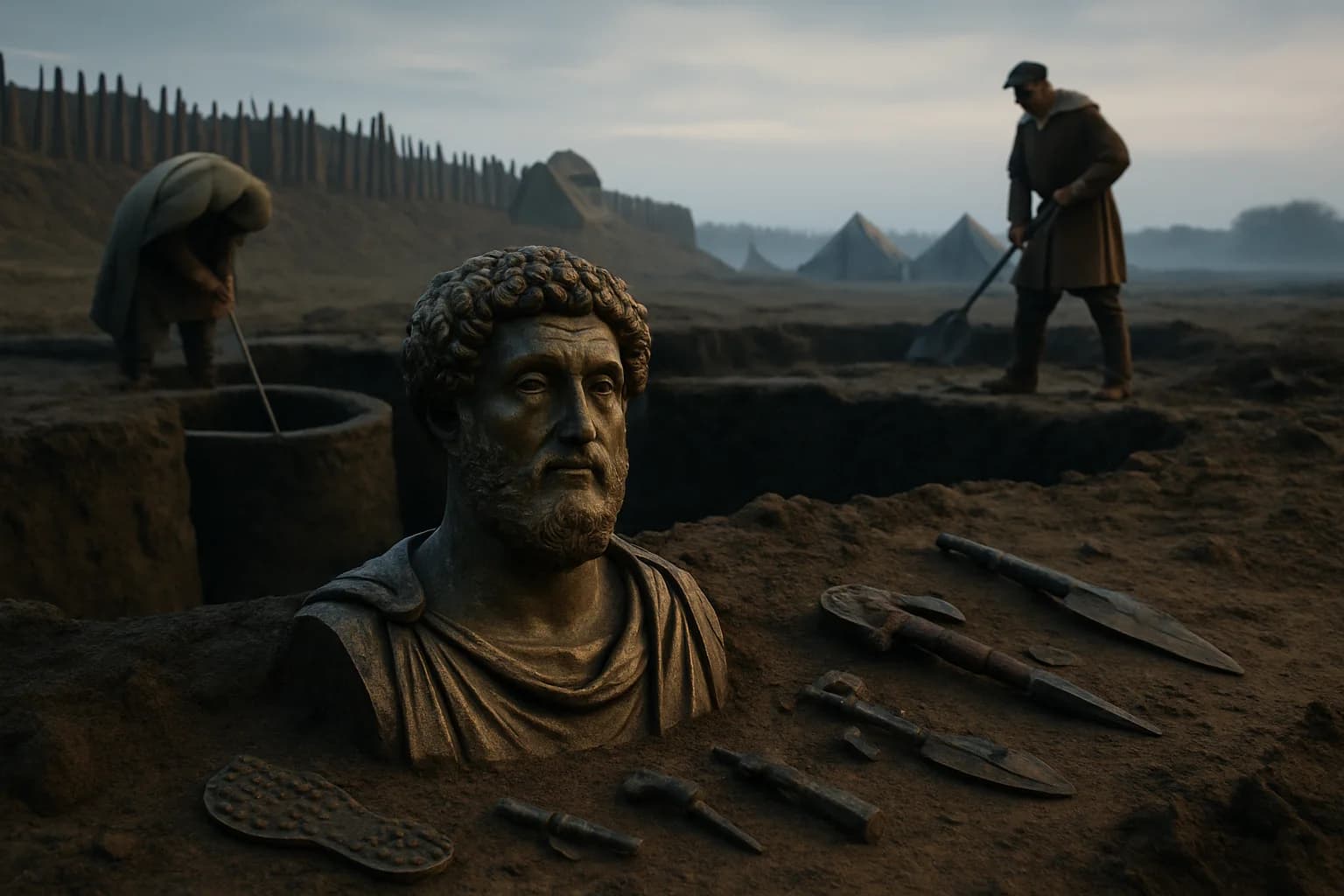
Human remains reported from ditches, pits and water-related features make this more than a routine overnight encampment. Preliminary descriptions indicate that some bodies may have been placed hastily or irregularly. It is tempting to identify them immediately as fallen Roman soldiers, but that conclusion must remain provisional until biological and chronological analyses are complete.
Osteological study can estimate age, biological sex, health and trauma. Radiocarbon dates can test whether all individuals belong to the military phase. Ancient DNA and isotope analysis may identify genetic relationships and the regions in which people grew up. Weapon injuries would strengthen a battle interpretation, while signs of disease or nutritional stress might support another kind of crisis. The Antonine epidemic forms part of the wider historical context, but connecting any individual at Šurany to epidemic disease requires direct biomolecular evidence.
What do weapons, armor and sandals reveal?
Reported finds include weapons, armor components, coins, hobnails from military footwear and personal objects. Coins may help establish chronology, although an old coin could remain in circulation for decades. Equipment styles can be compared with material from other Danubian sites to trace workshops, supply systems and the movement of units.
Hobnails are especially useful because their arrangement can preserve the outline of a sandal sole and sometimes provide an approximate foot size. Concentrations of lost nails may also mark heavily used paths inside the camp. A gaming die and other personal possessions add another dimension: soldiers ate, rested, gambled, repaired equipment and maintained social ties even during a dangerous campaign.
Why might the camp have been abandoned suddenly?
The survival of usable military objects and irregular human deposits raises the central question of why the site was left behind. During an orderly withdrawal, Roman troops would normally recover valuable metal, weapons and armor. Equipment left in place may indicate attack, panic, disease, rapid retreat or an emergency burial episode. Archaeologists must still consider later disturbance and the possibility that some objects entered the deposits after the main occupation.
The sequence of ditch fills will be crucial. A single, rapidly deposited layer associated with bodies and equipment could represent one destructive event. Multiple layers or repairs might show that the camp was occupied more than once. Burnt material, broken weapons, projectile points and the position of skeletons may eventually allow researchers to reconstruct the order of events.
How does Šurany change the history of Rome's frontier?
The Danube frontier is often imagined as a fixed line of forts and roads. Campaign camps show that it was also a broad and mobile military landscape. Roman power could extend beyond permanent installations through temporary engineering, supply routes and repeated advances into neighboring territory.
When Šurany is compared with other marching camps in Slovakia, Moravia and the wider middle Danube region, archaeologists may refine the operational map of Marcus Aurelius' campaigns. Distances between camps, access to rivers, enclosure sizes and gateway orientations can be used to estimate marching stages and possible corridors of movement. This makes it possible to test ancient narratives against measurable evidence on the ground.
What questions remain unanswered?
Researchers still need to establish the exact occupation date, the identity of the dead, the size and composition of the force, and whether the site ended in battle or another emergency. It is also unclear whether the camp was built for one night, reused during several operations or maintained for a longer tactical purpose.
The discovery is particularly valuable because these questions can be addressed through a combination of spatial archaeology and laboratory science. Rather than relying on one dramatic artifact, the project can integrate stratigraphy, material culture, skeletal biology, environmental samples, radiocarbon dating and isotope evidence.
Internal reading
For another example of archaeologists reconstructing behavior from direct traces rather than written testimony, see the article on the 1.4-million-year-old Lake Turkana footprints. The Font-de-Gaume cave art article also explains how laboratory methods can transform the dating of archaeological evidence.
Frequently Asked Questions
Where was the Šurany Roman camp found?
It was discovered near the town of Šurany in southwestern Slovakia, in the southern part of the planned Šurany Industrial Park.
How old is the camp?
Researchers date it to the second half of the second century AD, most likely the Marcomannic Wars of AD 166-180.
Was it a permanent fort?
No. The plan and defenses identify it as a temporary marching or field camp used during military operations.
Do the human remains belong to Roman soldiers?
That is a leading possibility, but final identification requires radiocarbon, DNA, isotope and osteological results.
Was Marcus Aurelius personally present?
The camp belongs to his reign and likely to his campaigns, but no direct evidence currently proves that the emperor himself stayed at this exact location.
References
- Slovak Academy of Sciences. “Archaeologists Discover Roman Military Camp from the Time of Marcus Aurelius Near Šurany.” 20 July 2026.
- Institute of Archaeology of the Slovak Academy of Sciences. Official Šurany excavation announcement. 21 July 2026.
- Slovak National Museum. “The Column of Marcus Aurelius and Slovakia.”
Source trail
Selected references and research starting points
- [object Object]
- [object Object]
- [object Object]
The list is a research trail. Specific claims should be checked against the cited edition, object record or publication.
How this page is handled: Evidence, interpretation and modern speculation are separated. Material corrections are reflected in the article date.