A 1,500-Year-Old Blacksmith Workshop at Seleukeia Sidera: How Did the Ancient Industrial Quarter Work?
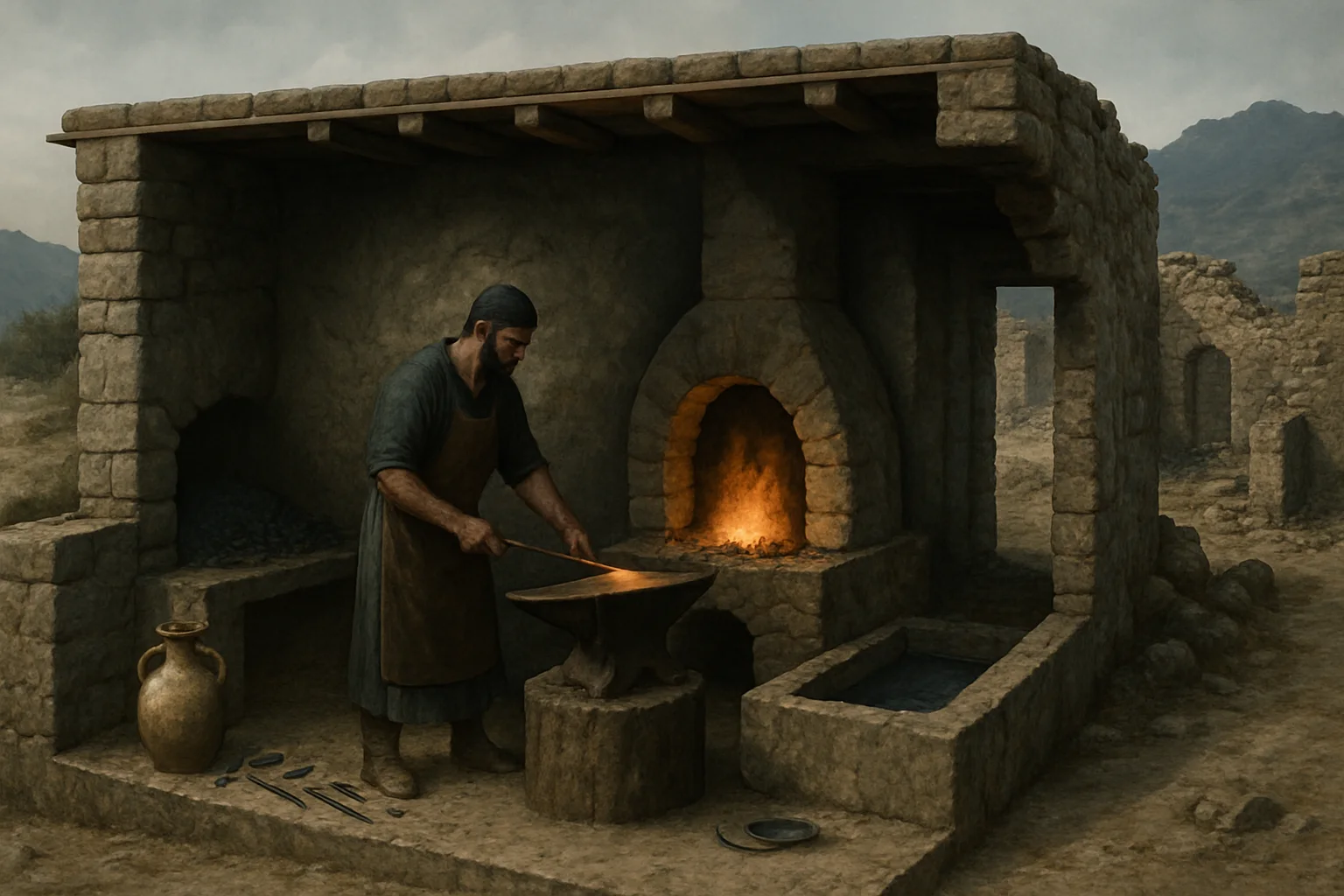
A fifth-century workshop uncovered at Seleukeia Sidera in Isparta preserves an iron furnace, anvil, charcoal store, quenching pool and semi-finished objects, revealing an unusually complete Eastern Roman production system.
Where was the blacksmith workshop found?
The workshop was discovered at Seleukeia Sidera near Bayat village in the Atabey district of Isparta, southwestern Türkiye. The city was an important settlement of ancient Pisidia. Excavations are conducted by Süleyman Demirel University on behalf of the Ministry of Culture and Tourism.
The team is investigating not only monumental buildings but also neighbourhoods that reveal the city’s economy and ordinary life. The workshop stood in an industrial quarter, suggesting that activities involving fire, smoke, noise and heavy materials were organised in a zone at least partly separated from domestic space. The discovery therefore represents more than one craft room: it exposes a planned urban production environment.
When was the workshop in use?
Its finds and architectural context date the workshop to the fifth century AD. This was a period when the eastern half of the Roman Empire remained politically powerful and cities across Anatolia continued to manufacture, trade and repair essential goods. The workshop can therefore be understood within a Late Roman or early Eastern Roman setting.
The fifth century was not a simple age of urban collapse. Iron was still needed for agricultural tools, construction fittings, knives, animal equipment and many objects used in everyday work. Seleukeia Sidera provides direct evidence that trained specialists met those needs through organised production.
How did the furnace, anvil and water pool form a production chain?
Ironworking required far more than a single hearth. Metal had to be heated, shaped with repeated hammer blows, returned to the fire and cooled at controlled moments. The furnace, anvil and water pool found in the workshop record these successive operations in one place.
The charcoal store was equally important. A smith needed a reliable supply of dry fuel to maintain high temperatures. Heated iron could be removed with tongs, hammered on the anvil and reheated several times before the desired form was reached. The cooling pool could then be used to quench or cool the object. The relationship between these features allows archaeologists to reconstruct how workers moved through the room as production advanced.
What iron objects were recovered?
Excavators found semi-finished horseshoes, nails, knives and large iron pieces. Semi-finished objects are especially valuable because they demonstrate that the building was a place of manufacture rather than merely a shop or storehouse containing completed goods.
Horseshoes connect the workshop to animal transport and agriculture. Nails were essential for buildings, wooden structures and repairs, while knives served domestic, agricultural and craft activities. The larger pieces may represent raw material, scrap awaiting recycling or blanks prepared for specific products. Metallurgical and use-wear analysis will be needed to identify each object more precisely.
Why is the workshop considered unusual in Anatolia?
Slag, nails, blades and isolated furnace remains are common discoveries at ancient sites. It is much rarer to preserve the complete spatial relationship between a furnace, anvil, fuel storage, cooling installation and unfinished products. Later construction often destroyed workshops, valuable metal was recycled and building stones were removed for reuse.
At Seleukeia Sidera, the legible arrangement turns an abstract technical process into a real working environment. Researchers can examine the position of the furnace, possible air flow, the route used to carry charcoal, the smith’s space around the anvil and the location of the quenching operation as parts of one system.
Is the name “Sidera” connected with iron?
The settlement is also known in ancient sources as Seleukeia Pisidias and, during the Roman period, Claudio Seleuceia. The later epithet “Sidera” has been associated with iron. The newly discovered workshop creates an intriguing connection between the city’s name and its material economy.
One workshop, however, does not prove that the city received its name specifically because of iron production. That conclusion would require evidence for mineral sources, multiple industrial installations, substantial slag deposits, trade patterns and long-term manufacture. The secure conclusion is narrower: organised ironworking formed part of the city’s economy in the fifth century.
What kind of city was Seleukeia Sidera?
Seleukeia Sidera is regarded as one of several cities called Seleukeia that were founded or reorganised under the Seleucid Kingdom. Its inland Pisidian position connected it to regional roads, agricultural landscapes and local resources. The settlement remained active under Roman rule and included public buildings, residential districts and production areas.
Recent research indicates that the city extended beyond its most visible central ruins into a broader settlement and economic landscape. The workshop may therefore have supplied farms, animal transport, construction projects and households across a wide territory. It should be understood as one component of a larger regional network rather than an isolated craft installation.
What might a normal working day have looked like?
The archaeology does not preserve the smith’s name or schedule, but the layout suggests a demanding routine. Charcoal was moved from storage to the furnace, air was forced into the fire, iron was heated and carried to the anvil, and the piece was hammered repeatedly. It might return to the furnace several times before being quenched or left to cool.
The workshop was probably not a quiet room occupied by a single person. Assistants may have prepared fuel, operated bellows, handled materials or delivered finished products. Ironworking involved heat, smoke, sparks and heavy repeated blows, making experience, timing and coordination essential.
What can scientific analysis reveal?
Residues in the furnace walls and floor may reveal operating temperatures, fuel choices and the types of metal processed. Chemical analysis of slag and iron could show whether ore was obtained locally or whether semi-processed metal arrived from another production centre.
Microscopic study of unfinished objects may identify forging, cutting, welding and heat-treatment techniques. The workshop can therefore contribute measurable evidence about raw-material supply, craft specialisation, labour organisation and regional trade in the Eastern Roman period, rather than serving only as a visually impressive excavation.
For another recent discovery from Türkiye, read our report on the two infants buried in an abandoned Roman latrine at Ephesus. More archaeology, history and ancient technology features are available in the ODYOMUH archive.
Frequently asked questions
Where is Seleukeia Sidera?
The ancient city is near Bayat village in the Atabey district of Isparta, within the ancient region of Pisidia in southwestern Türkiye.
How old is the blacksmith workshop?
It dates to the fifth century AD, approximately 1,500 years ago.
What was found inside?
The excavation revealed an ironworking furnace, anvil, charcoal store, water pool, semi-finished horseshoes, nails, knives and large iron pieces.
Why is the discovery important?
The survival of tools, installations and unfinished products together allows researchers to study the workshop’s complete operating sequence.
Sources and further reading
- Anadolu Agency, “1,500-year-old blacksmith workshop uncovered at ancient city in Türkiye”, 24 July 2026.
- Süleyman Demirel University, Seleukeia Sidera Excavation Project information, 2026.
- Republic of Türkiye Ministry of Culture and Tourism, Legacy for the Future Project.
- Daily Sabah, Anadolu Agency report on the Seleukeia Sidera workshop discovery, 24 July 2026.
Keep exploring: Use the topic hub for closely related articles or browse the full archive instead of starting a new search.