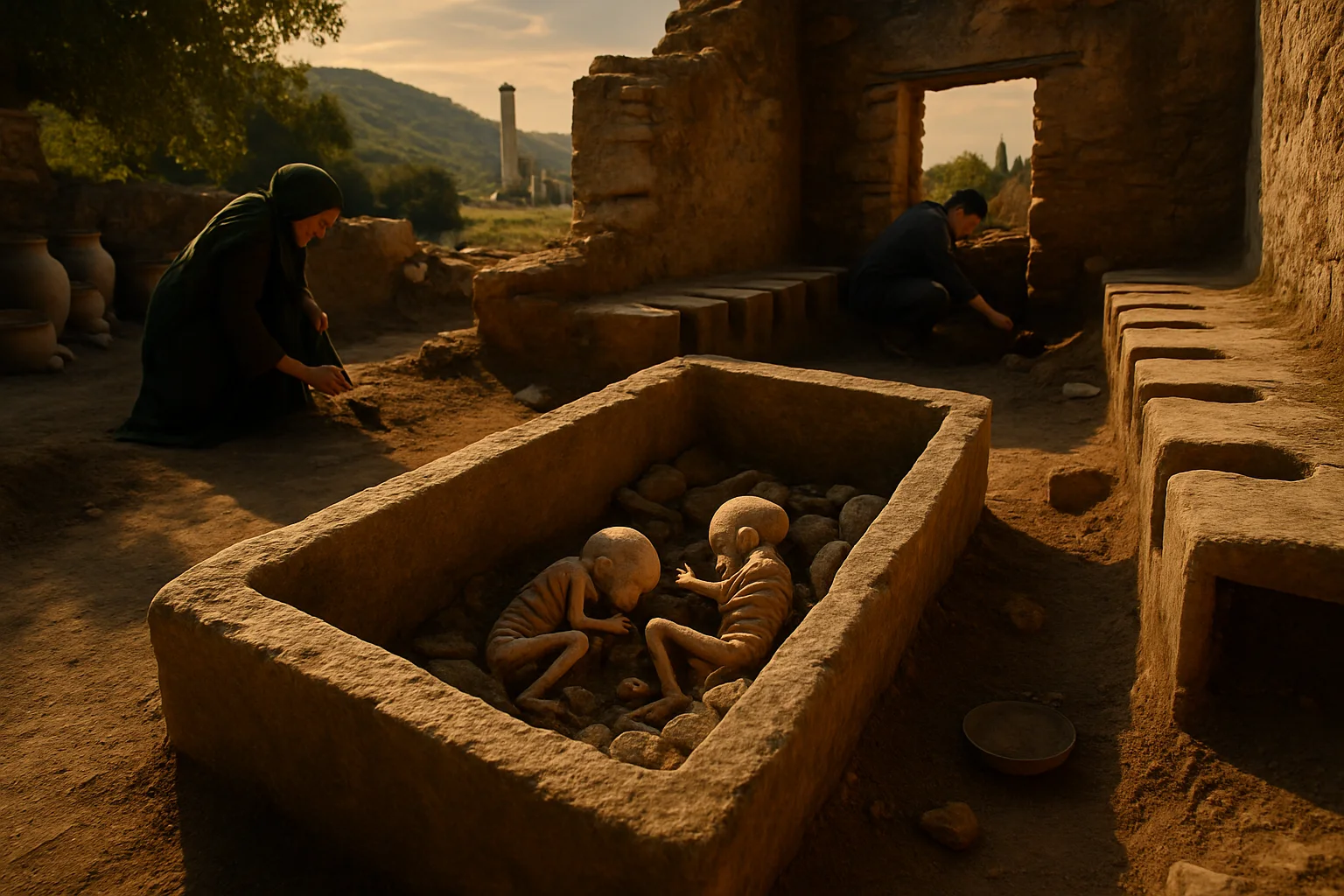
Two Infants in a Roman Latrine at Ephesus: Why Did a Byzantine Family Choose This Place?
A carefully built grave containing two premature infants in an abandoned Roman latrine at Ephesus reveals grief, protection and the changing status of children in Middle Byzantine society.
Where exactly was the infant grave found?
The grave was discovered in the Artemision at Ephesus, near modern Selçuk in western Türkiye. This was the sacred district surrounding the Temple of Artemis, one of the Seven Wonders of the ancient world. During the Roman imperial period, an odeion for performances and public gatherings stood within the wider precinct.
A public latrine with roughly thirty seats was later attached to the building. Its sewer channel carried waste during the Roman period, but the system had been abandoned for centuries by the time the infants were buried in the Middle Byzantine era. Describing the discovery simply as “babies buried in a toilet” is therefore misleading. The channel had become a closed, quiet architectural void with a completely different function and meaning.
Why do researchers think the infants may have been twins?
Bone size and development indicate that both children died around the same stage, probably at thirty-three to thirty-four weeks of gestation. They were premature or died very close to birth. Their bodies were placed in direct contact within the same small grave, making a twin burial the most plausible explanation.
The conclusion remains provisional. Two infants of the same developmental age buried together provide strong circumstantial evidence, but biological kinship can only be confirmed by successful ancient DNA analysis. The authors therefore use careful language and describe them as “possibly twins.”
What made the burial unusually careful?
Very young children were not always buried in the same places as adults in ancient and medieval societies. Infant remains are known from domestic floors, wells, building edges and abandoned spaces. Earlier interpretations sometimes treated such locations as evidence that newborns possessed little social value or were deliberately excluded.
The Ephesus grave complicates that picture. Stones and tiles formed a protective cist around the bodies. The infants were arranged deliberately, and traces in the grave suggest they may have been wrapped in a shroud. The channel itself offered shelter from disturbance. Every element points toward protection, mourning and care rather than disposal.
Were the infants wrapped in burial cloth?
The position of the bones and subtle traces within the grave are consistent with tightly wrapped bodies. An iron object near the head of one infant may have secured the cloth or another part of the burial covering. The textile itself did not survive, but the compact anatomical arrangement supports the shroud interpretation.
Wrapping the dead was common in Christian funerary practice during Late Antiquity and the Byzantine period. The possible use of a shroud is important because it shows that an unconventional location did not necessarily mean an unconventional or disrespectful ritual.
What does the extra cervical rib reveal?
One infant possessed a supernumerary cervical rib, an additional rib growing from the neck region. Today this congenital anatomical variant occurs in only a small percentage of people and often causes no symptoms in adults. In fetuses and newborns, however, cervical ribs can appear alongside broader developmental anomalies.
Researchers do not claim that the extra rib directly caused the infant’s death. Its association with changes in Hox genes, which help organise the developing body, nevertheless provides a rare clue about biological stress or abnormal development. A possible twin burial containing this feature has not previously been documented in a comparable archaeological context.
Why were the infants not placed in a formal cemetery?
Byzantine cemeteries are known elsewhere at Ephesus, including burial areas associated with major churches. The choice of an abandoned sewer channel therefore appears intentional. One possibility is that premature infants who died before baptism occupied an uncertain place within Christian funerary rules.
There is no direct evidence that these children were unbaptised, so the suggestion must remain hypothetical. The burial place may instead represent a practical compromise: outside a formal cemetery, but still inside an ancient sacred precinct and within a protected structure. The family could have selected a secluded location that balanced religious expectations with the desire to keep the children safe.
Does the discovery show that infants were socially unimportant?
The physical evidence suggests the opposite. Building a stone-lined grave required time and labour. Placing the two bodies carefully beside one another and possibly wrapping them indicates that their deaths mattered to somebody. The grave preserved an act of grief that written sources would almost certainly never record.
Imperial histories describe emperors, councils, wars and theological disputes. They rarely mention premature infants born to an ordinary family. Archaeology can recover these otherwise invisible lives. The Ephesus burial reveals that even children who survived only briefly could be acknowledged, protected and remembered by their community.
Why should the burial not be confused with infanticide deposits?
Large groups of infant bones found in wells or drains at some ancient Mediterranean sites have been interpreted as possible evidence for disposal or infanticide. The Ephesus context is fundamentally different. Only two infants were present, both retained anatomical order, and both lay within a purpose-built grave.
The cist construction, possible shroud and deliberate placement are incompatible with casual dumping. The former use of the surrounding architecture should not override the evidence from the burial itself. Buildings change meaning over time: a Roman sewer could become, centuries later, a secure place of rest in a transformed Christian landscape.
How does the grave change our picture of Byzantine Ephesus?
Ephesus is most famous for the Temple of Artemis, the Library of Celsus and its monumental Roman streets. Yet the city continued through Late Antiquity and the Byzantine period. Public buildings were abandoned, reused as workshops, occupied as houses, quarried for stone or converted into burial spaces.
The infant grave captures that long transformation. A Roman performance building, a public latrine and a Byzantine burial occupied the same location at different moments. The discovery therefore tells two histories at once: how urban spaces were recycled and how a family responded to the loss of two newborn children.
What questions remain unanswered?
Ancient DNA may establish whether the infants were twins and whether they shared maternal ancestry. Further microscopic and biochemical analysis may clarify their health, the circumstances of premature birth and whether the cervical rib accompanied other developmental problems. Researchers may also compare the burial with infant graves in the Church of Mary cemetery and elsewhere in Byzantine Ephesus.
The mother’s fate is unknown. No adult woman was found in the same grave, and there is no evidence that she died during childbirth. Maternal mortality was high in premodern societies, but absence from the grave cannot be used to reconstruct her life. The most responsible interpretation is therefore limited but powerful: two premature infants received a deliberate and protective burial in an unexpected place.
For another recent discovery from the Roman world, read our report on the Šurany military camp from the age of Marcus Aurelius. More history and archaeology features are available in the ODYOMUH archive.
Frequently asked questions
How old is the Ephesus infant burial?
Radiocarbon dating places it in the eighth or ninth century, roughly 1,100 to 1,300 years ago.
Were the infants definitely twins?
Their matching ages and close placement suggest twins, but only ancient DNA can establish biological kinship.
Why were they buried in a Roman latrine?
The latrine had been abandoned for centuries. Its enclosed sewer channel may have offered a secluded and protected burial space.
Were the bodies discarded?
No. The purpose-built stone grave, careful positioning and possible shroud demonstrate a respectful burial.
Sources and further reading
- Caroline Partiot and Lilli Zabrana, “Peace in Unexpected Places: The Middle Byzantine Burial of Two Perinates, Possibly Twins, in a Latrine Canal of the Odeion in the Artemision of Ephesos”, Childhood in the Past, 13 July 2026, DOI: 10.1080/17585716.2026.2682804.
- Austrian Academy of Sciences and Austrian Archaeological Institute research release, 23 July 2026.
- Live Science, “1,200-year-old infant burial found near famous Temple of Artemis in Turkey contains twins”, 24 July 2026.
- Antiquity, “Burial practices in Byzantine Ephesos”, 2026.
Keep exploring: Use the topic hub for closely related articles or browse the full archive instead of starting a new search.